
North Carolina / Southeast
Tuckasegee River
A Tuckasegee River report built for anglers checking delayed-harvest timing, Webster and Dillsboro access, Cullowhee flow context, and safe trout-season planning.
Image: Generated regional planning image for Tuckasegee River / BlueStreamFly generated; not exact location / BlueStreamFlyFishability now: Tuckasegee River fishability today
GoodData confidence: High70/100
Fishable now because the live gauge is rising, weather is usable, and no public alert is active.
Flow observed
4:15 PM UTC
Weather observed
5:00 PM UTC
Score calculated
5:25 PM UTC
Why this rating
Flow
Weather
Public alerts
Next 6-12 hours
Watch
Recheck within the next few hours; rising water or active weather can change clarity and wading quickly.
USGS flow
512 cfs
Current trend: flow rising, rating can drop quickly if clarity or wading safety deteriorates.
More planning details: flies, flow bands, and live source checks
Fish it today
Start here
Base in Sylva, Dillsboro, Webster, or Bryson City; check the regulation date first, then pick one public section and fish it thoroughly instead of bouncing all day.
Best flow clue
Stable low-to-moderate flow that leaves readable seams, safe bridge entries, and enough push to move trout without turning crossings risky.
Skip trigger
Skip or shorten the trip when rain has the river jumping, the rule date is unclear for your reach, or the bridge water is too crowded to fish cleanly.
Flow decision bands
Stable Bryson City trend
Stable low-to-moderate Bryson City flow, checked against Cullowhee context, is the best signal for public trout sections.
Best delayed-harvest window
Clear rules, safe bridge entries, moderate flow, and manageable pressure make Webster and Dillsboro water most useful.
Rain bump or pushy bridge water
Rising rain water, muddy seams, or strong current around bridge entries should shorten the plan or move it elsewhere.
Rule date, crowd, or warm-water issue
Delayed-harvest timing, youth windows, bridge crowding, or trout temperature can matter more than fly selection.
USGS flow
512 cfs
Current trend: flow rising, rating can drop quickly if clarity or wading safety deteriorates.
Live USGS flow
512 cfs / rising about 52%
Live NWS forecast
73F / Sunny
Water temperature not verified
Heat guidance uses weather and river type unless an official water-temperature value is available.
No NWS alert flag
No active NWS alert was returned for this forecast point.
NCWRC's May 11, 2026 update says delayed-harvest waters open to general harvest on June 6, 2026, with youth-only fishing from 6 a.m. to noon that day.
Webster's Mountain Heritage Trout Water covers the Tuckasegee from the N.C. 107 bridge to Savannah Creek under delayed-harvest regulations.
Dillsboro's Mountain Heritage Trout Water covers the 1.9-mile Tuckasegee section from Savannah Creek to the falls above U.S. 23-441 under delayed-harvest regulations.
Stable moderate flow is best for wading; rain bumps and dam influence can turn easy bank entries into a much bigger current problem.
Editorial review
How this report is maintained
This report starts with official regulation, access, flow, weather, and public-land sources, then adds practical planning guidance for fly anglers.
Byline
BlueStreamFly editorial desk
Reviewed by
BlueStreamFly source review
Maintained by
BlueStreamFly
Last material review
2026-06-02
Report confidence
High confidence
91/100
High confidence: RiverReports, two USGS Tuckasegee gauges, NCWRC regulations, Mountain Heritage Trout Waters, Webster and Dillsboro maps, delayed-harvest updates, weather coverage, image disclosure, and route-specific public-section guidance support the page. Confidence is moderated by regulation-date sensitivity, bridge pressure, rain bumps, and section-boundary checks.
Regulations
NCWRC regulations, delayed-harvest updates, stocking information, and Mountain Heritage section maps strongly support the rule-check path.
Access
NCWRC Mountain Heritage Trout Waters and Webster/Dillsboro maps support the public-access framework.
Flow and weather
RiverReports coverage is backed by USGS 03510577 near Bryson City with USGS 03508050 near Cullowhee context, and the National Weather Service point supports weather decisions.
Fishing usefulness
The page now separates Bryson City and Cullowhee flow, delayed-harvest timing, Webster and Dillsboro access, bridge pressure, rain bumps, and backup-water choices.
Fishability dashboard and source review
2026-06-02 / material content or source review
RiverReports, USGS 03510577 near Bryson City, USGS 03508050 near Cullowhee, NCWRC fishing regulations, trout resources, Mountain Heritage Trout Waters, Webster and Dillsboro maps, 2026 delayed-harvest stocking and opening updates, National Weather Service point data, and image-disclosure sources were checked before updating the current-fishability decision layer.
2026-06-02
Updated Tuckasegee River to the current fishability-page standard with Bryson City and Cullowhee trend bands, Mountain Heritage access cards, delayed-harvest backup cues, stable fishability SEO, and confidence signals.
2026-05-26
Published a new Tuckasegee River report with current delayed-harvest timing, Webster and Dillsboro access context, hatch guidance, and conservative wading advice.
Angler planning edge
Local details that change the plan
Best for
Public delayed-harvest trout fishing, Easy half-day access, Stocker-and-holdover nymphing
Wade or float
Wade first. Most visiting anglers do best on foot in the public-mountain-trout sections, then switch to a more limited bank plan when water rises.
Best flows
Stable low-to-moderate flow that leaves readable seams, safe bridge entries, and enough push to move trout without turning crossings risky.
When to skip
Skip or shorten the trip when rain has the river jumping, the rule date is unclear for your reach, or the bridge water is too crowded to fish cleanly.
Local plan
Base in Sylva, Dillsboro, Webster, or Bryson City; check the regulation date first, then pick one public section and fish it thoroughly instead of bouncing all day.
Pressure
The easiest bridge water gets worked hard. Start early, fish edges other anglers walk past, and move after the first good pass.
Access nuance
The Tuck rewards anglers who follow the posted Mountain Heritage sections instead of assuming every town reach has the same legal access and trout rules.
Backup water
Nantahala River, Oconaluftee River, and Davidson River offer nearby backup plans when the Tuck is high, crowded, or the regulation fit is wrong.
About the river
Setting, character, and why it fishes the way it does.
The Tuckasegee is one of western North Carolina's most useful trout rivers because it combines public access, regular stocking support, and enough width to fish as both an easy wade and a stronger pushy river after weather or generation changes.
This page is built around the best-documented public sections most visiting anglers actually use: Webster, Dillsboro, and the broader lower valley toward Bryson City. That keeps the guidance anchored to official access maps and current trout-rule language instead of vague basin-wide claims.
Because named reaches on the Tuck can carry different regulation categories, anglers should confirm exactly which bridge, town, or access area they plan to fish before assuming bait, harvest, or tackle rules are the same everywhere.
Target species
Rainbow trout
A core stocked and carryover target in the public-mountain-trout sections.
Brown trout
Present through the corridor and especially worth watching around structure, lower light, and streamer windows.
Stocker and holdover trout mix
The Tuck often rewards practical bug-fishing more than a strict wild-trout mindset.
Reading the water
Stable moderate flow
Best wading window for indicator nymphs, light streamers, and simple dry-dropper rigs.
Higher runoff or release influence
Fish softer banks, side seams, and inside turns rather than forcing mid-river crossings.
Very low clear water
Lengthen leaders, fish lighter indicators, and expect educated trout near easy-access pull-offs.
Cold spring mornings
Start subsurface and let the warmest afternoon water drive the better dry-fly chance.
Best seasons
Spring
Prime time for stocked trout, caddis, small mayflies, and cool-water nymphing.
Early summer
Watch the June 6 delayed-harvest switch and expect stronger pressure on easy-access water.
Summer
Morning dry-dropper and evening caddis windows can be good when flows stay reasonable.
Fall
Cooling water and lower crowds often bring the best mix of streamer and nymph fishing.
Preferred flow source
Tuckasegee River near Bryson City
RiverReports is the preferred chart source when coverage exists. When a matching USGS gauge exists, keep it open as the official backstop for station data and current hydrograph context.
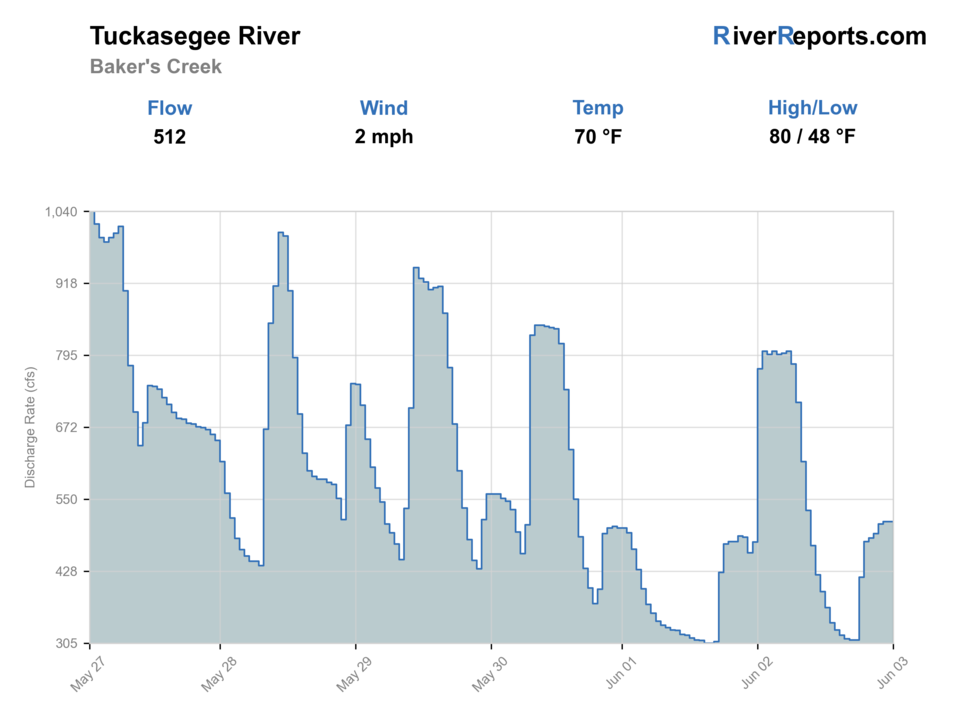
USGS data chart
Official USGS trend
Streamflow over the latest USGS reporting window.
Latest
512 cfs
Jun 3, 4 PM UTC
Weather
River weather report
Weather can change wading safety, road access, water temperature, hatches, and the best time of day to fish.
Live forecast loads as you reach this section
This keeps the report fast while still using the official National Weather Service forecast point.
Hatches and flies
Hatch chart and fly picks
March-April
Midges, little black stoneflies, blue-winged olives
Zebra midge, black stonefly nymph, BWO emerger
April-June
Caddis, sulphur-style mayflies, March browns
Elk hair caddis, soft hackle, pheasant tail, sulphur emerger
June-August
Caddis, yellow sallies, terrestrials
Yellow stimulator, foam ant, caddis pupa, prince nymph
September-November
BWOs, midges, caddis
BWO dry, zebra midge, olive soft hackle, bugger
Guide flies
Pheasant tail, hare's ear, zebra midge, perdigon
Start here any time you need to locate fish before chasing a hatch.
Soft hackles and caddis
Partridge and orange, olive soft hackle, caddis pupa
Best in moderate flow when trout are suspended or active in riffle tails.
Small streamers
Olive bugger, black bugger, mini sculpin
Use after rain, in lower light, or when browns slide to cover.
Topwater and dry-dropper
Yellow stimulator, elk hair caddis, parachute Adams
Summer evenings and clean riffle water.
Tactics
How to fish it
Pick the exact reach before rigging because the Tuck's rules are section-dependent.
Fish the first soft seam off the main push before trying to force deep mid-channel drifts.
On crowded public water, move more than you change flies; the next seam often matters more than the next pattern.
When flow rises, shorten the wading plan and fish banks, drop-offs, and structure with heavier nymphs or a light streamer.
Rigging
Rod, leader, and setup notes
A 9-foot 4- or 5-weight covers most Tuckasegee trout fishing.
Carry 4X to 6X tippet so you can shift between stocker water, pressured fish, and light streamer work.
Use a compact indicator rig with enough split shot to tick the bottom only occasionally.
A wading staff helps on the broader pushy runs near bridge access and tailouts.
Access
Access and planning notes
Bryson City and Cullowhee gauges
Corridor flow readWade / float / trail
RiverReports / USGS gauges / trout
When to pick it
Start here when flow direction and bridge-water safety decide whether the public sections are worth fishing.
Caution
The gauges do not confirm each Mountain Heritage boundary, access sign, or delayed-harvest rule date.
Webster Mountain Heritage Trout Water
Public trout sectionWade / float / trail
Mountain Heritage / wade / bank
When to pick it
Use it when NCWRC section details, rule timing, and safe entries line up.
Caution
Bridge water can be crowded, and section boundaries need a current map check.
Dillsboro Mountain Heritage Trout Water
Town-access trout planWade / float / trail
Mountain Heritage / wade / bank
When to pick it
Pick it when the Savannah Creek-to-falls section and current regulation timing match your plan.
Caution
Crowds, posted signs, rain bumps, and changing harvest dates can quickly alter the day.
Do not assume every roadside pull-off is public or safe for wading.
Bridge-adjacent entries are the easiest and usually the most pressured.
Rain and dam-influenced flow changes can make a short after-work stop fish very differently from a full-day plan.
Regulations
Check before fishing
As of May 26, 2026, the documented delayed-harvest Tuckasegee sections stay catch-and-release with single-hook artificials until Saturday, June 6, 2026. Recheck NCWRC before fishing if your trip is near or after that date.
Primary base
Sylva, Dillsboro, Webster, Cullowhee, or Bryson City
Best day style
Roadside public-mountain-trout access with delayed-harvest rules, easy pull-offs, and flow-dependent wading
Check first
RiverReports, USGS 03510577 and 03508050, NCWRC delayed-harvest timing, the Mountain Heritage maps, and the NWS forecast
Safety
Rain-driven rises, slick rock shelves, bridge-area crowding, and stronger current than the roadside access suggests
Gear
Helpful gear for this water
4- or 5-weight rod
Ideal for nymphs, soft hackles, and small streamers on the main public sections.
Wading staff
Useful on the broad slick runs that look easier from the road than they feel in current.
Polarized glasses
Helps read seams and avoid stepping into deep slots near bridge water.
Rain shell
Storm bumps can change both flow and comfort quickly in this corridor.
Nearby water
Other water to research
Backup logic
High or muddy water
Compare Nantahala River, Oconaluftee River, or Davidson River before forcing bridge water.
Rule timing uncertainty
Check NCWRC delayed-harvest and Mountain Heritage pages before fishing.
Crowded public sections
Move within confirmed public water or choose a less concentrated trout route.
Warm trout conditions
Fish cooler hours only or switch to a route with better temperature margin.
Nantahala River
A colder release-driven trout option with a different access and current profile.
Oconaluftee River
A Smokies-adjacent trout option when you want freestone character and park context.
Davidson River
A clearer and more technical trout option when you want more sight-fishing pressure.
FAQ
Fast answers
Is Tuckasegee River fishable today?
Tuckasegee River looks fishable right now. The live score is 70/100, based on current flow, weather, public alerts, and the report's planning context. Recheck the linked gauge and forecast before leaving because conditions can change quickly after rain, heat, access changes, or flow swings.
What flow is best for Tuckasegee River?
Stable low-to-moderate flow that leaves readable seams, safe bridge entries, and enough push to move trout without turning crossings risky.
When should I skip Tuckasegee River?
Skip or shorten the trip when rain has the river jumping, the rule date is unclear for your reach, or the bridge water is too crowded to fish cleanly.
Is Tuckasegee River safe to wade right now?
The fishability score is not a wading guarantee. Wade only where your chosen access has safe edges, clear footing, legal entry, and no forced crossings; high, rising, stained, or storm-affected water should be treated conservatively.
Can I keep trout on the Tuckasegee River right now?
Not on the documented delayed-harvest Webster and Dillsboro sections as of May 26, 2026. Those sections remain catch-and-release until Saturday, June 6, 2026, then shift to youth-only until noon and open harvest after noon.
What gauge should I use for the Tuckasegee River?
Use RiverReports for the quick chart, then back it with USGS near Bryson City and Cullowhee so you know whether the whole corridor is trending fishable or rising.
Is the Tuckasegee a good beginner fly-fishing river?
Yes, if you stay on the well-known public sections, respect the delayed-harvest rules, and avoid forcing wades when flow is up.
Sources
Source set for this report
Reviewed 2026-06-02