
Wyoming / Rockies
Lamar River
A Lamar River report built from current Yellowstone regulations, the northeast-region rule set, Tower-area access, and native-fish conservation first.
Image: Generated Lamar River planning image / BlueStreamFly generated; not exact location / BlueStreamFlyFishability now: Lamar River fishability today
GreatData confidence: High96/100
Fishable now because the live gauge is falling, weather is mild, and no public alert is active.
Flow observed
4:15 PM UTC
Weather observed
5:00 PM UTC
Score calculated
5:23 PM UTC
Why this rating
Flow
Water temperature
Public alerts
Next 6-12 hours
Improving / hold
A falling gauge and usable weather should keep the next 6-12 hours in play unless tributaries stain or heat builds.
USGS flow
3,480 cfs
Current trend: flow falling, rating likely holding strong unless weather or clarity changes.
More planning details: flies, flow bands, and live source checks
Fish it today
Start here
Check the Tower office and current rules first, scout the gauge trend, then commit to one valley section and fish it with conservation first.
Best flow clue
Best on clear dropping runoff or moderate summer flows that still let you see banks, seams, and fish movement.
Skip trigger
Skip when high dirty water, thunderstorms, wildlife congestion, or park advisories make the day unsafe or low value.
Flow decision bands
Park rules first
Current Yellowstone rules, native-fish requirements, and open reach status decide the day before fly choice.
Clear falling runoff
Clear, stable or slowly falling Lamar flow is the cleanest meadow-river signal.
High dirty water
Dirty runoff or a fast rise should make the day scouting only.
Wildlife or storm stop
Bison, bears, lightning, or park advisories should end the plan regardless of score.
USGS flow
3,480 cfs
Current trend: flow falling, rating likely holding strong unless weather or clarity changes.
Live USGS flow
3,480 cfs / falling about 19%
Live NWS forecast
64F / Sunny
Live water temperature
42F from USGS
No NWS alert flag
No active NWS alert was returned for this forecast point.
Yellowstone’s northeast-region rules say native fish are catch-and-release, while rainbow trout, brook trout, and identifiable cutthroat-rainbow hybrids in the Lamar drainage must be killed.
The Tower Backcountry Office is the cleanest official access and permit anchor in this part of the park.
The Lamar Valley page reminds you this is also major wildlife country, not just a fly-fishing backdrop.
Wind and afternoon storms can turn a perfect-looking meadow session into a short one fast.
Editorial review
How this report is maintained
This report starts with official regulation, access, flow, weather, and public-land sources, then adds practical planning guidance for fly anglers.
Byline
BlueStreamFly editorial desk
Reviewed by
BlueStreamFly source review
Maintained by
BlueStreamFly
Last material review
2026-06-02
Report confidence
High confidence
90/100
High confidence: Yellowstone fishing rules, Northeast region conservation rules, Tower access material, Lamar Valley and current-condition sources, RiverReports and USGS 06188000 flow, weather coverage, generated media disclosure, and route-specific Lamar guidance support the page. Confidence remains moderated by temporary closures, wildlife, storms, runoff, and native-fish handling requirements.
Regulations
Yellowstone fishing and Northeast region rules support current native-fish, nonnative-harvest, and legal-reach checks.
Access
NPS Tower, valley, and current-condition sources support access planning, with wildlife, road, and temporary closure checks still required.
Flow and weather
RiverReports, USGS 06188000 near Tower Ranger Station, and the National Weather Service point support live flow and weather decisions.
Fishing usefulness
The page now separates park-rule checks, native-fish conservation, meadow flow, wildlife and storm stops, pressure, and backup-water choices.
Fishability dashboard and source review
2026-06-02 / material content or source review
Yellowstone fishing rules, Northeast region rule sources, Tower access information, Lamar Valley and current-condition sources, RiverReports and USGS 06188000 flow, National Weather Service data, and route-specific media-credit sources were checked before updating the current-fishability decision layer.
2026-06-02
Updated Lamar River to the current fishability-page standard with park-rule flow bands, wildlife-aware access cards, backup cues, stable fishability SEO, and confidence signals.
2026-05-28
Published a new Lamar River report with Yellowstone regulation framing, Tower-area access anchors, and native-trout first guidance.
Angler planning edge
Local details that change the plan
Best for
native-trout Yellowstone days, summer meadow dry-fly fishing, wildlife-aware park trips with strong regulation discipline
Wade or float
Treat the Lamar as a wade-and-walk meadow river. The value is in bank reading and careful movement, not in trying to cover everything.
Best flows
Best on clear dropping runoff or moderate summer flows that still let you see banks, seams, and fish movement.
When to skip
Skip when high dirty water, thunderstorms, wildlife congestion, or park advisories make the day unsafe or low value.
Local plan
Check the Tower office and current rules first, scout the gauge trend, then commit to one valley section and fish it with conservation first.
Pressure
The Lamar is famous enough that obvious roadside stops can feel crowded quickly, especially on bluebird summer days.
Access nuance
Easy roadside orientation does not make this a casual river. Rules and wildlife can end the day faster than bad casting.
Backup water
Move to another open Yellowstone river if Lamar-specific rules, wildlife, or weather make the valley a poor choice.
About the river
Setting, character, and why it fishes the way it does.
The Lamar is the largest tributary to the Yellowstone River inside Yellowstone National Park, and it deserves to be treated like a native-fish conservation water with world-class scenery rather than just another roadside meadow stream.
The northeast-region fishing page is especially important here because Lamar-specific conservation rules are stricter than the assumptions many visiting anglers bring from outside the park.
For BlueStreamFly readers, the useful Lamar plan is simple: know the rule set, watch the gauge, carry bear spray, and fish only as long as the river and the valley are both cooperating.
Target species
Native cutthroat trout
The main reason most anglers come here and the fish most deserving of careful quick handling.
Mountain whitefish
Another native fish that must be released unharmed under park rules.
Rainbow trout and hybrids
In the Lamar drainage these nonnative fish must be killed under current park regulations.
Brook trout
Also a required-harvest nonnative fish in the Lamar drainage under current rules.
Reading the water
Clear dropping runoff
The most exciting all-around Lamar condition because banks, seams, and sight-fishing lanes all improve together.
Windy meadow flow
Still fishable, but presentations and fish handling become much harder than the river map suggests.
High dirty water
Usually a pass unless you are only scouting the valley for a later day.
Low late-season flow
Can still fish beautifully, but fish handling and trout stress need more attention.
Best seasons
Late spring
Only after park openings and runoff shape allow a real fishing day.
Summer
The signature Lamar window for meadow dries, nymphs, and long sight-fishing walks.
Early fall
Excellent for cooler mornings, cleaner banks, and less thermal stress.
Late fall
More selective and weather-driven, but still worthwhile when open and stable.
Preferred flow source
LAMAR RIVER NEAR TOWER RANGER STATION WY
RiverReports is the preferred chart source when coverage exists. When a matching USGS gauge exists, keep it open as the official backstop for station data and current hydrograph context.
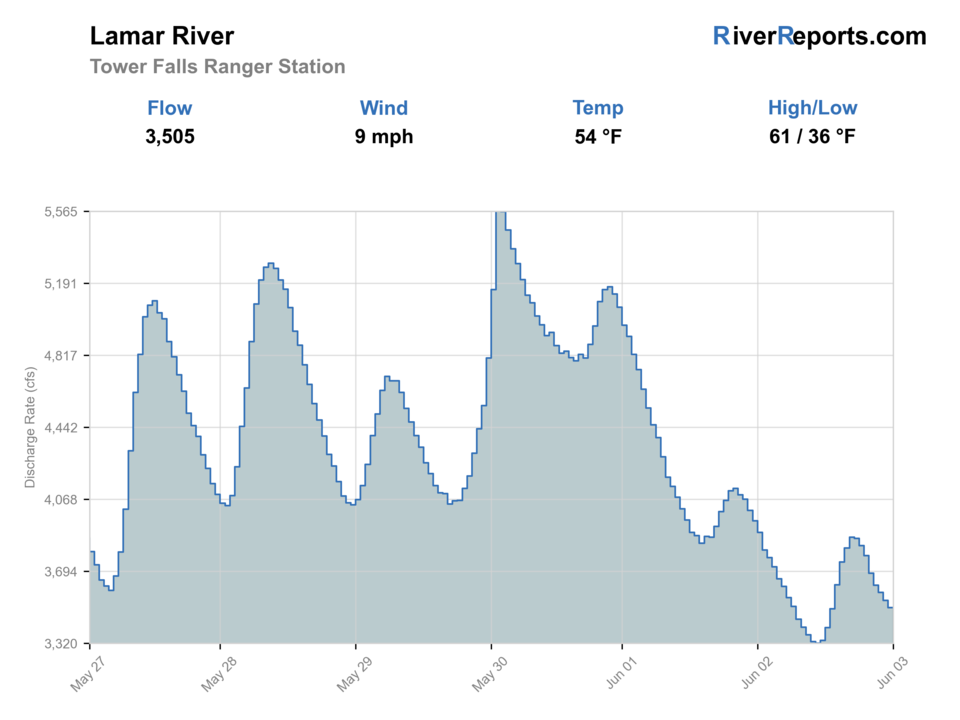
USGS data chart
Official USGS trend
Streamflow over the latest USGS reporting window.
Latest
3,480 cfs
Jun 3, 4 PM UTC
Weather
River weather report
Weather can change wading safety, road access, water temperature, hatches, and the best time of day to fish.
Live forecast loads as you reach this section
This keeps the report fast while still using the official National Weather Service forecast point.
Hatches and flies
Hatch chart and fly picks
Late May to June
Cold-water midges, BWOs, caddis, and early stoneflies once park water opens
Zebra midge, BWO emerger, caddis pupa, golden stone nymph, soft hackle
July
PMDs, caddis, golden stones, Green Drakes, and spinner falls
PMD emerger, X-caddis, golden stone dry, green drake, rusty spinner
August to September
Terrestrials, ants, beetles, hoppers, small caddis, and evening spinners
Foam ant, beetle, hopper, small caddis, parachute Adams, sparkle dun
October
BWOs, midges, and short cold-weather feeding windows
BWO emerger, midge pupa, small soft hackle, olive bugger, sculpin
Park dries
PMD, BWO, caddis, parachute Adams, ant, beetle, hopper, small stonefly dry
Best once the open reach, wind, and fish handling all line up for a visual day.
Park nymphs
Pheasant tail, hare's ear, zebra midge, caddis pupa, small stonefly
The higher-percentage choice in cold mornings and windy valley afternoons.
Careful streamer support
Olive bugger, small sculpin, soft-hackle streamer, sparse leech
Use only where legal and only after native-fish handling and visibility stay under control.
Tactics
How to fish it
Walk enough to leave the first roadside pullout crowd, but not so far that wildlife or weather trap you out in the valley.
Use dries whenever the fish are willing because the Lamar rewards clean visual fishing better than forced dredging on good days.
On windy afternoons, shorten drifts and fish the soft edges that still let you land and release fish quickly.
If you catch a nonnative fish in the Lamar drainage, follow the current park kill requirement instead of defaulting to outside habits.
Rigging
Rod, leader, and setup notes
A 5-weight is the easiest all-around Lamar rod because wind, larger trout, and long leaders all matter here.
Carry a dry-dropper and a light nymph rig so you can shift with wind and visibility without overcomplicating the day.
Bring a rubber net and keep handling efficient because this river is built around native-fish conservation.
Access
Access and planning notes
Tower-area access and information
Rules and permit anchorWade / float / trail
NPS access / wade
When to pick it
Start here before committing to a valley walk or named pullout.
Caution
Current park rules and advisories override the rating.
Lamar Valley pullouts
Meadow scoutWade / float / trail
Roadside / wade / walk
When to pick it
Use these when flow, wildlife spacing, and weather all support a careful walk.
Caution
Easy parking can still be unsafe or crowded because this is major wildlife country.
USGS near Tower gauge
Primary flow trendWade / float / trail
RiverReports / USGS gauge
When to pick it
Check it when runoff and clarity decide whether to fish or only scout.
Caution
Gauge data does not confirm wildlife, closures, or safe meadow exits.
Use the Tower Backcountry Office as your official information and permit anchor for this part of the park.
Give wildlife more room than you think you need; the valley belongs to bison and bears before it belongs to anglers.
A pretty meadow bank is not automatically a safe wading bank when storms or soft edges show up.
Regulations
Check before fishing
Check Yellowstone’s main fishing page, the northeast-region rules, and the current regulation booklet before fishing because Lamar-specific native-fish and required-harvest rules matter here.
Primary base
Tower Junction, Lamar Valley, and the northeast Yellowstone road corridor
Best day style
Park pullouts, roadside meadow water, and short wildlife-aware walks
Check first
Yellowstone fishing regulations, northeast-region rules, the 06188000 trend, current park conditions, and wildlife restrictions
Safety
Bears, bison, sudden wind, lightning, soft meadow banks, and any park advisory or closure affecting the valley
Gear
Helpful gear for this water
4- to 6-weight rod
A 5-weight is the easiest all-day Lamar choice for dries, nymphs, and wind.
Bear spray
Mandatory judgment gear in Lamar Valley where wildlife encounters are part of normal travel.
Layered clothing
The Lamar Valley can swing from bright sun to wind and cold in a single session.
Thermometer and net
Protect native trout by checking temperature and keeping releases short.
Nearby water
Other water to research
Backup logic
High or dirty runoff
Wait for the Lamar to clear or compare Yellowstone River in the park.
Wildlife or road issue
Give the valley room and choose another legal park route.
Storms
Leave exposed meadow water before lightning or mud makes exits worse.
Rule or species uncertainty
Recheck the current park regulation page before fishing.
Yellowstone River in Yellowstone Park
A broader park-river alternative with different access and closure details.
Madison River in Yellowstone Park
A very different park fishery with its own thermal and seasonal decisions.
Snake River
A Jackson-side Wyoming option when you want non-park logistics and a different access pattern.
FAQ
Fast answers
Is Lamar River fishable today?
Lamar River looks very fishable right now. The live score is 96/100, based on current flow, weather, public alerts, and the report's planning context. Recheck the linked gauge and forecast before leaving because conditions can change quickly after rain, heat, access changes, or flow swings.
What flow is best for Lamar River?
Best on clear dropping runoff or moderate summer flows that still let you see banks, seams, and fish movement.
When should I skip Lamar River?
Skip when high dirty water, thunderstorms, wildlife congestion, or park advisories make the day unsafe or low value.
Is Lamar River safe to wade right now?
The fishability score is not a wading guarantee. Wade only where your chosen access has safe edges, clear footing, legal entry, and no forced crossings; high, rising, stained, or storm-affected water should be treated conservatively.
What is the biggest Lamar River rule I need to remember?
In the Lamar drainage, native fish are catch-and-release, while rainbow trout, brook trout, and identifiable cutthroat-rainbow hybrids must be killed under current Yellowstone rules.
Where should I start on the Lamar River?
Start with the Tower-area information and pullouts, check the current park rules and gauge, then choose a meadow walk only after wildlife and weather both look manageable.
When should I skip the Lamar River?
Skip when runoff is still dirty, when thunderstorms or wildlife make the valley unsafe, or when park advisories say the reach is not a good call.
Sources
Source set for this report
Reviewed 2026-06-02