Washington / Pacific Northwest
Cedar River
An upper Cedar report focused on the Cedar Falls and watershed edge context, with live flow checks, restricted-access reminders, and practical go-or-no-go guidance.
Image: Generated Washington planning image for Cedar River near Cedar Falls / BlueStreamFly generated; not exact location / BlueStreamFlyFishability now: Cedar River fishability today
GreatData confidence: High93/100
Fishable now because the live gauge is stable, weather is mild, and no public alert is active.
Flow observed
3:45 PM UTC
Weather observed
4:00 PM UTC
Score calculated
4:20 PM UTC
Why this rating
Flow
Water temperature
Public alerts
Next 6-12 hours
Hold
Stable live data supports staying with the plan, but recheck the gauge and forecast before leaving.
USGS flow
132 cfs
Current trend: flow stable, so weather, temperature, and access checks drive the next change.
More planning details: flies, flow bands, and live source checks
Fish it today
Start here
Start with Seattle watershed rules and USGS 12116400, then decide whether Rattlesnake Lake/Cedar Falls public-edge access supports a short session.
Best flow clue
Use the Cedar Falls gauge with Seattle watershed context. Stable cold flow is useful only when the access boundary is legal and obvious.
Skip trigger
Skip when access is not clearly public, watershed boundaries are uncertain, flow is rising from release or rain, cold current is pushy, or slick canyon footing raises consequence.
Flow decision bands
Stable Cedar Falls flow
Stable USGS Cedar Falls flow with cold clear water is useful only if the legal public edge is confirmed.
Best short-session window
Mild weather, stable flow, clearly public access, and safe footing make the upper Cedar most useful.
Release, rain, or canyon push
Rising water, cold push, slick rock, or narrow exits should move the plan away from wading.
Watershed-boundary hard stop
Any uncertainty about municipal watershed access should cancel this route and move the plan downstream or elsewhere.
USGS flow
132 cfs
Current trend: flow stable, so weather, temperature, and access checks drive the next change.
Live USGS flow
132 cfs / stable
Live NWS forecast
57F / Mostly Cloudy
Live water temperature
54F from USGS
No NWS alert flag
No active NWS alert was returned for this forecast point.
Seattle Public Utilities restricts public access inside most of the municipal watershed.
Flow management here serves fish, hydropower, and regional water supply, so reading the level matters before you commit.
Cold water and boulder structure can keep fishable conditions interesting even when the access footprint stays small.
A disciplined short session is better than forcing a long exploratory day around closure boundaries.
Editorial review
How this report is maintained
This report starts with official regulation, access, flow, weather, and public-land sources, then adds practical planning guidance for fly anglers.
Byline
BlueStreamFly editorial desk
Reviewed by
BlueStreamFly source review
Maintained by
BlueStreamFly
Last material review
2026-06-02
Report confidence
Good confidence
84/100
Good confidence: RiverReports, USGS Cedar Falls flow, Washington fishing rules, Seattle watershed, instream-flow, water-supply access, and hydroelectric sources, weather coverage, image disclosure, and route-specific restricted-access guidance support the page. Confidence is moderated by municipal watershed closures, narrow legal public access, release or rain changes, slick cold water, and sensitive native-fish context.
Regulations
Washington sport-fishing rules support the legal-check path, while Seattle watershed sources define the access constraints.
Access
Seattle watershed and water-supply sources support a conservative public-edge plan, but broad access is restricted and must be verified by signs and official rules.
Flow and weather
RiverReports coverage is backed by USGS 12116400 near Cedar Falls, with Seattle instream-flow context and weather data supporting release and storm decisions.
Fishing usefulness
The page now separates Cedar Falls flow, municipal watershed boundaries, Rattlesnake Lake public-edge planning, cold-current safety, access hard stops, and backup-water choices.
Fishability dashboard and source review
2026-06-02 / material content or source review
RiverReports, USGS 12116400 near Cedar Falls, Washington sport-fishing regulations, Seattle Cedar River Watershed sources, instream flow management, water-supply access context, Cedar Falls Hydroelectric Project information, National Weather Service data, and image-disclosure sources were checked before updating the current-fishability decision layer.
2026-06-02
Updated Cedar River near Cedar Falls to the current fishability-page standard with Cedar Falls trend bands, municipal-watershed access cards, restricted-boundary skip cues, backup logic, stable fishability SEO, and confidence signals.
2026-05-28
Published a new Cedar Falls reach report with watershed-boundary guidance, flow support, and upper-Cedar access cautions.
Angler planning edge
Local details that change the plan
Best for
upper Cedar public-edge trout, short legal-access checks, cold boulder and pocket-water sessions
Wade or float
Bank and wade only where public access is clearly allowed near the Cedar Falls and Rattlesnake Lake edge; do not treat the municipal watershed as open water.
Best flows
Use the Cedar Falls gauge with Seattle watershed context. Stable cold flow is useful only when the access boundary is legal and obvious.
When to skip
Skip when access is not clearly public, watershed boundaries are uncertain, flow is rising from release or rain, cold current is pushy, or slick canyon footing raises consequence.
Local plan
Start with Seattle watershed rules and USGS 12116400, then decide whether Rattlesnake Lake/Cedar Falls public-edge access supports a short session.
Pressure
The bigger constraint is legal boundary discipline, not angling pressure.
Access nuance
Seattle manages this corridor for drinking water, fish habitat, and power; public access is narrow and must be treated conservatively.
Backup water
Compare Cedar River at Renton, Middle Fork Snoqualmie, or another greater-Seattle river when Cedar Falls access or flow is not right.
About the river
Setting, character, and why it fishes the way it does.
The Cedar River above Landsburg sits inside one of the most protected water-supply systems in the region. That alone changes the fishing plan, because much of the land that looks open on a map is managed under stricter public-access rules.
The Cedar Falls hydro and storage system also shapes the feel of this reach. Water supply, instream fish needs, and hydropower history all matter here more than casual angling folklore.
For BlueStreamFly readers, the value of this page is not hidden-hotspot mythology. It is knowing exactly why the upper Cedar can be appealing, and why access discipline has to lead the trip.
Target species
Resident trout
The most realistic fly target in the public-edge upper-Cedar context.
Bull trout context
A reminder that this watershed contains sensitive native fish and deserves careful handling.
Salmon and steelhead support
More important as a watershed and flow-management story than as a casual angler harvest narrative here.
Whitefish
A possible cold-water bonus where legal opportunities exist and the river settles into manageable shape.
Reading the water
Cold clear flow
Best for careful short presentations along boulders, seams, and pocket-water transitions.
Pushed release or rain flow
Back off quickly because access options are limited and wading consequence rises fast.
Low stable flow
The easiest time to make a short legal-access trip without overcommitting the day.
Warm lowland weather
Upper shade helps, but do not confuse a cooler canyon feel with universally safe trout conditions.
Best seasons
Spring
Good when snowmelt and rain are not combining into pushy, cold, hard-to-read water.
Summer
Often the cleanest short-session season if you start early and stay disciplined about access.
Fall
Strong for cooler weather and clear air, but keep any salmon-sensitive handling especially conservative.
Winter
A niche option centered on stable weather and very short, safe sessions.
Preferred flow source
Cedar River near Cedar Falls
RiverReports is the preferred chart source when coverage exists. When a matching USGS gauge exists, keep it open as the official backstop for station data and current hydrograph context.
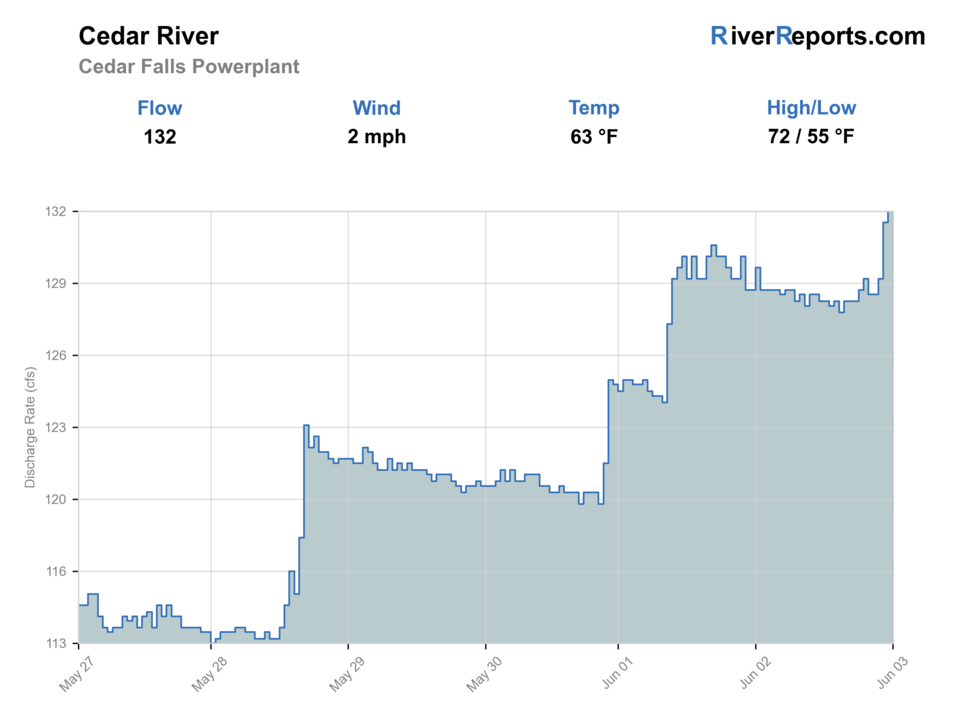
USGS data chart
Official USGS trend
Streamflow over the latest USGS reporting window.
Latest
132 cfs
Jun 3, 4 PM UTC
Weather
River weather report
Weather can change wading safety, road access, water temperature, hatches, and the best time of day to fish.
Live forecast loads as you reach this section
This keeps the report fast while still using the official National Weather Service forecast point.
Hatches and flies
Hatch chart and fly picks
Late winter to spring
Midges, stoneflies, and early caddis in cold, clear windows
Stonefly nymph, zebra midge, olive bugger, caddis pupa
Summer
Caddis, pale mayflies, and terrestrials around shaded banks and gravel edges
Elk hair caddis, Adams, beetle, ant, perdigon
Early fall
Caddis and opportunistic baitfish windows around migrating salmon
Sculpin streamer, caddis dry, egg imitation where legal and ethical
Late fall to winter
Sparse insect life and short steelhead-friendly windows
Leech, stonefly nymph, egg pattern, intruder-style swing fly
Trout and resident fish flies
Pheasant tail, hare's ear, perdigon, caddis pupa, Adams
Good for the low, clear summer and shoulder-season days that reward careful presentations.
Steelhead and salmon support flies
Sparse intruder, leech, stonefly, egg pattern
Carry them whenever seasonal runs or colored water justify a bigger offering.
Small streamers
Olive bugger, sculpin, minnow pattern
Useful along cut banks, deeper slots, and post-rain push when fish stop rising.
Tactics
How to fish it
Keep the day compact and fish only the clearly legal public edge instead of trying to force more mileage.
Work pocket water, current tongues, and shaded slots with controlled short drifts before switching to a light streamer.
If the flow looks pushier than expected, treat that as the answer and leave.
Carry a second plan toward the Middle Fork Snoqualmie or the lower Cedar if the upper reach is too restricted or too high.
Rigging
Rod, leader, and setup notes
A 4- or 5-weight with a tight-line nymph or dry-dropper rig covers most realistic upper-Cedar situations.
Keep a small olive bugger or sculpin pattern ready for deeper green slots.
Shorter leaders and careful footwork matter more here than heroic casting distance.
Access
Access and planning notes
Cedar Falls gauge
Primary upper-Cedar trendWade / float / trail
RiverReports / USGS gauge / trout
When to pick it
Start here when flow stability and cold-water safety decide whether a short public-edge session is possible.
Caution
The gauge does not open restricted watershed land or solve legal boundary questions.
Rattlesnake Lake recreation area
Practical public baseWade / float / trail
Public recreation edge / bank / short wade
When to pick it
Use it when Seattle watershed rules and signs keep the route clearly public.
Caution
Do not wander beyond signed public areas or assume nearby riverbanks are open.
Watershed education-center corridor
Boundary orientationWade / float / trail
Orientation / access check
When to pick it
Pick this before any fishing plan that approaches municipal watershed land.
Caution
This is a boundary check, not permission to fish closed water.
Seattle manages the municipal watershed for drinking water and fish habitat, not open wandering access.
If a route or bank is not clearly public, assume it is off limits.
Upper-Cedar success comes from respecting the boundary, not trying to sneak around it.
Regulations
Check before fishing
Check Washington sport fishing rules first, then layer Seattle watershed access rules over them before you treat the trip as fishable.
Primary base
North Bend, Cedar Falls, and the Rattlesnake Lake area
Best day style
Very limited public access near a protected municipal watershed with no room for casual bank-hopping assumptions
Check first
Seattle watershed rules, 12116400 flow, weather, trailhead access, and whether your plan stays outside closed water-supply ground
Safety
Restricted watershed boundaries, cold release-driven water, slick rock, and fast changes around narrow canyon water
Gear
Helpful gear for this water
4- to 6-weight rod
A 5-weight covers the widest mix of summer trout, cutthroat, and light streamer work.
Wading staff
A worthwhile safety tool on boulder gardens, woody edges, and sudden ledge drops.
Rain shell
Mountain and Puget weather can turn a clear morning into a wet canyon by lunch.
Thermometer
Helpful on urban or lowland reaches where warm water should change the plan before the first cast.
Nearby water
Other water to research
Backup logic
Access boundary uncertainty
Move to Cedar River at Renton or Middle Fork Snoqualmie instead of guessing.
Rising release or rain flow
Stay out of committed wades and wait for a stable trend.
Cold slick footing
Fish bank-first only or choose a safer public river.
Public edge too narrow
Use a downstream Cedar or Snoqualmie-area route with clearer access.
Cedar River at Renton
The lower river gives you a far more public-facing Cedar plan.
Middle Fork Snoqualmie River
A better mountain-public-land option when you want room to move.
Green River
Another greater-Seattle option when the Cedar feels too restricted.
FAQ
Fast answers
Is Cedar River fishable today?
Cedar River looks very fishable right now. The live score is 93/100, based on current flow, weather, public alerts, and the report's planning context. Recheck the linked gauge and forecast before leaving because conditions can change quickly after rain, heat, access changes, or flow swings.
What flow is best for Cedar River?
Use the Cedar Falls gauge with Seattle watershed context. Stable cold flow is useful only when the access boundary is legal and obvious.
When should I skip Cedar River?
Skip when access is not clearly public, watershed boundaries are uncertain, flow is rising from release or rain, cold current is pushy, or slick canyon footing raises consequence.
Is Cedar River safe to wade right now?
The fishability score is not a wading guarantee. Wade only where your chosen access has safe edges, clear footing, legal entry, and no forced crossings; high, rising, stained, or storm-affected water should be treated conservatively.
Can I freely roam the Cedar River near Cedar Falls?
No. Much of the surrounding municipal watershed is protected and access is restricted, so you should stay with clearly legal public-entry areas only.
Why fish the Cedar Falls reach at all?
Because when access, flow, and weather line up, it offers a colder upper-river feel close to Seattle without pretending to be a wide-open destination fishery.
What should I check before going?
Check the watershed-access rules, RiverReports, USGS 12116400, weather, and whether your chosen stop is unquestionably public.
Sources
Source set for this report
Reviewed 2026-06-02