Montana / West
Soda Butte Creek
A boundary-scoped Soda Butte report for anglers checking Northeast Yellowstone rules, native-fish conservation, flows, access, hatches, and bear-country safety.
Image: Generated regional planning image for Soda Butte Creek / BlueStreamFly generated; not exact location / BlueStreamFlyFishability now: Soda Butte Creek fishability today
GreatData confidence: High96/100
Fishable now because Park Boundary gauge is falling, weather is mild, and no public alert is active.
Flow observed
3:45 PM UTC
Weather observed
4:00 PM UTC
Score calculated
4:20 PM UTC
Why this rating
Flow
Weather
Public alerts
Next 6-12 hours
Improving / hold
A falling gauge and usable weather should keep the next 6-12 hours in play unless tributaries stain or heat builds.
USGS flow
331 cfs
Current trend: flow falling, rating likely holding strong unless weather or clarity changes.
More planning details: flies, flow bands, and live source checks
Fish it today
Start here
Check the park rules and boundary gauge, pick a short legal section, fish slowly with a dry or dry-dropper, and leave room for wildlife and other anglers.
Best flow clue
Clear post-runoff flows that let fish hold naturally without making the creek too shallow, warm, or pressured.
Skip trigger
Skip during high snowmelt, warm low water, closures, unsafe wildlife situations, or when crowding makes careful fishing impossible.
Flow decision bands
Clear post-runoff meadow flow
Stable or slowly falling boundary flow after runoff is the best sign that dries, light droppers, and sight fishing can work.
High snowmelt
High or pushy water should move the day to waiting, scouting, or a larger park river instead of forcing meadow wading.
Low clear pressure
Low clear water can fish with long leaders, minimal wading, and quick releases, but it becomes fragile fast.
Wildlife, closure, or storm issue
Park conditions, bear safety, storms, or closures can overrule a good flow number.
USGS flow
331 cfs
Current trend: flow falling, rating likely holding strong unless weather or clarity changes.
Live USGS flow
335 cfs / falling about 15%
Live NWS forecast
55F / Sunny
Water temperature not verified
Heat guidance uses weather and river type unless an official water-temperature value is available.
No NWS alert flag
No active NWS alert was returned for this forecast point.
RiverReports is used as the quick chart, backed by USGS 06187915 Soda Butte Creek at the park boundary near Silver Gate.
Yellowstone National Park fishing regulations, permit requirements, tackle rules, and native-fish conservation guidance are mandatory checks.
NPS identifies Soda Butte Creek as a notable Northeast Yellowstone stream, so users should expect park-level resource protection and crowd pressure.
Bear safety, storms, cold water, and careful meadow access matter as much as fly selection.
Editorial review
How this report is maintained
This report uses official regulation, flow, weather, access, and public-land sources first, then adds practical planning guidance for fly anglers.
Byline
BlueStreamFly editorial desk
Reviewed by
BlueStreamFly source review
Maintained by
BlueStreamFly
Last material review
2026-06-02
Report confidence
Good confidence
89/100
Good confidence: RiverReports, USGS 06187915 at the park boundary, Yellowstone National Park fishing regulations, NPS Soda Butte Creek background, weather coverage, generated media disclosure, and route-specific meadow-stream guidance support the page. Confidence is moderated by park closures, wildlife movement, native-fish rules, crowd pressure, fragile banks, and snowmelt timing.
Regulations
Yellowstone National Park fishing regulation sources support permit, tackle, native-fish, and closure checks.
Access
NPS Soda Butte Creek and park-context sources support boundary and Northeast Yellowstone access planning, with wildlife and closure conditions remaining day-specific.
Flow and weather
RiverReports, USGS 06187915 at the park boundary, and the National Weather Service point support live flow and weather decisions.
Fishing usefulness
The page now separates boundary gauge logic, Yellowstone rules, native cutthroat handling, meadow-bank fragility, bear safety, crowd pressure, and park-water backups.
Fishability dashboard and source review
2026-06-02 / material content or source review
RiverReports and USGS 06187915 Soda Butte Creek boundary flow, Yellowstone National Park fishing regulations, National Park Service Soda Butte Creek background, National Weather Service data, and route-specific native-fish, meadow-bank, and bear-country guidance were checked before updating the current-fishability decision layer.
2026-06-02
Updated Soda Butte Creek with Yellowstone boundary flow bands, park access cards, backup cues, and confidence signals.
2026-05-26
Published a new Soda Butte Creek report with Yellowstone boundary framing, native-fish guardrails, flow checks, hatch guidance, and bear-country safety notes.
Angler planning edge
Local details that change the plan
Best for
Northeast Yellowstone dry-fly windows, Native cutthroat-focused planning, Small meadow-stream fishing
Wade or float
Wade only, and wade lightly. This is careful meadow-stream fishing, not a float plan.
Best flows
Clear post-runoff flows that let fish hold naturally without making the creek too shallow, warm, or pressured.
When to skip
Skip during high snowmelt, warm low water, closures, unsafe wildlife situations, or when crowding makes careful fishing impossible.
Local plan
Check the park rules and boundary gauge, pick a short legal section, fish slowly with a dry or dry-dropper, and leave room for wildlife and other anglers.
Pressure
Pressure can be high because the creek is visible and famous. The best advantage is careful timing and restraint.
Access nuance
The stream may look roadside, but park rules, fragile meadow banks, and wildlife closures shape what is appropriate.
Backup water
Use the Lamar, Yellowstone, or Madison Park pages when Soda Butte is too high, warm, crowded, or restricted.
About the river
Setting, character, and why it fishes the way it does.
Soda Butte Creek flows through the Silver Gate and Northeast Yellowstone area, where small-stream fishing, park rules, wildlife, and native trout conservation overlap.
It is not a generic Montana creek page. The park boundary, Yellowstone fishing permit rules, and Lamar drainage conservation context shape how anglers should approach it.
Because the water is visible and sensitive, a good plan means fewer steps, better casts, and a willingness to leave fish alone when flows, temperature, or pressure say no.
Target species
Yellowstone cutthroat trout
The key native fish context; follow NPS rules and handle fish quickly and gently.
Brook trout
Possible in the drainage, with NPS rules determining harvest or removal expectations where applicable.
Rainbow or hybridized trout
Check current NPS conservation guidance before making assumptions about fish handling or harvest.
Reading the water
Clear post-runoff flow
Best for dry flies, dry-dropper rigs, and sight-fishing when approaches stay quiet.
High snowmelt
Usually too pushy or cold for precise meadow-stream fishing. Wait for definition and visibility.
Low clear summer water
Use long leaders, smaller flies, and minimal wading; stop if fish are stressed.
Storm or bear activity
Do not force the creek when weather, visibility, or wildlife safety becomes the main issue.
Best seasons
Late spring
Often still limited by snowmelt and park-season timing; check rules and flows.
Early summer
Good once flows settle and hatches start lining up with clear water.
Mid to late summer
Can be strong with terrestrials and mayflies, but pressure and low water require restraint.
Fall
Check Yellowstone season dates and weather before planning; cold storms can change the day fast.
Preferred flow source
Soda Butte Creek at Park Boundary
RiverReports is the preferred chart source when coverage exists. When a matching USGS gauge exists, keep it open as the official backstop for station data and current hydrograph context.
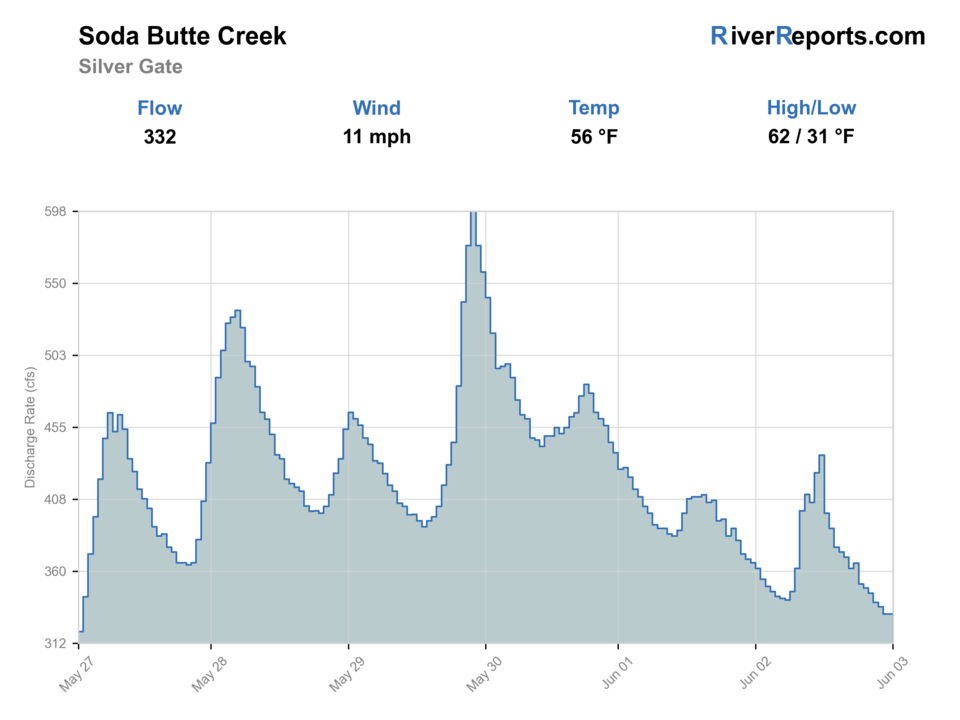
USGS data chart
Official USGS trend
Streamflow over the latest USGS reporting window.
Latest
331 cfs
Jun 3, 4 PM UTC
Weather
River weather report
Weather can change wading safety, road access, water temperature, hatches, and the best time of day to fish.
Live forecast loads as you reach this section
This keeps the report fast while still using the official National Weather Service forecast point.
Hatches and flies
Hatch chart and fly picks
Early season
Midges, small mayflies, early caddis
Zebra midge, BWO emerger, small caddis
Summer
PMDs, caddis, drakes, terrestrials
PMD cripple, elk hair caddis, green drake, beetle
Late summer
Ants, beetles, hoppers, small mayflies
Foam ant, beetle, small hopper, parachute Adams
Fall
BWOs, midges
BWO emerger, parachute BWO, zebra midge
Meadow dries
Parachute Adams, PMD cripple, elk hair caddis, green drake
Clear water and rising fish reward precise presentations.
Terrestrials
Ant, beetle, small hopper
Late summer banks and meadow grass put fish on surface food.
Light droppers
Pheasant tail, zebra midge, caddis pupa
Fish are visible but not consistently eating dries.
Tactics
How to fish it
Check Yellowstone fishing rules and permit requirements before choosing the creek.
Stay low, wade little, and make the first cast count because clear meadow water does not forgive sloppy approaches.
Use barbless hooks and quick releases, especially around native cutthroat.
Carry bear spray, make noise when visibility is poor, and give wildlife more room than you think you need.
Rigging
Rod, leader, and setup notes
A 3- or 4-weight rod with a long leader is ideal for most Soda Butte dry-fly work.
Use 5X or 6X when low clear water demands it, but keep fights short and releases quick.
A single dry or small dry-dropper is usually better than heavy nymph rigs in fragile meadow water.
Bring bear spray, polarized glasses, rain shell, and warm layers even on summer days.
Access
Access and planning notes
Silver Gate and park boundary
Gauge and rule startWade / float / trail
Boundary / walk-wade
When to pick it
Start here when the flow and current Yellowstone rules both support a short careful session.
Caution
Boundary water requires current rule and permit awareness before fishing.
Northeast Yellowstone corridor
Park access contextWade / float / trail
NPS corridor / walk-wade
When to pick it
Use it when signed parking, wildlife safety, and meadow-bank protection all line up.
Caution
Wildlife distance and resource-protection rules matter as much as a rising trout.
Legal roadside pullouts
Short meadow-stream stopsWade / float / trail
Roadside scout / walk-wade
When to pick it
Pick them when the creek is clear, uncrowded, and access is explicitly appropriate.
Caution
Do not trample meadow banks or create new informal trails.
Yellowstone rules and boundaries matter. Carry the required permit where applicable and follow current NPS fishing regulations.
This is bear country and wildlife viewing country. Do not let a rising fish pull you into unsafe distance from wildlife.
Meadow banks are fragile. Use durable access points and avoid trampling streamside vegetation.
Regulations
Check before fishing
Check Yellowstone National Park fishing regulations before fishing, including permit requirements, tackle rules, native-fish conservation rules, and any current closures.
Primary base
Silver Gate, Cooke City, or Yellowstone's Lamar Valley corridor
Best day style
NPS-first boundary water with walk-wade planning, park rules, bear safety, and fragile meadow-stream etiquette
Check first
RiverReports, USGS 06187915, Yellowstone fishing regulations, current park conditions, bear safety, and local forecast
Safety
Bear country, park rules, cold water, lightning, fragile meadow banks, wildlife traffic, and native-fish handling
Gear
Helpful gear for this water
3- or 4-weight rod
Matches the clear meadow-stream scale and dry-fly focus.
Long leaders and small dries
Useful when fish are visible and pressure is high.
Bear spray
Essential safety gear in the Northeast Yellowstone corridor.
Thermometer and rain shell
Helps with fish handling and fast mountain weather changes.
Nearby water
Other water to research
Backup logic
High snowmelt
Move to Lamar, Yellowstone, or Madison Park planning once their conditions make more sense.
Low warm or pressured water
Fish a short cool window, rest visible fish, or leave the creek alone.
Wildlife or closure issue
Give wildlife priority and switch to another legal park water or a non-fishing plan.
Rule uncertainty
Confirm Yellowstone permit, tackle, native-fish, and closure rules before fishing.
Lamar River
A larger Northeast Yellowstone meadow-river comparison.
Yellowstone River in Yellowstone Park
A broader park river option with its own rules and access.
Madison River in Yellowstone Park
A different park fishery with separate thermal and seasonal considerations.
FAQ
Fast answers
Is Soda Butte Creek fishable today?
Soda Butte Creek looks very fishable right now. The live score is 96/100, based on current flow, weather, public alerts, and the report's planning context. Recheck the linked gauge and forecast before leaving because conditions can change quickly after rain, heat, access changes, or flow swings.
What flow is best for Soda Butte Creek?
Clear post-runoff flows that let fish hold naturally without making the creek too shallow, warm, or pressured.
When should I skip Soda Butte Creek?
Skip during high snowmelt, warm low water, closures, unsafe wildlife situations, or when crowding makes careful fishing impossible.
Is Soda Butte Creek safe to wade right now?
The fishability score is not a wading guarantee. Wade only where your chosen access has safe edges, clear footing, legal entry, and no forced crossings; high, rising, stained, or storm-affected water should be treated conservatively.
Do Yellowstone rules apply to Soda Butte Creek?
Yes for water inside Yellowstone National Park, and boundary details matter. Check the current NPS fishing regulations and permit requirements before fishing.
What gauge should I check?
Use RiverReports for the quick chart and USGS 06187915 at the park boundary near Silver Gate as the official flow reference.
Is Soda Butte Creek beginner friendly?
Only in the sense that it is visible and small. Clear water, native fish, park rules, wildlife, and fragile banks require careful behavior.
Sources
Source set for this report
Reviewed 2026-06-02