
Massachusetts / Northeast
Deerfield River
A lower Deerfield planning page for anglers using the West Deerfield gauge corridor, Mohawk and Zoar access context, and a more downstream trout decision than the Charlemont tailwater alone.
Image: Generated regional planning image for Deerfield River at West Deerfield / BlueStreamFly generated; not exact location / BlueStreamFlyFishability now: Deerfield River fishability today
GoodData confidence: High70/100
Fishable now because the live gauge is rising, weather is usable, and no public alert is active.
Flow observed
4:30 PM UTC
Weather observed
5:00 PM UTC
Score calculated
5:26 PM UTC
Why this rating
Flow
Weather
Public alerts
Next 6-12 hours
Watch
Recheck within the next few hours; rising water or active weather can change clarity and wading quickly.
USGS flow
585 cfs
Current trend: flow rising, rating can drop quickly if clarity or wading safety deteriorates.
More planning details: flies, flow bands, and live source checks
Fish it today
Start here
Use the West Deerfield gauge to decide whether the lower river is earning the drive, then commit either to the lower catch-and-release section or to a float plan with a clear take-out.
Best flow clue
Moderate readable flow that still lets you fish bank structure and deeper seams without turning the lower river into a pushy transport lane.
Skip trigger
Skip when summer heat removes the trout edge, when access commitment is higher than the water quality justifies, or when the river is too pushy to wade cleanly.
Flow decision bands
Cool moderate lower flow
Stable or slowly falling West Deerfield flow with cool weather is the best sign that the lower catch-and-release water still has a trout-shaped window.
High downstream push
Rising or pushy lower-river flow should move the plan to bank scouting, a conservative float, or the colder upper Deerfield.
Low clear technical water
Low clear water can fish with longer leaders and smaller bugs, but expect wary trout and less margin in bright conditions.
Warm lower-river window
Warm afternoons make this reach a weaker trout bet before the upper tailwater loses its usefulness.
USGS flow
585 cfs
Current trend: flow rising, rating can drop quickly if clarity or wading safety deteriorates.
Live USGS flow
585 cfs / rising about 63%
Live NWS forecast
80F / Sunny
Water temperature not verified
Heat guidance uses weather and river type unless an official water-temperature value is available.
No NWS alert flag
No active NWS alert was returned for this forecast point.
RiverReports is the public chart and USGS 01170000 near West Deerfield is the official downstream reference.
MassWildlife says the lower Deerfield catch-and-release section begins at Pelham Brook and runs one mile downstream to the Mohawk campground.
MassWildlife notes Mohawk State Forest walk-in access, a Zoar Road pull-off near Pelham Brook, and frequent boat access from the Zoar Gap Bridge.
The lower river keeps trout value, but MassWildlife also notes it is more susceptible to summer heat and drought than the Fife Brook corridor.
Editorial review
How this report is maintained
This report uses official regulation, flow, weather, access, and public-land sources first, then adds practical planning guidance for fly anglers.
Byline
BlueStreamFly editorial desk
Reviewed by
BlueStreamFly source review
Maintained by
BlueStreamFly
Last material review
2026-06-02
Report confidence
Good confidence
89/100
Good confidence: RiverReports, USGS 01170000 near West Deerfield, Massachusetts freshwater regulations, MassWildlife lower Deerfield catch-and-release guidance, Mohawk Trail State Forest access, Great River Hydro recreation context, weather coverage, generated media disclosure, and route-specific lower-river guidance support the page. Confidence is moderated by downstream heat, generation carry-through, float logistics, exact boundary awareness, and access commitment.
Regulations
Massachusetts freshwater and MassWildlife lower Deerfield catch-and-release sources support current lower-reach rule checks.
Access
MassWildlife, Mohawk Trail State Forest, and Great River Hydro sources support Zoar, Mohawk, and float-planning access context.
Flow and weather
RiverReports, USGS 01170000 near West Deerfield, and the National Weather Service point support live flow and weather decisions.
Fishing usefulness
The page now separates lower catch-and-release water, Mohawk and Zoar access, float decisions, warm-water trout stops, upper Deerfield backups, and rule-boundary checks.
Fishability dashboard and source review
2026-06-02 / material content or source review
RiverReports and USGS 01170000 West Deerfield flow, Massachusetts freshwater regulations, MassWildlife lower Deerfield catch-and-release guidance, Mohawk Trail State Forest access, Great River Hydro recreation context, National Weather Service data, and route-specific lower-river heat and float guidance were checked before updating the current-fishability decision layer.
2026-06-02
Updated the Deerfield River at West Deerfield with lower-corridor flow bands, Mohawk and Zoar access cards, backup cues, and confidence signals.
2026-05-26
Published a new lower Deerfield report with West Deerfield gauge context, Mohawk and Zoar access framing, and downstream trout-planning guidance.
Angler planning edge
Local details that change the plan
Best for
Cool-season lower-river trout days, Selective float-assisted planning, Downstream Deerfield scouting tied to the West Deerfield gauge
Wade or float
Either, but choose one on purpose. The lower Deerfield gets messy when you try to force a full wade day out of water that is really better covered by short walk-ins or a controlled float.
Best flows
Moderate readable flow that still lets you fish bank structure and deeper seams without turning the lower river into a pushy transport lane.
When to skip
Skip when summer heat removes the trout edge, when access commitment is higher than the water quality justifies, or when the river is too pushy to wade cleanly.
Local plan
Use the West Deerfield gauge to decide whether the lower river is earning the drive, then commit either to the lower catch-and-release section or to a float plan with a clear take-out.
Pressure
Pressure is lighter and more spread out than on the upper river, but lower access points are fewer, so the practical water still concentrates effort.
Access nuance
The lower river has legitimate public access, but the best options involve a longer walk or a boat. Do not assume the lower corridor is easier just because it is broader.
Backup water
If the lower Deerfield feels too warm or too broad for the day, move back to the upper Deerfield or switch to the Westfield or Millers instead of salvaging a weak trout plan.
About the river
Setting, character, and why it fishes the way it does.
The Deerfield below Charlemont gradually shifts from a release-dominated upper tailwater into a broader lower valley river with longer drift lanes, more float utility, and more weather sensitivity.
West Deerfield is a useful downstream reference because it captures what the river is doing after it leaves the most obvious Fife Brook trout corridor.
That makes this page less about one famous wading beat and more about deciding whether the lower river still holds a trout-shaped day or should be treated as a scouting, floating, or backup plan.
Target species
Brown trout
Still the primary lower-river trout target, especially around the lower catch-and-release water and structured seams.
Rainbow trout
Part of the lower Deerfield stocking mix and most likely in cooler, release-supported sections.
Brook trout
More relevant in tributary influence and colder edges than in the broader main lower river.
Reading the water
Cool moderate flow
The best lower-river trout window for nymphing, streamer swings, and selective dry-fly water.
High downstream push
A sign to fish from the bank, shift upstream, or skip the float if the river loses shape.
Warm bright summer day
Question the trout plan early because the lower river warms sooner than the Fife Brook reach.
Falling shoulder-season flow
A good sign for streamer or nymph coverage along deeper banks and tailouts.
Best seasons
Spring
The safest lower-river trout window because water stays cooler and flows usually still shape the river well.
Early summer
Good while cool nights continue and the lower catch-and-release reach still feels like trout water.
Mid summer
Can narrow quickly into short morning windows or become a better scouting and floating corridor than a trout day.
Fall
A strong reset once cooler nights tighten temperatures and the river becomes easier to read again.
Preferred flow source
Deerfield River near West Deerfield
RiverReports is the preferred chart source when coverage exists. When a matching USGS gauge exists, keep it open as the official backstop for station data and current hydrograph context.
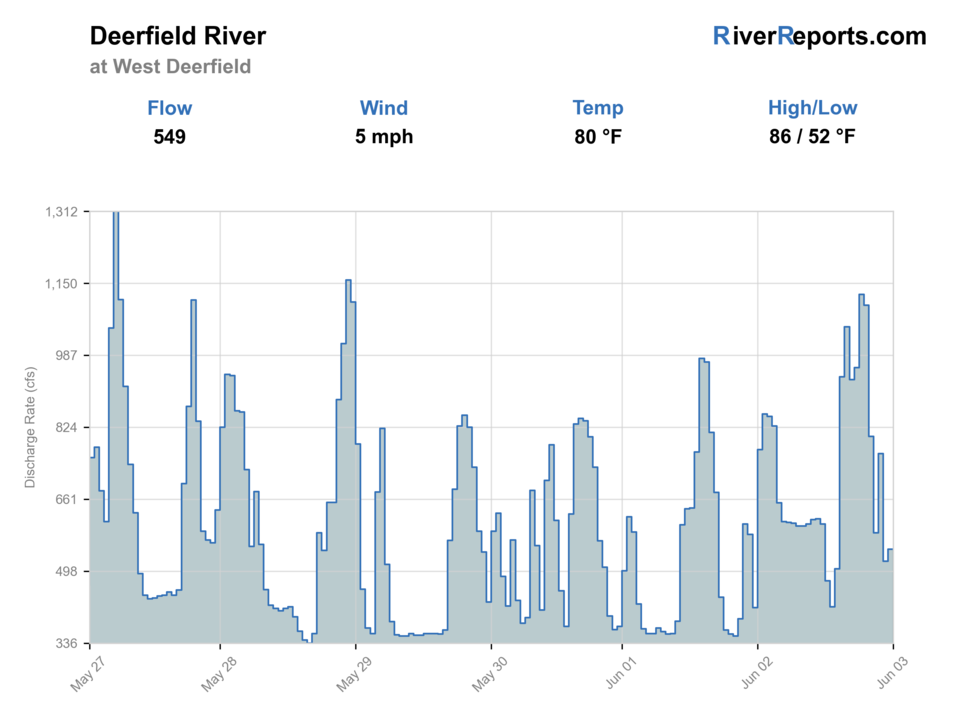
USGS data chart
Official USGS trend
Streamflow over the latest USGS reporting window.
Latest
585 cfs
Jun 3, 4 PM UTC
Weather
River weather report
Weather can change wading safety, road access, water temperature, hatches, and the best time of day to fish.
Live forecast loads as you reach this section
This keeps the report fast while still using the official National Weather Service forecast point.
Hatches and flies
Hatch chart and fly picks
Spring
Midges, caddis, and BWOs
Zebra midge, caddis pupa, BWO emerger
Late spring
Caddis, March Browns, sulphurs
March Brown wet fly, sulphur emerger, X-caddis
Summer
Caddis and terrestrials
Elk hair caddis, ant, beetle, hopper-dropper
Fall
BWOs and caddis
Parachute BWO, caddis pupa, olive streamer
Lower-river nymphs
Pheasant tail, caddis pupa, perdigon, hare's ear
You need to probe broader seams and slightly deeper banks than the upper Deerfield often offers.
Dry-dropper and attractors
Caddis dry, ant, beetle, small sulphur, tungsten dropper
Flows are moderate and the lower river still looks trout-clear and cool.
Streamers
Olive bugger, conehead sculpin, slim baitfish pattern
Cloud cover, fall conditions, or a slightly raised lower river push fish into bank structure.
Tactics
How to fish it
Decide first whether you are really fishing the lower catch-and-release reach or using the West Deerfield gauge to judge a broader downstream plan.
Cover deeper seams and banks patiently because the lower river gives trout more room to slide away from shallow community water.
If temperatures or low-summer water remove the trout edge, move upstream rather than rationalizing a warm lower-river afternoon.
For float days, think in terms of safe access, legal take-outs, and one or two target structures instead of trying to fish every bank mile.
Rigging
Rod, leader, and setup notes
A 5-weight is the most flexible lower Deerfield rod because it handles nymphs, dries, and small streamers in broader current.
Carry 4X and 5X for most trout fishing, plus slightly heavier tippet for streamer or boat work around structure.
A thermometer matters more here than on the upper river because the lower corridor gives up the cold-water edge earlier.
If you float, keep a wade-ready setup because many productive lower-river plays still come from getting out and fishing structure carefully.
Access
Access and planning notes
Zoar Road near Pelham Brook
Lower catch-and-release startWade / float / trail
Roadside pull-off / walk-wade
When to pick it
Start here when you want the lower special-regulation water and the flow still leaves safe, readable edges.
Caution
Boundary awareness and lawful parking matter before moving between the lower access points.
Mohawk Trail State Forest
Walk-in lower-river planWade / float / trail
State forest walk-in
When to pick it
Use it when you are willing to trade a longer approach for less casual roadside pressure.
Caution
This is not a quick hop-out stop, so flow, heat, and daylight need to justify the walk.
Zoar Gap Bridge float context
Lower float planningWade / float / trail
Launch / scout / float
When to pick it
Pick it when the day is really a controlled lower-river float or access comparison.
Caution
Floatable water is not automatically trout-safe or wade-safe in warm or pushy conditions.
The lower Deerfield asks for more commitment than the River Road upper river because the easiest lower public entries are more walk-in or float-oriented.
Mohawk Trail State Forest is a useful access anchor, but it is not a quick walk-down trout stop.
This corridor rewards anglers who separate trout water from generic floatable water instead of assuming every lower mile should be fished the same way.
Regulations
Check before fishing
Use current Massachusetts freshwater regulations and the Deerfield catch-and-release references before fishing. The lower special-regulation stretch from Pelham Brook to Mohawk is artificial lures only and all fish must be released.
Primary base
Shelburne Falls, Charlemont, Greenfield, or Deerfield
Best day style
Walk-in state-forest access, roadside scouting, and float-friendly lower-river planning
Check first
RiverReports trend, USGS 01170000, lower-reach access choice, regulations, and cool-weather window
Safety
Generation carry-through, warm summer trout stress, long walk-ins, slick banks, and float logistics
Gear
Helpful gear for this water
5-weight rod
The most flexible lower-river setup for broader currents and occasional streamer work.
Thermometer
Important because the lower corridor can warm enough to change the trout call fast.
Wading boots with support
Useful for longer walk-ins, uneven banks, and slick lower-river rock.
Compact pack
Helps on Mohawk or Zoar access approaches where hauling extra gear adds little value.
Nearby water
Other water to research
Backup logic
Lower river too warm
Move upstream to the Charlemont tailwater, fish only low light, or skip trout handling.
High West Deerfield flow
Stay bank-first, delay the float, or choose Westfield or Millers instead.
Access commitment mismatch
Use a shorter upper Deerfield access plan instead of forcing a long lower walk-in.
Rule or boundary uncertainty
Confirm the lower Deerfield catch-and-release map before fishing Pelham-to-Mohawk water.
Deerfield River
The colder upper Charlemont tailwater if the lower corridor loses its trout edge.
Westfield River
A Massachusetts major-river alternative when you want more freestone character.
Millers River
A smaller regional backup with separate trout and warmwater reach choices.
FAQ
Fast answers
Is Deerfield River fishable today?
Deerfield River looks fishable right now. The live score is 70/100, based on current flow, weather, public alerts, and the report's planning context. Recheck the linked gauge and forecast before leaving because conditions can change quickly after rain, heat, access changes, or flow swings.
What flow is best for Deerfield River?
Moderate readable flow that still lets you fish bank structure and deeper seams without turning the lower river into a pushy transport lane.
When should I skip Deerfield River?
Skip when summer heat removes the trout edge, when access commitment is higher than the water quality justifies, or when the river is too pushy to wade cleanly.
Is Deerfield River safe to wade right now?
The fishability score is not a wading guarantee. Wade only where your chosen access has safe edges, clear footing, legal entry, and no forced crossings; high, rising, stained, or storm-affected water should be treated conservatively.
How is the West Deerfield page different from the upper Deerfield page?
This page is built around the lower corridor and downstream gauge context, where summer heat, access logistics, and float planning matter more than they do right below Fife Brook.
Is the lower Deerfield still trout water?
Yes, but it is more condition-sensitive than the upper river. Cool weather and moderate flow matter more as you move farther from the dam.
What is the cleanest lower public access plan?
Start by choosing between the Zoar Road and lower catch-and-release approach or a Mohawk Trail State Forest walk-in, then decide whether the day is really a wade or float plan.
Sources
Source set for this report
Reviewed 2026-06-02