California / West
Upper Truckee River
A practical Upper Truckee plan built around meadow and willow water near Meyers, current Tahoe-basin access, trout-safe conditions, and gentle presentation tactics.
Image: Generated regional planning image for Upper Truckee River / BlueStreamFly generated; not exact location / BlueStreamFlyFishability now: Upper Truckee River fishability today
GreatData confidence: High96/100
Fishable now because the live gauge is stable, weather is mild, and no public alert is active.
Flow observed
5:00 PM UTC
Weather observed
5:00 PM UTC
Score calculated
5:24 PM UTC
Why this rating
Flow
Weather
Public alerts
Next 6-12 hours
Hold
Stable live data supports staying with the plan, but recheck the gauge and forecast before leaving.
USGS flow
71 cfs
Current trend: flow stable, so weather, temperature, and access checks drive the next change.
More planning details: flies, flow bands, and live source checks
Fish it today
Start here
Stay based near Meyers, check the gauge and weather first, fish one durable access section carefully, and keep Truckee River as the backup if the meadow feels too soft or warm.
Best flow clue
Moderate stable flows with clear edges, defined undercuts, and temperatures cool enough for ethical trout handling.
Skip trigger
Skip during flooded meadow conditions, soft-bank runoff, or warm summer afternoons that put trout under stress.
Flow decision bands
Low but fishable
Low meadow water may fish only when temperatures are safe and the channel still has enough depth and cover.
Best meadow trout window
Stable or gently falling Meyers flow with cool weather and durable banks creates the strongest short-session setup.
Runoff or flooded meadow unsafe
Spring runoff, flooded banks, or fast crossings should stop wading and meadow trampling.
Soft-bank and warm-water caution
A legal day can still be poor if banks are fragile or trout temperatures are stressful.
USGS flow
71 cfs
Current trend: flow stable, so weather, temperature, and access checks drive the next change.
Live USGS flow
71 cfs / stable
Live NWS forecast
70F / Mostly Sunny
Water temperature not verified
Heat guidance uses weather and river type unless an official water-temperature value is available.
No NWS alert flag
No active NWS alert was returned for this forecast point.
Use RiverReports for a quick read and USGS 103366092 above Meyers as the official flow check before you commit to a wade plan.
This river fishes best when the meadow channel is clear enough to spot structure and move slowly around cut banks, wood, and soft edges.
Carry small attractors, midges, and terrestrial patterns because fish often hold in softer current and feed opportunistically rather than in big obvious riffles.
Skip the day if runoff has spread into the meadow, banks are fragile, or warm summer water makes trout handling a poor idea.
Editorial review
How this report is maintained
This report uses official regulation, flow, weather, access, and public-land sources first, then adds practical planning guidance for fly anglers.
Byline
BlueStreamFly editorial desk
Reviewed by
BlueStreamFly source review
Maintained by
BlueStreamFly
Last material review
2026-05-31
Report confidence
Good confidence
87/100
Good confidence: RiverReports, USGS Meyers flow, weather data, Washoe Meadows access information, Lake Tahoe Basin fishing guidance, and CDFW trout sources support the page. Confidence is moderated by sensitive meadow access, restoration-area bank concerns, warm summer water, and reach-by-reach Tahoe rules.
Regulations
Lake Tahoe Basin fishing information, CDFW inland guidance, and Lahontan cutthroat trout sources support the rule and species-care check path.
Access
Washoe Meadows State Park provides a strong public-access anchor, with meadow-bank durability and restoration areas still requiring careful day-of judgment.
Flow and weather
RiverReports, USGS 103366092, and the National Weather Service point are attached to the route.
Fishing usefulness
The page now separates meadow bank restraint, warm-water cutoffs, short-session planning, Tahoe backup water, and low-impact access decisions.
Fishability dashboard and source review
2026-05-31 / material content or source review
RiverReports, USGS Upper Truckee River above Meyers flow data, Washoe Meadows State Park access information, Lake Tahoe Basin fishing guidance, CDFW inland fishing and Lahontan cutthroat trout sources, and the National Weather Service point were checked before updating the current fishability guidance.
2026-05-31
Updated Upper Truckee River with meadow flow guidance, soft-bank access cards, warm-water caution, backup cues, stable fishability SEO, and confidence signals.
2026-05-29
Added a page-specific report-confidence meter for Upper Truckee flow, meadow access, Tahoe-basin rule checks, weather, trout-handling guidance, and low-impact fishing planning.
2026-05-25
Published a new Upper Truckee River report with official flow context, Tahoe access guidance, meadow tactics, and trout-safe planning notes.
Angler planning edge
Local details that change the plan
Best for
Short Tahoe-basin trout sessions, Careful meadow-water presentations, Warm-season terrestrial fishing
Wade or float
Wade only. This river is best treated as a short walk-in meadow plan, not a float or cover-water mission.
Best flows
Moderate stable flows with clear edges, defined undercuts, and temperatures cool enough for ethical trout handling.
When to skip
Skip during flooded meadow conditions, soft-bank runoff, or warm summer afternoons that put trout under stress.
Local plan
Stay based near Meyers, check the gauge and weather first, fish one durable access section carefully, and keep Truckee River as the backup if the meadow feels too soft or warm.
Pressure
Most pressure gathers near obvious trail access and roadside checks. Moving slowly into quieter bends matters more than covering distance.
Access nuance
The challenge is not finding the river but finding durable entry points that do not damage banks or force awkward brush crashes.
Backup water
Truckee River is the cleanest nearby backup when the Upper Truckee is too soft, too warm, or too flooded to fish responsibly.
About the river
Setting, character, and why it fishes the way it does.
The Upper Truckee drains the southern Lake Tahoe basin through meadow, willow, and forested sections around Meyers before it reaches the lake. That shape makes it feel more like a careful stalking river than a classic boulder freestone.
Because much of the river runs through sensitive habitat and active restoration country, the best days come when you fish lightly, enter only where the bank can handle traffic, and keep expectations focused on quality drifts instead of covering miles.
This is a river where stealth matters. Fish often sit close to cover, slower seams, and protected bends, especially when the water is lower and clearer.
Target species
Lahontan cutthroat trout
Native-drainage fish worth handling carefully wherever restoration and stocking support the fishery.
Rainbow trout
Resident trout show up in the softer meadow and willow sections.
Brown trout
More likely in deeper bends, undercuts, and lower-light windows.
Reading the water
Low clear water
Use longer leaders, smaller dries or nymphs, and stay well back from cut banks.
Moderate steady flow
Best all-around condition for short indicator rigs, terrestrials, and slow-bank drifts.
Runoff or flooded meadow water
Treat it as a scouting day or move elsewhere; soft banks and unclear channels raise the cost of mistakes.
Warm summer afternoons
Carry a thermometer and end the trout plan if the water warms into stress territory.
Best seasons
Late spring
Fish only after runoff settles enough to protect banks and give trout clean feeding lanes.
Summer
Early and late windows can be productive with terrestrials and small nymphs when water temperatures stay safe.
Early fall
Often the best mix of lower flows, cool nights, and clearer presentations.
Shoulder season
Cold weather can still produce, but meadow footing and weather swings matter more than raw calendar dates.
Preferred flow source
Upper Truckee River
RiverReports is the preferred chart source when coverage exists. When a matching USGS gauge exists, keep it open as the official backstop for station data and current hydrograph context.
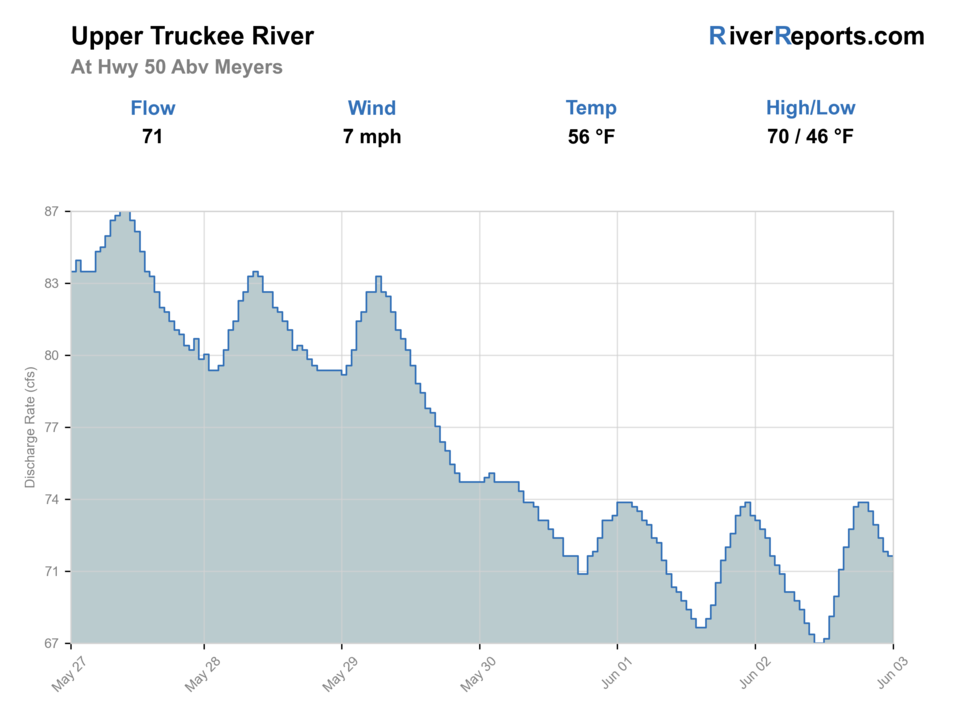
USGS data chart
Official USGS trend
Streamflow over the latest USGS reporting window.
Latest
71 cfs
Jun 3, 5 PM UTC
Weather
River weather report
Weather can change wading safety, road access, water temperature, hatches, and the best time of day to fish.
Live forecast loads as you reach this section
This keeps the report fast while still using the official National Weather Service forecast point.
Hatches and flies
Hatch chart and fly picks
Spring
Midges, BWOs, and small mayflies
Zebra midge, RS2, pheasant tail, BWO emerger
Summer
Caddis, terrestrials, and smaller attractor windows
Elk hair caddis, ant, beetle, hopper-dropper
Late summer
Terrestrials and evening caddis
Foam ant, beetle, caddis emerger, soft hackle
Fall
BWOs and midges
Parachute BWO, midge larva, tiny baetis nymph
Meadow dries
Parachute Adams, elk hair caddis, ant, beetle
Best for calm bends, edges, and late-day rise windows.
Small nymphs
RS2, zebra midge, pheasant tail, perdigon
Use when fish are hugging slower slots or deeper bends.
Search patterns
Chubby, hopper-dropper, soft hackle
Good for covering water without overcomplicating a short session.
Tactics
How to fish it
Approach from downstream and make the first cast count because meadow fish see pressure quickly in clear water.
Target undercut bends, wood, and slower green slots rather than the fastest visible current.
Use short drifts and reposition often instead of trying to mend a long line through twisting willow banks.
If the channel is brushy or soft-edged, downsize the session rather than forcing aggressive wading.
Rigging
Rod, leader, and setup notes
A 4-weight with floating line covers nearly all Upper Truckee trout situations.
Carry 5X and 6X tippet for smaller flies and cleaner presentations in low water.
A dry-dropper or small indicator rig is usually enough; oversized weights and heavy indicators tend to fight the meadow current.
Felt-free sticky rubber and careful foot placement matter more here than heavy wading armor.
Access
Access and planning notes
Washoe Meadows State Park
Primary public meadow accessWade / float / trail
Walk / wade / bank scout
When to pick it
Use it when flow, temperature, and bank durability support a low-impact session.
Caution
Stay off fragile banks and respect restoration areas.
Meyers and Highway 50 corridor
Gauge and road checkWade / float / trail
Gauge / roadside / short walk
When to pick it
Start here when the graph is stable and access is straightforward.
Caution
Roadside proximity does not prove every bank is legal or durable.
Upper basin walk-ins
Cooler small-water optionWade / float / trail
Walk / meadow wade
When to pick it
Pick these for short sessions when weather is mild and habitat can handle foot traffic.
Caution
Sensitive meadow water should not be forced in warm, low, or muddy conditions.
Washoe Meadows State Park gives the clearest public starting point for this page, but not every bend is worth stepping into.
Treat restoration areas and soft meadow edges conservatively; the best access decision is often the one that keeps you on durable ground.
This is a better walk-and-watch river than a hurry-up numbers river.
Regulations
Check before fishing
Use current California inland fishing regulations for the Tahoe basin before you fish, and double-check any local closures or species-handling guidance that applies to Lahontan cutthroat trout waters.
Primary base
South Lake Tahoe or Meyers
Best day style
Short walk-in trout session with a backup plan
Check first
RiverReports, USGS 103366092, Tahoe rules, and weather
Safety
Soft banks, woody bends, afternoon wind, and warm summer water
Gear
Helpful gear for this water
4-weight rod
A clean fit for short accurate casts around meadow cover.
Thermometer
Important in midsummer when the basin warms quickly.
Long leader material
Helpful for calm bends and wary trout in clear water.
Compact net
Keeps fish handling short in brushy landing zones.
Nearby water
Other water to research
Backup logic
High water
Wait for meadow flow to drop or compare the California Truckee or other Tahoe-area water.
Heat
Fish early, carry a thermometer, and stop when trout handling becomes questionable.
Storms or soft banks
Avoid muddy meadow edges and wait for trails and banks to firm up.
Access issue
Use signed park access or choose another public Tahoe Basin option.
Truckee River
A stronger backup when you want a bigger public river with more obvious current seams.
Hot Creek
Better for technical spring-creek style fishing if you want steadier sight-fishing conditions.
East Walker River
Worth the drive when you need a more defined tailwater-style plan.
FAQ
Fast answers
Is Upper Truckee River fishable today?
Upper Truckee River looks very fishable right now. The live score is 96/100, based on current flow, weather, public alerts, and the report's planning context. Recheck the linked gauge and forecast before leaving because conditions can change quickly after rain, heat, access changes, or flow swings.
What flow is best for Upper Truckee River?
Moderate stable flows with clear edges, defined undercuts, and temperatures cool enough for ethical trout handling.
When should I skip Upper Truckee River?
Skip during flooded meadow conditions, soft-bank runoff, or warm summer afternoons that put trout under stress.
Is Upper Truckee River safe to wade right now?
The fishability score is not a wading guarantee. Wade only where your chosen access has safe edges, clear footing, legal entry, and no forced crossings; high, rising, stained, or storm-affected water should be treated conservatively.
Is the Upper Truckee River best for wading or floating?
This is a wade-first page. Most anglers do best with short walk-in sessions rather than trying to float the meadow channel.
What flow source should I check first?
Use RiverReports for a quick trend read, then verify with USGS 103366092 above Meyers before you decide whether the meadow is clear and fishable enough.
What makes a good Upper Truckee day?
A good day has moderate flow, firm enough banks to access responsibly, cool water, and enough clarity to fish cut banks, willow edges, and slower seams.
Sources
Source set for this report
Reviewed 2026-05-31