California / West
Hot Creek
An Eastern Sierra spring-creek report for technical trout, no-wading caution, public access boundaries, live flow context, and CDFW rules.
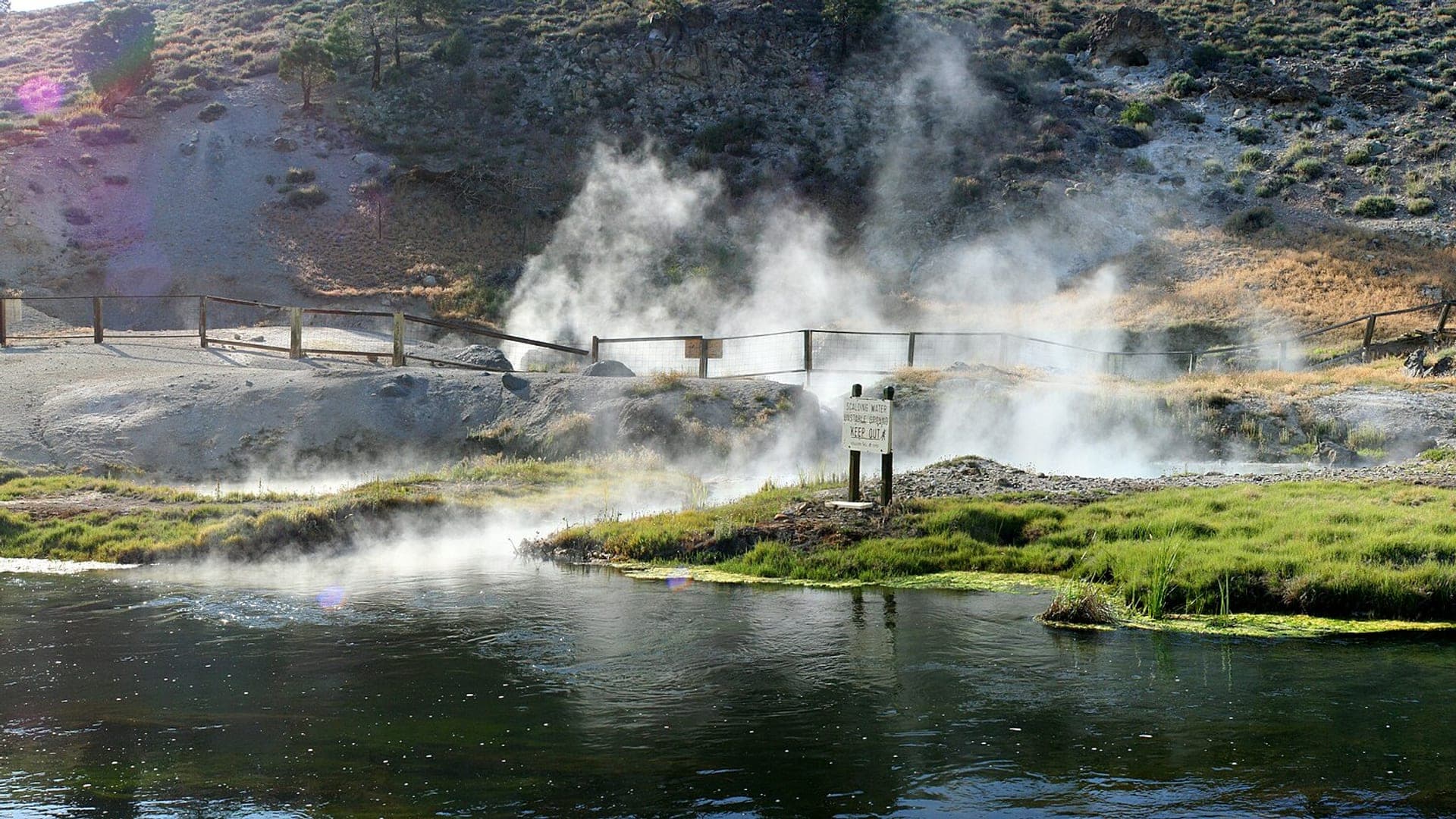
Image: Hot Creek near Mammoth Lakes, California 02 / CC BY 2.0 / clickfarmerFishability now: Hot Creek fishability today
PoorData confidence: High39/100
Not a strong choice now because Flume near Mammoth Lakes gauge is stable, weather is mild, and a public alert may affect the plan.
Flow observed
5:00 PM UTC
Weather observed
5:00 PM UTC
Score calculated
5:25 PM UTC
Why this rating
Flow
Water temperature
Public alerts
Next 6-12 hours
Hold
Do not force the next window until safety, heat, or public-alert flags clear.
USGS flow
56 cfs
Hard-stop flag active; rating should stay conservative until it clears.
More planning details: flies, flow bands, and live source checks
Fish it today
Start here
Start by separating three things before you rig: the closed geologic-site corridor, the private ranch context, and the signed public fishing water. Once the legal access point is settled, watch one weed lane or feeding fish before deciding whether the day should be dries, emergers, or a small indicator rig.
Best flow clue
Use the flume trend as a context check, not a magic number. Stable clear flow is the best signal for technical dry-fly or emerger fishing; sudden color, weed drag, or a sharp jump in current should push the day toward fewer casts or another creek.
Skip trigger
Skip the trip when closure boundaries near the geologic site are active in the reach you planned to fish, when wind ruins long-leader control, when snowmelt muddies the lanes, or when crowding forces you to rush drifts in a tiny public section.
Flow decision bands
Low but fishable
Low clear water can fish with tiny flies and bank-first angles, but crowding and closure boundaries decide whether it is worth it.
Best technical window
Stable flume flow, legal public access, light wind, and visible feeding lanes create the best green light.
Pushy or poor
Stain, sudden flow changes, snowmelt mud, or weed drag should shrink the plan or move it elsewhere.
Closure hard stop
Closed geothermal areas are not fishing access, regardless of the score or flow.
USGS flow
56 cfs
Hard-stop flag active; rating should stay conservative until it clears.
Live USGS flow
56 cfs / stable
Live NWS forecast
71F / Mostly Sunny
Live water temperature
82F from USGS
No NWS alert flag
No active NWS alert was returned for this forecast point.
Use RiverReports and USGS 10265150 for current flow context near the flume.
Do not fish or enter closed geothermal areas at the Hot Creek Geologic Site.
Respect Hot Creek Ranch private water and reservation-only access.
Plan on tiny midges, BWOs, scuds, caddis, and bank-first presentations.
Editorial review
How this report is maintained
This report starts with official regulation, access, flow, weather, and public-land sources, then adds practical planning guidance for fly anglers.
Byline
BlueStreamFly editorial desk
Reviewed by
BlueStreamFly source review
Maintained by
BlueStreamFly
Last material review
2026-05-31
Report confidence
High confidence
90/100
High confidence: RiverReports, USGS flume flow, Inyo National Forest geologic-site and closure sources, CDFW regulation and hatchery context, and weather data support the page. Confidence is moderated by a small public corridor, closure boundaries, private-water proximity, and crowding.
Regulations
CDFW freshwater regulations and Inyo National Forest closure sources support the legal and safety check path.
Access
Inyo National Forest and closure-order sources provide strong hard-stop access and safety context, with private-water boundaries still needing current confirmation.
Flow and weather
RiverReports, USGS 10265150, and the National Weather Service point are attached to the route.
Fishing usefulness
The page now separates public water, geologic-site closures, private-water boundaries, tiny-fly tactics, and backup decisions.
Fishability dashboard and source review
2026-05-31 / material content or source review
RiverReports, USGS Hot Creek flume flow, Inyo National Forest geologic-site and closure sources, CDFW Hot Creek Hatchery context, CDFW freshwater regulations, and the National Weather Service point were checked before updating the current-fishability decision layer.
2026-05-31
Updated Hot Creek to the current fishability-page standard with no-wade flow guidance, closure/access cards, backup cues, stable fishability SEO, and confidence signals.
2026-05-28
Added editorial review signals, a public verification note, original angler-planning guidance covering bank-first fishing, skip triggers, crowd timing, closure boundaries, backup-water choices, and a page-specific report-confidence meter after source review.
2026-05-24
Initial source-reviewed report published with flows, weather, hatches, flies, tactics, access, regulations, and FAQs.
Angler planning edge
Local details that change the plan
Best for
Technical trout anglers who would rather stalk one lane than cover miles of water, Short Mammoth-area sessions where precise legal access matters more than broad exploration, Small-fly dry, emerger, and scud fishing when the creek is clear and stable, Trips where you are willing to leave the creek if closure boundaries, wind, or crowding ruin the presentation game
Wade or float
Treat Hot Creek as a bank-first walk-and-wade page with as little wading as possible. The useful fishing is built around legal pullouts, careful bank angles, and sighted lanes, not pushing through the channel or trying to cover water quickly.
Best flows
Use the flume trend as a context check, not a magic number. Stable clear flow is the best signal for technical dry-fly or emerger fishing; sudden color, weed drag, or a sharp jump in current should push the day toward fewer casts or another creek.
When to skip
Skip the trip when closure boundaries near the geologic site are active in the reach you planned to fish, when wind ruins long-leader control, when snowmelt muddies the lanes, or when crowding forces you to rush drifts in a tiny public section.
Local plan
Start by separating three things before you rig: the closed geologic-site corridor, the private ranch context, and the signed public fishing water. Once the legal access point is settled, watch one weed lane or feeding fish before deciding whether the day should be dries, emergers, or a small indicator rig.
Pressure
Hot Creek fish and anglers both stack into the same obvious public lanes. Early starts, shoulder-season weekdays, and a willingness to rest one run instead of joining a line of anglers usually matter more than constant fly changes.
Access nuance
The easiest mistake here is confusing famous scenery with legal fishing room. The geologic site has no-fishing restrictions, the current closure order blocks entry in and immediately beside the hazardous hot-springs corridor, and private-water assumptions around the ranch can end a day fast if you do not verify where you are standing.
Backup water
If Hot Creek is too windy, crowded, or legally cramped, pivot to the East Walker for a bigger flow-driven tailwater day or to Hat Creek when you still want technical trout water with more room to move.
About the river
Setting, character, and why it fishes the way it does.
Hot Creek flows through the Long Valley Caldera near Mammoth Lakes and is shaped by cold spring flow, geothermal influence, and a small technical channel.
The Hot Creek Geologic Site is for viewing geothermal features, not fishing. Boiling water, gases, and sudden changes make the closure language important.
Public fishing water and private ranch water are close enough that anglers need to know exactly where they are before stepping in or casting.
The creek's slow, clear lanes can make trout selective, so fly size, drift, and line control matter more than covering water fast.
Target species
Rainbow trout
A primary target in the public creek sections, often feeding in clear lanes and weed edges.
Brown trout
Present and often cautious in low, clear, pressured water.
Aquatic insects and scuds
A major part of the food base, especially for technical nymph and emerger fishing.
Sensitive creek habitat
Fragile banks, vegetation, and geothermal hazards make bank-first fishing the conservative default.
Reading the water
Clear normal flow
Use long leaders, tiny flies, and clean downstream or across-stream drifts.
Low and weedy
Target lanes, edges, and sighted fish. Avoid dragging rigs through vegetation.
Stained or high
Use small streamers or visible nymphs only where access is safe and legal.
Geothermal area
Do not enter closed water or closed ground. The danger is real and unrelated to fishing skill.
Best seasons
Winter
Midges and tiny nymphs can matter, but access and snow conditions decide the day.
Spring
BWOs, midges, scuds, and early caddis create technical opportunities.
Summer
Tricos, caddis, terrestrials, and weed-lane fishing can be useful in early or late windows.
Fall
Cooler weather brings BWOs, midges, and lighter pressure, with careful stealth still required.
Preferred flow source
Hot Creek at Flume near Mammoth Lakes
RiverReports is the preferred chart source when coverage exists. When a matching USGS gauge exists, keep it open as the official backstop for station data and current hydrograph context.
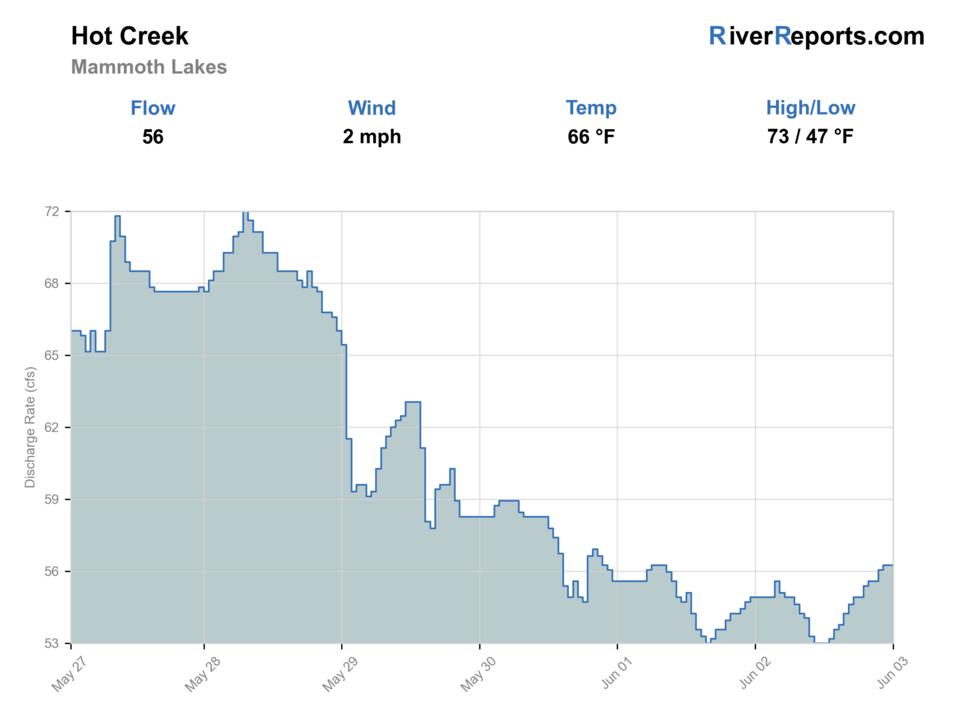
USGS data chart
Official USGS trend
Streamflow over the latest USGS reporting window.
Latest
56 cfs
Jun 3, 5 PM UTC
Weather
River weather report
Weather can change wading safety, road access, water temperature, hatches, and the best time of day to fish.
Live forecast loads as you reach this section
This keeps the report fast while still using the official National Weather Service forecast point.
Hatches and flies
Hatch chart and fly picks
Winter
Midges and tiny mayflies
Zebra midge, Griffith's gnat, RS2, WD-40, scud
Spring
BWOs, midges, caddis, scuds
BWO emerger, midge emerger, caddis pupa, scud, soft hackle
Summer
Tricos, caddis, terrestrials
Trico spinner, elk hair caddis, ant, beetle, micro hopper
Fall
BWOs, midges, streamer windows
BWO, zebra midge, leech, scud, soft hackle
Tiny dries
Griffith's gnat, trico spinner, BWO, CDC midge, parachute Adams
Use during visible rise forms in slow slicks and foam lanes.
Small nymphs
Zebra midge, WD-40, RS2, pheasant tail, perdigon
Use when trout feed below the surface in lanes or under weed edges.
Scuds and emergers
Olive scud, tan scud, midge emerger, BWO emerger
Use when fish refuse standard nymphs or feed low in clear water.
Small streamers
Micro bugger, leech, small sculpin
Use sparingly during higher water, low light, or when tiny flies are not practical.
Tactics
How to fish it
Confirm the legal public section before fishing; do not trespass on private ranch water.
Avoid wading when a bank presentation can work, because fish and habitat are both sensitive.
Watch one fish or lane before casting instead of blind-casting the entire creek.
Use downstream drifts, reach casts, and slack management to keep leader away from trout.
Treat the geologic site as a viewing area with closures, not as a fishing access shortcut.
Keep fish wet and releases quick in warmer weather.
Rigging
Rod, leader, and setup notes
A 9-foot 3-weight or 4-weight with a floating line is enough for most fishing.
Use 10- to 12-foot leaders and 5X to 7X tippet for tiny dries and emergers.
Carry small yarn indicators, dry-dropper materials, and light split shot.
Bring polarized glasses because sighting fish is a major advantage.
Use barbless flies for faster releases and safer handling.
Access
Access and planning notes
Signed public fishing water
Primary legal accessWade / float / trail
Bank-first / minimal wade
When to pick it
Start here when current rules, flow, and crowding support careful creek fishing.
Caution
Public water is narrow; do not step into private or closed water.
Hot Creek Geologic Site
Closure and hazard checkWade / float / trail
No fishing / safety boundary
When to pick it
Use it to confirm what not to fish before planning the day.
Caution
Geothermal hazards and closure orders are hard-stop safety factors.
Hot Creek Ranch boundary context
Private-water awarenessWade / float / trail
Private / reservation context
When to pick it
Use it when separating public fishing from private managed water.
Caution
Do not assume access without current permission.
Inyo National Forest states the Hot Creek Geologic Site has no fishing and serious geothermal hazards.
Public fishing access and private ranch water are close together, so boundary awareness matters.
Snow, mud, and road conditions can affect winter and spring access near Mammoth Lakes.
Small creek size means crowding affects both fishing quality and habitat.
Use official closures and posted signs over older guidebook descriptions.
Regulations
Check before fishing
Verify current CDFW regulations and Inyo National Forest closure notices before fishing. Do not fish in closed Hot Creek Geologic Site areas, and do not enter private water without permission or a valid reservation.
Primary base
Mammoth Lakes, California
Best day style
Public creek sections with private and closure boundaries
Check first
CDFW regulations, Inyo National Forest closures, flow, and weather
Safety
Geothermal hazards, no-swimming/no-fishing zones, private water, fragile banks
Gear
Helpful gear for this water
Fine tippet
5X to 7X helps with tiny flies and clear slicks.
Polarized glasses
Sight fishing and lane selection are central to Hot Creek.
Tiny-fly storage
Midges, BWOs, tricos, and emergers are easy to lose without organized boxes.
Warm layer
Eastern Sierra wind and weather can change quickly.
Nearby water
Other water to research
Backup logic
High water
Move to the East Walker or another river with more room instead of forcing a tiny public section.
Heat
Fish early, keep trout wet, and stop if the small creek warms or crowds up.
Wind or crowding
Rest the obvious lanes or compare Hat Creek/East Walker for a less cramped day.
Access issue
Treat geologic-site closures and private boundaries as hard stops, then choose another legal water.
East Walker River
A high-desert tailwater option with flow-sensitive larger-river tactics.
Hat Creek
Another technical California wild-trout stream with clear-water presentations.
Truckee River at Reno
A bigger technical trout river when you want more room and a different access style.
FAQ
Fast answers
Is Hot Creek fishable today?
Hot Creek does not look like a strong choice right now. The live score is 39/100, based on current flow, weather, public alerts, and the report's planning context. Recheck the linked gauge and forecast before leaving because conditions can change quickly after rain, heat, access changes, or flow swings.
What flow is best for Hot Creek?
Use the flume trend as a context check, not a magic number. Stable clear flow is the best signal for technical dry-fly or emerger fishing; sudden color, weed drag, or a sharp jump in current should push the day toward fewer casts or another creek.
When should I skip Hot Creek?
Skip the trip when closure boundaries near the geologic site are active in the reach you planned to fish, when wind ruins long-leader control, when snowmelt muddies the lanes, or when crowding forces you to rush drifts in a tiny public section.
Is Hot Creek safe to wade right now?
The fishability score is not a wading guarantee. Wade only where your chosen access has safe edges, clear footing, legal entry, and no forced crossings; high, rising, stained, or storm-affected water should be treated conservatively.
Can you fish at the Hot Creek Geologic Site?
No. Inyo National Forest lists no fishing at the geologic site. Fish only legal public sections and obey closures.
What flow source should I use?
Use RiverReports and USGS 10265150 at the Hot Creek flume for current flow context.
Should I wade Hot Creek?
Avoid wading when bank presentations work. The creek is small, clear, and sensitive, and some areas are closed for safety.
What flies work best?
Bring tiny midges, BWOs, tricos, scuds, caddis, emergers, ants, beetles, and a few small leeches.
Sources
Source set for this report
Reviewed 2026-05-31