Alaska / Alaska
Talkeetna River
A Talkeetna River report for Susitna drainage planning, RiverReports flow, USGS data, weather, salmon and trout rule checks, access logistics, hatches, flies, and safety notes.
Image: Generated regional planning image for Talkeetna River / BlueStreamFly generated; not exact location / BlueStreamFlyFishability now: Talkeetna River fishability today
GoodData confidence: High72/100
Fishable now because the live gauge is rising, weather is mild, and no public alert is active.
Flow observed
4:45 PM UTC
Weather observed
5:00 PM UTC
Score calculated
5:24 PM UTC
Why this rating
Flow
Water temperature
Public alerts
Next 6-12 hours
Watch
Recheck within the next few hours; rising water or active weather can change clarity and wading quickly.
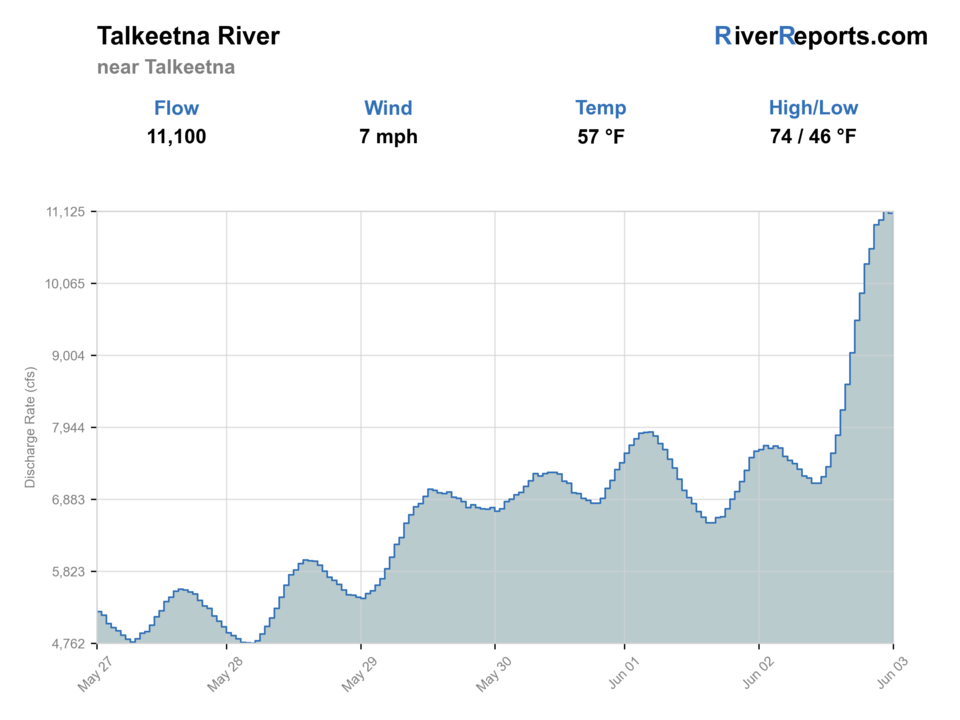
USGS flow
11,100 cfs
Current trend: flow rising, rating can drop quickly if clarity or wading safety deteriorates.
More planning details: flies, flow bands, and live source checks
Fish it today
Start here
Use Talkeetna as the base, check ADF&G and emergency orders, review RiverReports/USGS flow, then pick a legal target and access method.
Best flow clue
Stable flows that make boat positioning and bank edges readable.
Skip trigger
Skip during high glacial flow, unsafe wind, unclear salmon rules, or if access depends on informal assumptions.
Flow decision bands
Low but fishable
Lower stable edges and clearer side water can fish, but the mainstem still needs conservative footing.
Best big-water window
Stable Talkeetna flow, manageable weather, and a legal target species make the best starting call.
Pushy or unsafe
High glacial flow can make bank fishing, wading, and boat mistakes serious; choose side water or another river.
Tributary clarity clue
Clear tributary influence can be a better fly-fishing signal than forcing the main river.
USGS flow
11,100 cfs
Current trend: flow rising, rating can drop quickly if clarity or wading safety deteriorates.
Live USGS flow
11,100 cfs / rising about 45%
Live NWS forecast
59F / Sunny
Live water temperature
41F from USGS
No NWS alert flag
No active NWS alert was returned for this forecast point.
Use RiverReports for the quick chart and USGS 15292700 as the official flow source.
Check ADF&G Southcentral/Mat-Su rules and emergency orders before targeting salmon.
Boat access and tributary choices can make the day safer and more productive than forcing bank water.
Cold, powerful flow means wading plans should stay conservative.
Editorial review
How this report is maintained
This report uses official regulation, flow, weather, access, and public-source material first, then adds practical angler planning guidance without replacing current rules.
Byline
BlueStreamFly editorial desk
Reviewed by
BlueStreamFly source review
Maintained by
BlueStreamFly
Last material review
2026-05-31
Report confidence
Good confidence
86/100
Good confidence: RiverReports, USGS Talkeetna flow, National Weather Service data, ADF&G Mat-Su information, and Alaska regulation/emergency-order sources support the report. Confidence is moderated by big-water reach variation, boat logistics, tributary access, and salmon-rule changes.
Regulations
ADF&G Mat-Su/Susitna information, statewide regulations, and emergency orders support the legal-check path.
Access
The source set supports the big-water planning frame, but exact launch, bank, tributary, and guide logistics require current confirmation.
Flow and weather
RiverReports, USGS 15292700, and the National Weather Service point are attached to the route.
Fishing usefulness
The page now separates big-water flow, tributary clarity, boat versus bank decisions, legal targets, and backup choices.
Fishability dashboard and source review
2026-05-31 / material content or source review
Official regulation, emergency-order, flow, weather, access, safety, and fishability guidance sources were checked before updating the current-fishability decision layer.
2026-05-31
Updated to the current fishability-page standard with route-specific dashboard guidance, flow bands, access cards, backup cues, source timing, and confidence signals.
Angler planning edge
Local details that change the plan
Best for
Big-water Alaska planning near Talkeetna, Boat-supported trout and char trips, Anglers comparing mainstem and tributary-style options
Wade or float
Mostly boat-conscious planning. Wade only shallow, soft edges with a clear exit.
Best flows
Stable flows that make boat positioning and bank edges readable.
When to skip
Skip during high glacial flow, unsafe wind, unclear salmon rules, or if access depends on informal assumptions.
Local plan
Use Talkeetna as the base, check ADF&G and emergency orders, review RiverReports/USGS flow, then pick a legal target and access method.
Pressure
Pressure can concentrate near town and boat access. Better planning usually means better spacing.
Access nuance
Bank access and river access are not the same thing; confirm land status, launch options, and local conditions.
Backup water
Compare Gulkana, Chena, or Kenai options if the Talkeetna is too high or logistically weak.
About the river
Setting, character, and why it fishes the way it does.
The Talkeetna River enters the Susitna system near the town of Talkeetna. It is a large, cold Alaska river with boat-based logistics and tributary planning often more useful than simple roadside wading.
Fish timing can involve trout, char, grayling, and salmon, but exact rules depend on ADF&G area regulations and emergency orders.
For a visiting fly angler, the page should answer the real question: do I have safe access, the right flow, legal target species, and weather that supports a river day?
Target species
Rainbow trout
Possible in the drainage; fish structure, side water, and tributary influence where legal.
Dolly Varden / char
A salmon-influenced planning target when fish are present and rules allow.
Arctic grayling
More likely in tributary and clearer-water contexts; small dries and nymphs can matter.
Salmon
Seasonal and heavily regulated. Check ADF&G emergency orders before making salmon the plan.
Reading the water
Stable flow
Best for boat control, edge fishing, and reading side channels.
High glacial flow
Can make wading and bank fishing unsafe. Use a guide or pick different water.
Clear tributary influence
Often the better fly-fishing setup than pushing the main river blindly.
Cold weather
Bring immersion-minded layers and a conservative exit plan.
Best seasons
Late May to June
Best for early clear-water trout, grayling, and pre-runoff or settling-flow windows where the reach is legal.
July to August
Prime salmon-influenced planning on many Alaska rivers; check emergency orders before targeting salmon.
September
Good for trout, char, grayling, and coho where open; egg, flesh, streamer, and bead-style fly choices become more important.
October to winter
Cold, short-day fishing is specialized. Ice, access, and legal-season checks should drive the plan.
Preferred flow source
Talkeetna River
RiverReports is the preferred chart source when coverage exists. When a matching USGS gauge exists, keep it open as the official backstop for station data and current hydrograph context.
USGS data chart
Official USGS trend
Streamflow over the latest USGS reporting window.
Latest
11,100 cfs
Jun 3, 4 PM UTC
Weather
River weather report
Weather can change wading safety, road access, water temperature, hatches, and the best time of day to fish.
Live forecast loads as you reach this section
This keeps the report fast while still using the official National Weather Service forecast point.
Hatches and flies
Hatch chart and fly picks
Late spring
Midges, blackflies, small mayflies, early caddis
Midge pupa, Adams, mosquito, hare's ear, small caddis
Summer
Caddis, mayflies, mosquitoes, terrestrials
Elk hair caddis, foam attractor, parachute Adams, small streamer
Late summer
Salmon eggs, flesh, caddis, small mayflies
Legal egg pattern, flesh fly, caddis, sculpin, soft hackle
Fall
Midges, sparse olives, baitfish and flesh activity
Midge, olive emerger, flesh fly, leech, sculpin
Dry flies
Mosquito, elk hair caddis, Adams, caddis skater, small mayfly, foam attractor
Use for grayling, trout, and quiet edges when fish are looking up.
Nymphs
Pheasant tail, hare's ear, stonefly nymph, caddis pupa, midge, small bead-head nymph
Use when cold water or bright light keeps fish below the surface.
Streamers
Sculpin, flesh fly, egg-sucking leech, small clouser, black or olive bugger
Use for trout, char, and salmon-influenced water when flow and clarity are safe.
Egg and flesh patterns
Pegged bead where legal, glo bug, pale flesh, peach egg, veil egg
Use only where legal and match salmon timing without crowding spawning fish.
Tactics
How to fish it
Use the main river for travel and edges, then look for clearer side water and tributary influence.
Fish streamers, sculpins, flesh, and legal egg patterns when salmon timing supports that food source.
Keep grayling dries and small nymphs for clearer tributary-style water.
Do not wade deep glacial current to reach a marginal slot.
Rigging
Rod, leader, and setup notes
A 6-weight is a flexible trout/char setup; carry heavier tackle only when current rules and targets justify it.
Pack sink tips, streamers, flesh, legal egg options, and a small dry/nymph box.
Use strong tippet and simple rigs that can be changed quickly from a boat.
Bring rain gear, bear-aware storage, and cold-water safety layers.
Access
Access and planning notes
Talkeetna town area
Planning baseWade / float / trail
Bank scout / services
When to pick it
Start here when you need a practical base before checking flow, weather, and boat options.
Caution
Bank-visible water is not automatically safe or legal wading water.
Boat-based river access
Safer mainstem reach choiceWade / float / trail
Boat / guide
When to pick it
Use it when local help, legal target, and flow make the mainstem practical.
Caution
Cold glacial flow and braided channels are not forgiving.
Tributary-influenced water
Clearer fly setupWade / float / trail
Boat / side-water scout
When to pick it
Pick it when the main river is high, off-color, or too broad for a good fly plan.
Caution
Tributaries can have separate access or rule details.
Check land status and local access before walking banks or using informal trails.
Do not assume a bank-visible river is safely wadeable.
Boat logistics, weather, and current flow should decide the day plan.
Regulations
Check before fishing
Check ADF&G Southcentral/Mat-Su regulations and emergency orders before fishing the Talkeetna River. Salmon and tributary rules can be specific by date, reach, and species.
Primary base
Talkeetna
Best day style
Town-based bank access, boats, guides, and remote tributary logistics
Check first
ADF&G Mat-Su/Susitna rules, emergency orders, RiverReports, USGS 15292700, NWS weather, and boat access
Safety
Cold glacial flow, boat traffic, braided channels, bears, and weather
Gear
Helpful gear for this water
6-weight rod
A practical starting rod for trout, char, grayling, and streamers.
Sink-tip line
Useful in bigger edges and streamer water.
Cold-water layers
Mainstem water and weather can punish light packing.
Bear-aware kit
Important around salmon timing and remote banks.
Nearby water
Other water to research
Backup logic
High water
Move to clearer side water, a guide-supported plan, or compare Gulkana/Chena/Kenai before forcing the mainstem.
Heat
Fish cooler windows and avoid stressing trout, char, or grayling in shallow side water.
Storms or wind
Let weather and boat safety override the gauge if the river is too exposed or braided.
Access issue
Confirm land status and launch options rather than walking informal banks.
Gulkana River
A clearwater float plan with more defined upper-river logistics.
Chena River
A lighter grayling-first plan near Fairbanks.
Kenai River
A Southcentral trout and char option with strong public planning sources.
FAQ
Fast answers
Is Talkeetna River fishable today?
Talkeetna River looks fishable right now. The live score is 72/100, based on current flow, weather, public alerts, and the report's planning context. Recheck the linked gauge and forecast before leaving because conditions can change quickly after rain, heat, access changes, or flow swings.
What flow is best for Talkeetna River?
Stable flows that make boat positioning and bank edges readable.
When should I skip Talkeetna River?
Skip during high glacial flow, unsafe wind, unclear salmon rules, or if access depends on informal assumptions.
Is Talkeetna River safe to wade right now?
The fishability score is not a wading guarantee. Wade only where your chosen access has safe edges, clear footing, legal entry, and no forced crossings; high, rising, stained, or storm-affected water should be treated conservatively.
Is the Talkeetna mostly a wade fishery?
Treat it as big Alaska water first. Some bank or edge fishing may work, but boats, guides, and safer side water are often more realistic.
What should I target?
Plan around trout, char, grayling, and salmon timing only after checking current ADF&G rules and emergency orders.
Which flow source should I use?
Use the RiverReports Talkeetna chart for quick context and USGS 15292700 as the official flow source.
Sources
Source set for this report
Reviewed 2026-05-31