Alaska / Alaska
Kenai River
An upper Kenai and Cooper Landing report for trout, Dolly Varden, sockeye-season pressure, RiverReports flow, USGS data, emergency-order checks, weather, access, flies, and responsible planning.
Image: Generated regional planning image for Kenai River / BlueStreamFly generated; not exact location / BlueStreamFlyFishability now: Kenai River fishability today
GreatData confidence: High96/100
Fishable now because Cooper Landing gauge is stable, weather is mild, and no public alert is active.
Flow observed
5:00 PM UTC
Weather observed
5:00 PM UTC
Score calculated
5:24 PM UTC
Why this rating
Flow
Water temperature
Public alerts
Next 6-12 hours
Hold
Stable live data supports staying with the plan, but recheck the gauge and forecast before leaving.
USGS flow
1,440 cfs
Current trend: flow stable, so weather, temperature, and access checks drive the next change.
More planning details: flies, flow bands, and live source checks
Fish it today
Start here
Start early, verify rules, pick one access zone, and carry trout/char flies even if salmon timing is the reason for the trip.
Best flow clue
Use the Cooper Landing gauge trend with actual color and boat traffic; stable water is easier to fish and safer to wade.
Skip trigger
Skip salmon-focused plans when emergency orders close or restrict the target fishery, or when crowding makes safe fishing unrealistic.
Flow decision bands
Best starting window
Stable or gently falling live flow is the cleanest planning signal unless the route profile says otherwise.
Skip or scale back
Rising, stained, hot, or unsafe water should move the plan to banks, backup water, or a later check.
USGS flow
1,440 cfs
Current trend: flow stable, so weather, temperature, and access checks drive the next change.
Live USGS flow
1,460 cfs / stable
Live NWS forecast
58F / Partly Sunny
Live water temperature
41F from USGS
No NWS alert flag
No active NWS alert was returned for this forecast point.
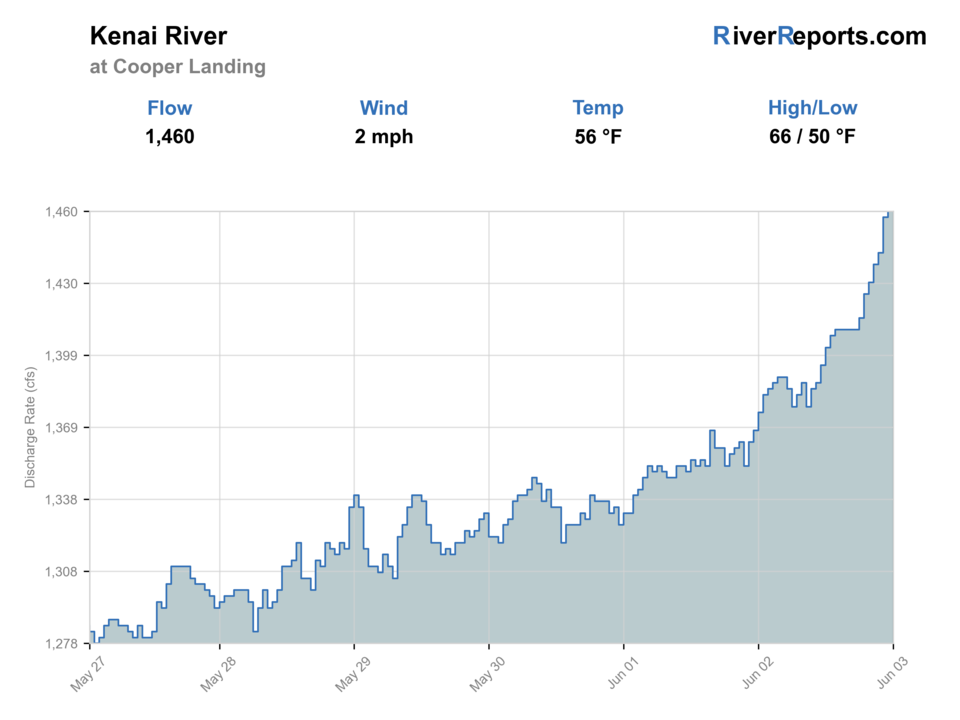
RiverReports gives the quick chart; USGS 15258000 is the official Cooper Landing flow source.
ADF&G identifies the Kenai as a major salmon, rainbow trout, and Dolly Varden system.
Do not promote king salmon targeting without checking current emergency orders.
Use developed access and bank protection; the river sees heavy angler and boat traffic.
Editorial review
How this report is maintained
This report uses official regulation, flow, weather, access, and public-source material first, then adds practical angler planning guidance without replacing current rules.
Byline
BlueStreamFly editorial desk
Reviewed by
BlueStreamFly source review
Maintained by
BlueStreamFly
Last material review
2026-05-25
Report confidence
Very high confidence
96/100
Very high confidence: official sources, live planning signals, and angler-use guidance are present for this report.
Regulations
Current rules are tied to an official regulation source.
Access
Access planning is backed by a public agency or access source.
Flow and weather
Flow guidance uses RiverReports or USGS support plus a forecast point.
Fishing usefulness
The page includes practical planning details beyond source summaries.
Source and access review
2026-05-25 / material content or source review
Official regulation, emergency-order, flow, weather, access, and image-license sources were checked before this report was published.
2026-05-25
Published a new river report with flow, weather, hatch, fly, tactics, access, regulation, source, image-credit, and angler-planning sections.
Angler planning edge
Local details that change the plan
Best for
Upper Kenai trout and Dolly Varden trips, Cooper Landing drift plans, Anglers who will check emergency orders first
Wade or float
The upper river is often best from a legal drift or developed bank plan. Wade conservatively and protect sensitive banks.
Best flows
Use the Cooper Landing gauge trend with actual color and boat traffic; stable water is easier to fish and safer to wade.
When to skip
Skip salmon-focused plans when emergency orders close or restrict the target fishery, or when crowding makes safe fishing unrealistic.
Local plan
Start early, verify rules, pick one access zone, and carry trout/char flies even if salmon timing is the reason for the trip.
Pressure
Expect pressure around salmon timing, Russian River access, and easy banks. Off-peak timing matters.
Access nuance
Upper Kenai management protects banks and habitat; use developed access and follow reach-specific boating rules.
Backup water
If the upper Kenai is crowded, check below-Skilak or Soldotna only after confirming their separate rules and access.
About the river
Setting, character, and why it fishes the way it does.
The Kenai begins at Kenai Lake near Cooper Landing and flows west toward Cook Inlet. ADF&G describes it as one of Alaska's best-known freshwater sport fisheries, with salmon, rainbow trout, and Dolly Varden/Arctic char opportunities.
The upper river is not the same plan as Soldotna or the below-Skilak reach. Cooper Landing puts anglers near clearer upper-river water, drift traffic, the Russian River orbit, and strict reach-specific management.
A useful upper Kenai plan is regulation-first: flow, emergency orders, boat rules, bank protection, and crowd timing should all be checked before choosing a fly box.
Target species
Rainbow trout
A key upper Kenai fly target; fish egg, flesh, sculpin, and nymph patterns with careful handling.
Dolly Varden / Arctic char
Often tied to salmon timing and softer edges; use conservative releases.
Sockeye, coho, pink, and king salmon
Managed by season and emergency order. Do not assume any salmon opportunity is open.
Reading the water
Stable upper-river flow
Best for drifting, reading soft seams, and managing bank or boat traffic.
Low clear water
Use lighter presentations and longer casts; fish can be pressured near obvious access.
High glacial flow
Avoid risky wading and fish from legal, protected banks or a qualified boat plan.
Cold water
Handle trout and char quickly and keep hands wet.
Best seasons
Late May to June
Best for early clear-water trout, grayling, and pre-runoff or settling-flow windows where the reach is legal.
July to August
Prime salmon-influenced planning on many Alaska rivers; check emergency orders before targeting salmon.
September
Good for trout, char, grayling, and coho where open; egg, flesh, streamer, and bead-style fly choices become more important.
October to winter
Cold, short-day fishing is specialized. Ice, access, and legal-season checks should drive the plan.
Preferred flow source
Kenai River at Cooper Landing
RiverReports is the preferred chart source when coverage exists. When a matching USGS gauge exists, keep it open as the official backstop for station data and current hydrograph context.
USGS data chart
Official USGS trend
Streamflow over the latest USGS reporting window.
Latest
1,460 cfs
Jun 3, 5 PM UTC
Weather
River weather report
Weather can change wading safety, road access, water temperature, hatches, and the best time of day to fish.
Live forecast loads as you reach this section
This keeps the report fast while still using the official National Weather Service forecast point.
Hatches and flies
Hatch chart and fly picks
Late spring
Midges, blackflies, small mayflies, early caddis
Midge pupa, Adams, mosquito, hare's ear, small caddis
Summer
Caddis, mayflies, mosquitoes, terrestrials
Elk hair caddis, foam attractor, parachute Adams, small streamer
Late summer
Salmon eggs, flesh, caddis, small mayflies
Legal egg pattern, flesh fly, caddis, sculpin, soft hackle
Fall
Midges, sparse olives, baitfish and flesh activity
Midge, olive emerger, flesh fly, leech, sculpin
Dry flies
Mosquito, elk hair caddis, Adams, caddis skater, small mayfly, foam attractor
Use for grayling, trout, and quiet edges when fish are looking up.
Nymphs
Pheasant tail, hare's ear, stonefly nymph, caddis pupa, midge, small bead-head nymph
Use when cold water or bright light keeps fish below the surface.
Streamers
Sculpin, flesh fly, egg-sucking leech, small clouser, black or olive bugger
Use for trout, char, and salmon-influenced water when flow and clarity are safe.
Egg and flesh patterns
Pegged bead where legal, glo bug, pale flesh, peach egg, veil egg
Use only where legal and match salmon timing without crowding spawning fish.
Tactics
How to fish it
Check emergency orders first, then choose a trout, char, or salmon-season plan.
Fish behind and beside salmon activity without disturbing spawning fish or violating snagging/gear rules.
Use sculpins and flesh when fish are hunting, and small nymphs when bright sun slows movement.
Move off the most obvious banks when crowds build; the first clean drift often matters.
Rigging
Rod, leader, and setup notes
A 6-weight is a practical upper Kenai trout and char rod; bring heavier gear only for legal salmon work.
Carry sink tips, floating line, beads where legal, flesh flies, sculpins, and small nymphs.
Use abrasion-resistant tippet around big fish, rocks, and boat traffic.
Respect hook, bait, and reach restrictions from current ADF&G rules.
Access
Access and planning notes
Cooper Landing / upper Kenai
Access checkWade / float / trail
Match to local conditions
When to pick it
Use developed access and current KRSMA guidance for bank protection and boating rules.
Caution
Confirm current rules, legal access, and water safety before committing.
Russian River orbit
Access checkWade / float / trail
Match to local conditions
When to pick it
A high-pressure planning area that needs current access, crowd, and emergency-order checks.
Caution
Confirm current rules, legal access, and water safety before committing.
Drift and boat access
Access checkWade / float / trail
Match to local conditions
When to pick it
Reach rules can differ, so match your craft and plan to current official guidance.
Caution
Confirm current rules, legal access, and water safety before committing.
Stay on legal access and protected bank infrastructure where provided.
Expect crowding during salmon timing and around developed access.
Give bears, salmon, and other anglers extra room.
Regulations
Check before fishing
Kenai River rules and emergency orders change often. Check ADF&G Southcentral regulations and emergency orders before targeting salmon, trout, or char.
Primary base
Cooper Landing
Best day style
High-use road, drift, and bank access with reach-specific boating rules
Check first
ADF&G Southcentral regulations, emergency orders, KRSMA rules, RiverReports, USGS 15258000, and NWS weather
Safety
Cold glacial water, crowding, boat traffic, bank protection rules, bears, and salmon closures
Gear
Helpful gear for this water
6-weight rod
A balanced choice for trout, char, beads, sculpins, and windy river conditions.
Polarized glasses
Essential for spotting fish, depth, and other anglers' lines.
Wading staff
Cold glacial water and slick rock make wading conservative.
Rain and bear kit
Weather and wildlife are part of normal Kenai planning.
Nearby water
Other water to research
Backup logic
Primary plan slips
Compare Kenai River at Soldotna, Kenai River below Skilak Lake, Situk River only after checking current rules, access, and safety.
Kenai River at Soldotna
A lower-river city-access and boat-traffic plan with different rules and flow.
Kenai River below Skilak Lake
A middle-river plan below Skilak with its own access and boating context.
Situk River
A coastal Yakutat steelhead, salmon, and Dolly Varden plan with very different logistics.
FAQ
Fast answers
Is Kenai River fishable today?
Kenai River looks very fishable right now. The live score is 96/100, based on current flow, weather, public alerts, and the report's planning context. Recheck the linked gauge and forecast before leaving because conditions can change quickly after rain, heat, access changes, or flow swings.
What flow is best for Kenai River?
Use the Cooper Landing gauge trend with actual color and boat traffic; stable water is easier to fish and safer to wade.
When should I skip Kenai River?
Skip salmon-focused plans when emergency orders close or restrict the target fishery, or when crowding makes safe fishing unrealistic.
Is Kenai River safe to wade right now?
The fishability score is not a wading guarantee. Wade only where your chosen access has safe edges, clear footing, legal entry, and no forced crossings; high, rising, stained, or storm-affected water should be treated conservatively.
Is this the same as the Soldotna Kenai report?
No. This page is for the upper Cooper Landing reach. Soldotna and below-Skilak water have different access, flow, and rule context.
Can I target king salmon on the Kenai?
Only if current ADF&G regulations and emergency orders allow it. This page does not assume king salmon opportunity is open.
What flies should I carry?
Bring sculpins, flesh flies, legal egg patterns or beads where allowed, nymphs, leeches, and a few dries for quiet trout or char water.
Sources
Source set for this report
Reviewed 2026-05-25