Alaska / Alaska
Kenai River at Soldotna
A lower Kenai report for Soldotna-area flow, boat and bank access, emergency-order checks, salmon-season pressure, trout and Dolly Varden tactics, weather, and source links.
Image: Generated regional planning image for Kenai River at Soldotna / BlueStreamFly generated; not exact location / BlueStreamFlyFishability now: Kenai River at Soldotna fishability today
GreatData confidence: High96/100
Fishable now because Soldotna gauge is stable, weather is mild, and no public alert is active.
Flow observed
5:00 PM UTC
Weather observed
5:00 PM UTC
Score calculated
5:26 PM UTC
Why this rating
Flow
Water temperature
Public alerts
Next 6-12 hours
Hold
Stable live data supports staying with the plan, but recheck the gauge and forecast before leaving.
USGS flow
3,240 cfs
Current trend: flow stable, so weather, temperature, and access checks drive the next change.
More planning details: flies, flow bands, and live source checks
Fish it today
Start here
Check rules, choose one access zone, arrive early, and keep a trout/char plan ready if salmon opportunity is poor.
Best flow clue
Stable flows make lower-river travel lanes easier to read; pair the gauge with boat traffic and clarity.
Skip trigger
Skip salmon-focused trips when emergency orders close or restrict the target fishery, or when crowds make clean fishing impossible.
Flow decision bands
Low but fishable
Lower, clear Soldotna water can still fish from developed access, but pressure and visibility make stealth and legal lanes important.
Best lower-river window
Stable lower Kenai flow with manageable boat traffic and clear emergency-order status is the best green light.
Pushy or unsafe
High or rising water makes bank platforms, boat control, and cold-water wading more serious.
Crowd or rule pressure
A legal salmon window can still be a poor fly plan if crowding prevents safe casts or clean releases.
USGS flow
3,240 cfs
Current trend: flow stable, so weather, temperature, and access checks drive the next change.
Live USGS flow
3,240 cfs / stable
Live NWS forecast
56F / Mostly Sunny
Live water temperature
47F from USGS
No NWS alert flag
No active NWS alert was returned for this forecast point.
Use RiverReports and USGS 15266300 for lower-river flow near Soldotna.
ADF&G and DNR sources should be checked before targeting salmon or choosing a boat plan.
Fish developed access carefully and expect pressure during sockeye and coho timing.
Trout and Dolly Varden tactics often depend on salmon timing but still require current rules.
Editorial review
How this report is maintained
This report uses official regulation, flow, weather, access, and public-source material first, then adds practical angler planning guidance without replacing current rules.
Byline
BlueStreamFly editorial desk
Reviewed by
BlueStreamFly source review
Maintained by
BlueStreamFly
Last material review
2026-05-31
Report confidence
High confidence
90/100
High confidence: RiverReports, USGS Soldotna flow, National Weather Service data, ADF&G Kenai information, KRSMA access material, and Alaska emergency-order sources support the report. Confidence is moderated by dynamic salmon orders, boat congestion, and developed-site rules.
Regulations
ADF&G Kenai information, statewide regulations, and emergency orders support the legal-check path.
Access
KRSMA and developed lower-river access context support planning, but bank-protection details and boat use still require current checks.
Flow and weather
RiverReports, USGS 15266300, and the National Weather Service point are attached to the route.
Fishing usefulness
The page now separates lower-river flow, crowds, salmon-rule checks, trout/char backups, and developed-access decisions.
Fishability dashboard and source review
2026-05-31 / material content or source review
Official regulation, emergency-order, flow, weather, access, safety, and fishability guidance sources were checked before updating the current-fishability decision layer.
2026-05-31
Updated to the current fishability-page standard with route-specific dashboard guidance, flow bands, access cards, backup cues, source timing, and confidence signals.
Angler planning edge
Local details that change the plan
Best for
Lower Kenai bank and boat planning, Salmon-season access checks, Trout and char backup plans
Wade or float
Use developed bank access or a legal boat plan. Wading is secondary to safe access and crowd management.
Best flows
Stable flows make lower-river travel lanes easier to read; pair the gauge with boat traffic and clarity.
When to skip
Skip salmon-focused trips when emergency orders close or restrict the target fishery, or when crowds make clean fishing impossible.
Local plan
Check rules, choose one access zone, arrive early, and keep a trout/char plan ready if salmon opportunity is poor.
Pressure
Soldotna pressure can be intense during salmon timing. Off-peak hours and secondary water matter.
Access nuance
The lower river has protected bank areas, developed access, and boat congestion. Follow official access guidance.
Backup water
If Soldotna is too crowded, compare the upper Kenai and below-Skilak reports before moving.
About the river
Setting, character, and why it fishes the way it does.
The Soldotna reach is lower, busier, and more developed than the Cooper Landing reach. It has city services, launch infrastructure, fish-count context, and intense seasonal pressure.
DNR's Kenai River Special Management Area material highlights heavy river use, boating, habitat protection, and access considerations. Those details matter as much as fly selection here.
A good Soldotna report should not read like a generic Kenai page. It needs lower-river access, boat traffic, bank protection, emergency-order, and crowd-management guidance.
Target species
Sockeye and coho salmon
Important seasonal targets only when current ADF&G rules and emergency orders allow the plan.
Rainbow trout
Often tied to salmon timing and softer seams; handle fish quickly and avoid redd disturbance.
Dolly Varden / Arctic char
A common fly target around salmon timing, softer edges, and legal access.
King salmon
High-risk regulation topic. Check current emergency orders before any king salmon assumption.
Reading the water
Stable lower-river flow
Best for bank platforms, boat control, and reading travel lanes.
High or pushy flow
Use developed access, avoid wading beyond your footing, and expect more boat-management challenges.
Low clear flow
Fish can be pressured and visible; lighten presentations and avoid crowding obvious runs.
Cold glacial water
Dress for immersion and keep fish handling short.
Best seasons
Late May to June
Best for early clear-water trout, grayling, and pre-runoff or settling-flow windows where the reach is legal.
July to August
Prime salmon-influenced planning on many Alaska rivers; check emergency orders before targeting salmon.
September
Good for trout, char, grayling, and coho where open; egg, flesh, streamer, and bead-style fly choices become more important.
October to winter
Cold, short-day fishing is specialized. Ice, access, and legal-season checks should drive the plan.
Preferred flow source
Kenai River at Soldotna
RiverReports is the preferred chart source when coverage exists. When a matching USGS gauge exists, keep it open as the official backstop for station data and current hydrograph context.
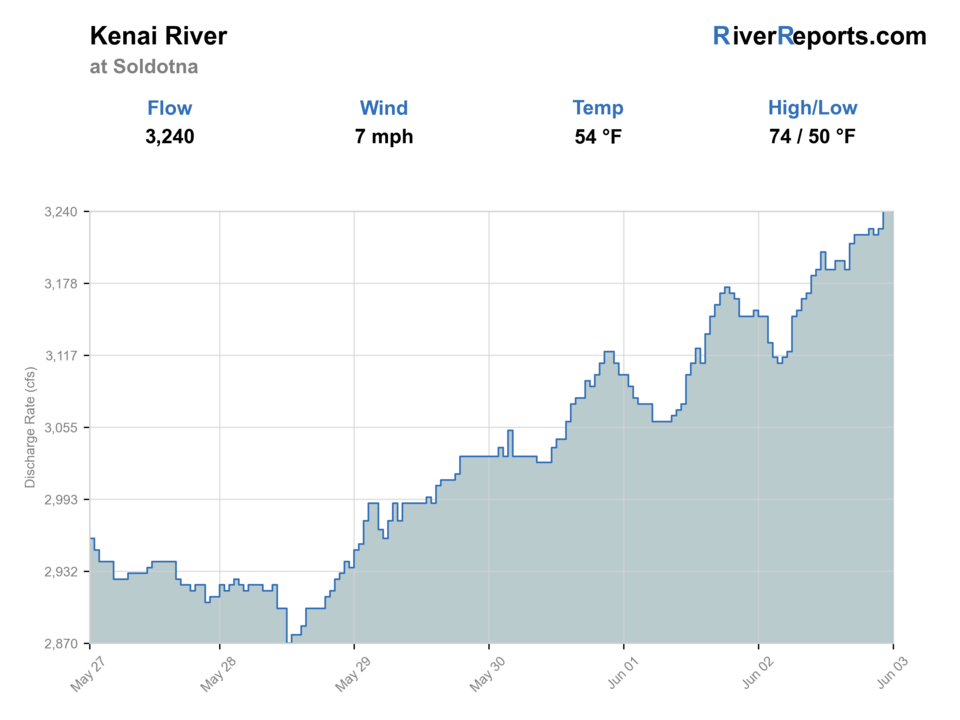
USGS data chart
Official USGS trend
Streamflow over the latest USGS reporting window.
Latest
3,240 cfs
Jun 3, 5 PM UTC
Weather
River weather report
Weather can change wading safety, road access, water temperature, hatches, and the best time of day to fish.
Live forecast loads as you reach this section
This keeps the report fast while still using the official National Weather Service forecast point.
Hatches and flies
Hatch chart and fly picks
Late spring
Midges, blackflies, small mayflies, early caddis
Midge pupa, Adams, mosquito, hare's ear, small caddis
Summer
Caddis, mayflies, mosquitoes, terrestrials
Elk hair caddis, foam attractor, parachute Adams, small streamer
Late summer
Salmon eggs, flesh, caddis, small mayflies
Legal egg pattern, flesh fly, caddis, sculpin, soft hackle
Fall
Midges, sparse olives, baitfish and flesh activity
Midge, olive emerger, flesh fly, leech, sculpin
Dry flies
Mosquito, elk hair caddis, Adams, caddis skater, small mayfly, foam attractor
Use for grayling, trout, and quiet edges when fish are looking up.
Nymphs
Pheasant tail, hare's ear, stonefly nymph, caddis pupa, midge, small bead-head nymph
Use when cold water or bright light keeps fish below the surface.
Streamers
Sculpin, flesh fly, egg-sucking leech, small clouser, black or olive bugger
Use for trout, char, and salmon-influenced water when flow and clarity are safe.
Egg and flesh patterns
Pegged bead where legal, glo bug, pale flesh, peach egg, veil egg
Use only where legal and match salmon timing without crowding spawning fish.
Tactics
How to fish it
Begin with ADF&G emergency orders, then decide whether salmon, trout, or char should be the focus.
Use legal bank platforms and access lanes rather than trampling sensitive banks.
Fish softer edges and travel lanes with sculpins, flesh, and legal egg patterns when salmon timing supports it.
Avoid joining crowded lines if you cannot make safe casts and clean releases.
Rigging
Rod, leader, and setup notes
A 6 or 7-weight covers most trout, char, and lighter salmon-season fly work where legal.
Carry sink tips, floating line, beads where legal, flesh, sculpins, and leaders built for abrasion.
Use current hook, bait, and tackle rules; they can differ by reach and date.
Bring rain layers and spare gloves for cold water and long bank waits.
Access
Access and planning notes
Soldotna developed access
Lower-river bank checkWade / float / trail
Bank / platform / city access
When to pick it
Start here when you want developed access and the Soldotna gauge to match the reach.
Caution
Protected banks and crowded public access require current site rules and restraint.
Morgan's Landing / Big Eddy area
Boat and bank planningWade / float / trail
Launch / bank / scout
When to pick it
Use this orbit when a lower-river boat or secondary bank plan is realistic.
Caution
Verify parking, launch rules, boat traffic, and current emergency orders.
Boat-access water
Spread-out lower riverWade / float / trail
Boat / guide / shuttle
When to pick it
Pick it when you have legal target species, safe flow, and a real boat plan.
Caution
Boat congestion and cold water can make a technically open day unfishable.
Do not assume an open parking spot means legal bank access.
Give boats, bank anglers, and fish-count equipment plenty of room.
Emergency orders can change the value of a trip overnight.
Regulations
Check before fishing
Check ADF&G Southcentral regulations and current emergency orders before fishing the Soldotna reach. Salmon regulations are especially dynamic and supersede printed summaries.
Primary base
Soldotna
Best day style
Developed lower-river parks, boat launches, bank platforms, and high-use salmon water
Check first
ADF&G emergency orders, Southcentral regulations, KRSMA access/boating rules, RiverReports, USGS 15266300, and NWS weather
Safety
Heavy boat traffic, cold water, bank rules, crowding, tidal/lower-river influence, and salmon closures
Gear
Helpful gear for this water
6 or 7-weight rod
Useful for lower-river wind, weighted flies, trout, char, and legal salmon-season work.
Wading staff
Use it only where wading is legal and safe; cold water is unforgiving.
Polarized glasses
Needed for travel lanes, depth, and crowded bank awareness.
Rain shell
Soldotna trips often involve long waits in changing weather.
Nearby water
Other water to research
Backup logic
High water
Stay on developed access, avoid unnecessary wading, or compare upper Kenai and below-Skilak conditions first.
Heat
Use cooler windows for trout and char, but let salmon rules and fish handling decide the final target.
Storms or turbidity
Recheck the gauge, forecast, and lower-river visibility before committing to bank or boat water.
Access issue
Move to another developed KRSMA or city access instead of improvising around protected banks.
Kenai River
Upper Cooper Landing water with a different flow and access pattern.
Kenai River below Skilak Lake
Middle-river context that separates the lake outlet from Soldotna.
Gulkana River
A remote float alternative if Kenai crowds are not the right fit.
FAQ
Fast answers
Is Kenai River at Soldotna fishable today?
Kenai River at Soldotna looks very fishable right now. The live score is 96/100, based on current flow, weather, public alerts, and the report's planning context. Recheck the linked gauge and forecast before leaving because conditions can change quickly after rain, heat, access changes, or flow swings.
What flow is best for Kenai River at Soldotna?
Stable flows make lower-river travel lanes easier to read; pair the gauge with boat traffic and clarity.
When should I skip Kenai River at Soldotna?
Skip salmon-focused trips when emergency orders close or restrict the target fishery, or when crowds make clean fishing impossible.
Is Kenai River at Soldotna safe to wade right now?
The fishability score is not a wading guarantee. Wade only where your chosen access has safe edges, clear footing, legal entry, and no forced crossings; high, rising, stained, or storm-affected water should be treated conservatively.
Is Soldotna different from the upper Kenai?
Yes. Soldotna is lower-river, more developed, and often more crowded. Use the Soldotna gauge and lower-river rules.
Should I check emergency orders before fishing?
Yes. Kenai salmon rules can change quickly, and emergency orders supersede printed regulations.
What flies work near Soldotna?
Sculpins, flesh flies, legal egg patterns, leeches, and nymphs are useful, but the right fly depends on season and current rules.
Sources
Source set for this report
Reviewed 2026-05-31