Alaska / Alaska
Gulkana River
A source-reviewed Gulkana River report for Richardson Highway access, BLM wild-and-scenic float planning, RiverReports flow, salmon rule checks, grayling, rainbow trout, flies, and weather.
Image: Generated regional planning image for Gulkana River / BlueStreamFly generated; not exact location / BlueStreamFlyFishability now: Gulkana River fishability today
GreatData confidence: High96/100
Fishable now because the live gauge is falling, weather is mild, and no public alert is active.
Flow observed
4:15 PM UTC
Weather observed
5:00 PM UTC
Score calculated
5:24 PM UTC
Why this rating
Flow
Water temperature
Public alerts
Next 6-12 hours
Improving / hold
A falling gauge and usable weather should keep the next 6-12 hours in play unless tributaries stain or heat builds.
USGS flow
4,690 cfs
Current trend: flow falling, rating likely holding strong unless weather or clarity changes.
More planning details: flies, flow bands, and live source checks
Fish it today
Start here
Pick either a short walk-in grayling/trout day or a fully planned float. Do not mix both without enough time.
Best flow clue
Stable flows that match your boat and wading skill are more important than a single ideal number.
Skip trigger
Skip during rising water, canyon uncertainty, unresolved access fees, wildfire/smoke issues, or unclear salmon regulations.
Flow decision bands
Low but fishable
Lower clear water can favor walk-in grayling and trout, but boats may scrape and fish can become selective.
Best float window
Stable Gulkana flow that matches your boat skill, shuttle, and chosen reach is the best planning signal.
Pushy or unsafe
High or rising water raises the cost of canyon, sweeper, and remote-camp mistakes; shorten the trip or wait.
Cold rain or salmon pressure
Bad weather and run timing can crowd access or change the legal target, so re-check rules before committing.
USGS flow
4,690 cfs
Current trend: flow falling, rating likely holding strong unless weather or clarity changes.
Live USGS flow
4,690 cfs / falling about 10%
Live NWS forecast
55F / Mostly Sunny
Live water temperature
47F from USGS
No NWS alert flag
No active NWS alert was returned for this forecast point.
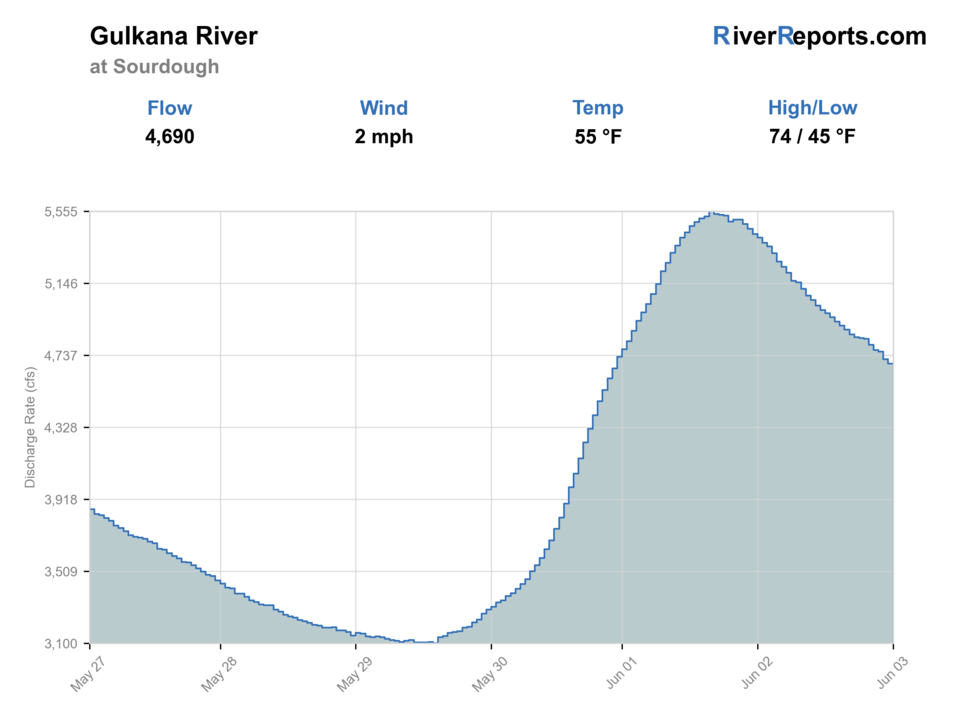
RiverReports gives a quick visual flow check with USGS 15200280 as the official source.
ADF&G lists Richardson Highway walk-in points and a longer Paxson-to-Sourdough float context.
BLM manages the Wild and Scenic River corridor and is the key source for float logistics.
Check emergency orders before any salmon plan; do not rely on last year's timing or limits.
Editorial review
How this report is maintained
This report uses official regulation, flow, weather, access, and public-source material first, then adds practical angler planning guidance without replacing current rules.
Byline
BlueStreamFly editorial desk
Reviewed by
BlueStreamFly source review
Maintained by
BlueStreamFly
Last material review
2026-05-31
Report confidence
High confidence
89/100
High confidence: RiverReports, USGS Gulkana flow, National Weather Service data, ADF&G fishery information, BLM Wild and Scenic River access material, and Alaska regulation/emergency-order sources support the report. Confidence is moderated by remote float logistics, fee/private-access notes, and fast salmon-rule changes.
Regulations
ADF&G Gulkana fishery material plus statewide regulations and emergency orders support species and legal checks.
Access
BLM Wild and Scenic River material and ADF&G access notes support float and walk-in planning, with remote logistics still requiring current checks.
Flow and weather
RiverReports, USGS 15200280, and the National Weather Service point are attached to the route.
Fishing usefulness
The page now separates walk-in versus float decisions, salmon-rule checks, canyon safety, and backup-water choices.
Fishability dashboard and source review
2026-05-31 / material content or source review
Official regulation, emergency-order, flow, weather, access, safety, and fishability guidance sources were checked before updating the current-fishability decision layer.
2026-05-31
Updated to the current fishability-page standard with route-specific dashboard guidance, flow bands, access cards, backup cues, source timing, and confidence signals.
Angler planning edge
Local details that change the plan
Best for
Alaska float anglers, Grayling and rainbow trout scouting, Salmon-season plans only after rule checks
Wade or float
Walk-in fishing is best near verified highway access. Floating opens more water but requires real boating skill and shuttle planning.
Best flows
Stable flows that match your boat and wading skill are more important than a single ideal number.
When to skip
Skip during rising water, canyon uncertainty, unresolved access fees, wildfire/smoke issues, or unclear salmon regulations.
Local plan
Pick either a short walk-in grayling/trout day or a fully planned float. Do not mix both without enough time.
Pressure
Salmon timing can concentrate people near easier access; trout and grayling plans often improve away from obvious stops.
Access nuance
Some access points can involve landowner fees. Use official source guidance and posted signs.
Backup water
If the Gulkana is too big or the float logistics are not ready, choose a simpler road-access grayling plan.
About the river
Setting, character, and why it fishes the way it does.
The Gulkana is an Alaska Wild and Scenic River with a mix of road access, wild float water, and salmon-season pressure. BLM describes the river as a sportfishing and multi-day float destination with challenging rapids in places.
ADF&G's Gulkana River fishing opportunity page lists Arctic grayling, king salmon, rainbow trout, and sockeye salmon as species context, while reminding anglers to check current regulations.
For fly anglers, this is not just a hatch-chart river. The useful plan is matching flow, access, season, species rules, and float skill before committing.
Target species
Arctic grayling
A realistic fly target in clearer, softer water and tributary-influenced reaches.
Rainbow trout
Present in the system; use conservative handling and watch water temperature in shallow summer edges.
Sockeye and king salmon
Seasonal and regulation-sensitive. Check ADF&G regulations and emergency orders before targeting salmon.
Reading the water
Stable floatable flow
Best for multi-day planning when rapids, camps, and takeouts match your skill.
Low clear flow
Better for walk-in grayling and trout tactics, but boats may scrape and fish can be spooky.
High or rising flow
Can make the canyon and sweepers serious; do not force a float because a salmon window is open.
Cold rain
Pack for exposure and be ready to change from dries to streamers or nymphs.
Best seasons
Late May to June
Best for early clear-water trout, grayling, and pre-runoff or settling-flow windows where the reach is legal.
July to August
Prime salmon-influenced planning on many Alaska rivers; check emergency orders before targeting salmon.
September
Good for trout, char, grayling, and coho where open; egg, flesh, streamer, and bead-style fly choices become more important.
October to winter
Cold, short-day fishing is specialized. Ice, access, and legal-season checks should drive the plan.
Preferred flow source
Gulkana River
RiverReports is the preferred chart source when coverage exists. When a matching USGS gauge exists, keep it open as the official backstop for station data and current hydrograph context.
USGS data chart
Official USGS trend
Streamflow over the latest USGS reporting window.
Latest
4,690 cfs
Jun 3, 4 PM UTC
Weather
River weather report
Weather can change wading safety, road access, water temperature, hatches, and the best time of day to fish.
Live forecast loads as you reach this section
This keeps the report fast while still using the official National Weather Service forecast point.
Hatches and flies
Hatch chart and fly picks
Late spring
Midges, blackflies, small mayflies, early caddis
Midge pupa, Adams, mosquito, hare's ear, small caddis
Summer
Caddis, mayflies, mosquitoes, terrestrials
Elk hair caddis, foam attractor, parachute Adams, small streamer
Late summer
Salmon eggs, flesh, caddis, small mayflies
Legal egg pattern, flesh fly, caddis, sculpin, soft hackle
Fall
Midges, sparse olives, baitfish and flesh activity
Midge, olive emerger, flesh fly, leech, sculpin
Dry flies
Mosquito, elk hair caddis, Adams, caddis skater, small mayfly, foam attractor
Use for grayling, trout, and quiet edges when fish are looking up.
Nymphs
Pheasant tail, hare's ear, stonefly nymph, caddis pupa, midge, small bead-head nymph
Use when cold water or bright light keeps fish below the surface.
Streamers
Sculpin, flesh fly, egg-sucking leech, small clouser, black or olive bugger
Use for trout, char, and salmon-influenced water when flow and clarity are safe.
Egg and flesh patterns
Pegged bead where legal, glo bug, pale flesh, peach egg, veil egg
Use only where legal and match salmon timing without crowding spawning fish.
Tactics
How to fish it
Choose a species after checking rules; a grayling/trout day and a salmon day are different trips.
For grayling, fish soft seams, side channels, and tailouts with small dries or bead-head nymphs.
For trout, work structure behind salmon only where legal and without disturbing spawning fish.
On floats, scout rapids and camps before fishing; the canyon is not the place to improvise.
Rigging
Rod, leader, and setup notes
A 5-weight covers grayling, trout, and most nymph/streamer work; salmon-specific fishing may require heavier tackle where legal.
Carry sink tips or weighted streamers only when water clarity supports a moving fly.
Pack extra leaders, repair gear, rain layers, and bear-aware food storage for multi-day floats.
Use legal terminal tackle and hook rules for the target species and area.
Access
Access and planning notes
Paxson Lake / upper river
Long-float stagingWade / float / trail
Float / shuttle
When to pick it
Use it for a fully planned multi-day float with confirmed shuttle and conditions.
Caution
Remote travel, rapids, bears, and weather make this a planning-heavy choice.
Sourdough Creek
BLM corridor anchorWade / float / trail
Campground / float access
When to pick it
Pick it when you want a shorter float reference or official corridor planning point.
Caution
Confirm current BLM conditions, fees, and site status before relying on it.
Richardson Highway points
Walk-in scoutingWade / float / trail
Roadside / walk-in
When to pick it
Use these for shorter grayling or trout checks when the bigger float is not the right plan.
Caution
Some access can involve private land or fees; follow posted signs.
Do not assume every road pullout is free public access; ADF&G notes some access points require fees to landowners.
Use the BLM float guide for trip length, rapids, and campsite planning.
Remote travel requires a shuttle, emergency plan, and weather margin.
Regulations
Check before fishing
Check the current Alaska Upper Copper/Upper Susitna regulations and emergency orders before fishing. Salmon opportunity can change quickly, and this report does not replace current rules.
Primary base
Glennallen, Paxson, or Sourdough Creek corridor
Best day style
Roadside walk-in points, multi-day float planning, and fee/private-access checks
Check first
ADF&G Upper Copper/Upper Susitna rules, emergency orders, BLM float guide, RiverReports, USGS 15200280, and NWS weather
Safety
Class II-III/IV float hazards, cold water, remote travel, private-fee access, bears, and fast salmon rule changes
Gear
Helpful gear for this water
5 or 6-weight rod
Covers grayling, trout, and most streamers; bring heavier gear only for legal salmon work.
Boat safety kit
Needed for cold water, remote floats, and canyon hazards.
Bear-aware storage
Keep food and fish handling clean in camp.
Satellite backup
Useful where road access, cell coverage, and weather are unreliable.
Nearby water
Other water to research
Backup logic
High water
Avoid the canyon and shift to verified walk-in water or a simpler road-access grayling plan.
Heat
Fish cooler windows and keep trout/grayling handling short instead of grinding shallow edges.
Storms or smoke
Check weather, fire/smoke, BLM notices, and emergency orders before starting a remote float.
Access issue
Use another verified BLM/ADF&G access point rather than assuming an unsigned pullout is available.
Chena River
A lighter grayling-focused Interior plan with road access near Fairbanks.
Talkeetna River
Another Alaska big-water plan where boat access and salmon rules matter.
Kenai River
A more developed Southcentral salmon, trout, and char system with heavy use.
FAQ
Fast answers
Is Gulkana River fishable today?
Gulkana River looks very fishable right now. The live score is 96/100, based on current flow, weather, public alerts, and the report's planning context. Recheck the linked gauge and forecast before leaving because conditions can change quickly after rain, heat, access changes, or flow swings.
What flow is best for Gulkana River?
Stable flows that match your boat and wading skill are more important than a single ideal number.
When should I skip Gulkana River?
Skip during rising water, canyon uncertainty, unresolved access fees, wildfire/smoke issues, or unclear salmon regulations.
Is Gulkana River safe to wade right now?
The fishability score is not a wading guarantee. Wade only where your chosen access has safe edges, clear footing, legal entry, and no forced crossings; high, rising, stained, or storm-affected water should be treated conservatively.
Is the Gulkana River a float or wade fishery?
Both are possible, but the full river is a float-planning project. Walk-in anglers should use verified highway access and check landowner fee notes.
What species should fly anglers target?
Grayling and rainbow trout are the safer general fly targets. Salmon require current ADF&G regulation and emergency-order checks.
Which flow should I use?
Use the RiverReports chart for a quick read and USGS 15200280 as the official Gulkana flow source.
Sources
Source set for this report
Reviewed 2026-05-31