West Virginia / Southeast
Cranberry River
A Cranberry River report focused on the Richwood and Forest Road 76 trout corridor, with live flow checks, public camp access, and high-country caution.
Image: Generated Monongahela planning image for Cranberry River / BlueStreamFly generated; not exact location / BlueStreamFlyFishability now: Cranberry River fishability today
GreatData confidence: High96/100
Fishable now because the live gauge is stable, weather is mild, and no public alert is active.
Flow observed
4:30 PM UTC
Weather observed
5:00 PM UTC
Score calculated
5:25 PM UTC
Why this rating
Flow
Water temperature
Public alerts
Next 6-12 hours
Hold
Stable live data supports staying with the plan, but recheck the gauge and forecast before leaving.
USGS flow
91 cfs
Current trend: flow stable, so weather, temperature, and access checks drive the next change.
More planning details: flies, flow bands, and live source checks
Fish it today
Start here
Pick a short stretch of the public corridor, fish it carefully, then move by road instead of crossing repeatedly.
Best flow clue
Best when the graph is level or falling gently and the river still shows pocket seams without forcing hard crossings.
Skip trigger
Skip high cold pushes, warm midsummer trout stress, and any day when mountain storms will trap you in a long wet corridor.
Flow decision bands
Stable or slowly falling Richwood flow
This is the best public-corridor trout signal when pockets, bends, and camp-area seams stay readable without forcing repeated crossings.
Fresh mountain rain bump
Wait for the graph to flatten and for color to clear before committing deep into Forest Road 76 or the riverside camps.
Low clear summer water
Fish early, stay stealthy, check temperature, and stop trout pressure when handling would be poor.
Fast cold push or unsafe crossings
A clear skip signal for long wading days and any plan that depends on hiking back after dark.
USGS flow
91 cfs
Current trend: flow stable, so weather, temperature, and access checks drive the next change.
Live USGS flow
91 cfs / stable
Live NWS forecast
67F / Sunny
Live water temperature
59F from USGS
No NWS alert flag
No active NWS alert was returned for this forecast point.
WVDNR's stream guide calls Cranberry one of the state's standout trout waters, which matches how many anglers use it during stocking and fall sessions.
The Forest Service confirms Cranberry Campground and the lower corridor receive heavy trout use, so access quality is good but pressure can be real.
The river is long enough to keep giving you options, but only if the gauge is stable and recent rain has not turned the crossings risky.
This is a trout day built around cool water and public corridor discipline, not around hoping a random turnout leads to better water.
Editorial review
How this report is maintained
This report starts with official regulation, access, flow, weather, and public-water sources, then adds practical planning guidance for fly anglers.
Byline
BlueStreamFly editorial desk
Reviewed by
BlueStreamFly source review
Maintained by
BlueStreamFly
Last material review
2026-06-03
Report confidence
Good confidence
89/100
Good confidence: RiverReports, USGS 03187500 near Richwood, West Virginia regulation and stocking sources, WVDNR river guidance, Monongahela National Forest campground and wilderness sources, weather data, and route-specific Cranberry guidance support the page. Confidence is moderated by remote mileage, campground pressure, storm-driven rises, exact road conditions, and summer trout temperature.
Regulations
West Virginia fishing regulations and trout stocking sources support current legal and timing checks.
Access
Monongahela National Forest campground and corridor sources support the public access framework, with road, campsite, and wilderness conditions still requiring current checks.
Flow and weather
RiverReports, USGS 03187500 near Richwood, and the National Weather Service point support live flow and weather decisions.
Fishing usefulness
The page now separates Richwood flow, Forest Road 76 access, campground pressure, remote-trip safety, rain skips, warm-water restraint, and West Virginia backup choices.
Fishability dashboard and source review
2026-06-03 / material content or source review
RiverReports, USGS 03187500 near Richwood, West Virginia regulations and trout stocking sources, WVDNR river guidance, Monongahela National Forest Cranberry Campground and wilderness sources, National Weather Service point data, and route-specific remote-corridor safety guidance were checked before updating the current-fishability decision layer.
2026-06-03
Updated Cranberry River to the current fishability-page standard with Richwood flow bands, Forest Road 76 and campground access cards, mountain-storm backup cues, stable fishability SEO, and confidence signals.
2026-05-27
Published a new Cranberry River page with lower-corridor trout access, Forest Service trip planning, and RiverReports plus USGS flow support.
Angler planning edge
Local details that change the plan
Best for
Public-corridor trout days, Camp-and-fish trips, Long cool-weather wading sessions
Wade or float
Wade it. The useful Cranberry plan is a sequence of public camp and roadside starts rather than a float.
Best flows
Best when the graph is level or falling gently and the river still shows pocket seams without forcing hard crossings.
When to skip
Skip high cold pushes, warm midsummer trout stress, and any day when mountain storms will trap you in a long wet corridor.
Local plan
Pick a short stretch of the public corridor, fish it carefully, then move by road instead of crossing repeatedly.
Pressure
The easy campground and roadside sections can get crowded during stocking and prime fall weekends, especially around daylight.
Access nuance
Public access is strong, but the better water is still earned by walking and by respecting how quickly weather changes the river.
Backup water
Move to a shorter, lower-risk trout option if corridor pressure, road conditions, or water level take the Cranberry out of play.
About the river
Setting, character, and why it fishes the way it does.
The Cranberry River runs through one of the most fish-focused public trout corridors in West Virginia. Forest Road 76, the river camps, and the lower campground structure are why this page is so specific about the section it covers.
The Forest Service campground page is unusually useful here because it admits what anglers already know: trout fishing drives heavy use in spring and again in the fall. That tells you both where the public value is and where pressure will concentrate.
This is a large enough trout stream to reward methodical moving, but still a mountain river that can punish bad weather timing. The right day feels expansive. The wrong day feels remote fast.
Target species
Rainbow trout
A consistent public-corridor target through the stocked stretches.
Brown trout
A realistic target in deeper runs and steadier fall water.
Brook trout
More relevant in colder upper tributary context and side-water influence than in every roadside mile.
Reading the water
Stable medium flow
The best blend of wading, nymphing, and pocket-water dry-dropper fishing.
Low clear summer flow
Fish early, stay stealthy, and protect trout when temperatures start climbing.
Fresh rain color
Worth waiting out if the trend is already falling, but not worth blind backcountry commitments.
High cold push
A skip signal for long wading and for any plan that depends on repeated crossings.
Best seasons
Spring
Prime stocked-trout period with the widest range of productive water if rain stays manageable.
Summer
Good early and late, but temperature and midday pressure matter more than in spring.
Fall
One of the strongest windows for cooler water, fewer campers, and all-day trout activity.
Winter
Possible for hardy anglers, but road conditions and icy wading narrow the useful range quickly.
Preferred flow source
CRANBERRY RIVER NEAR RICHWOOD, WV
RiverReports is the preferred chart source when coverage exists. When a matching USGS gauge exists, keep it open as the official backstop for station data and current hydrograph context.
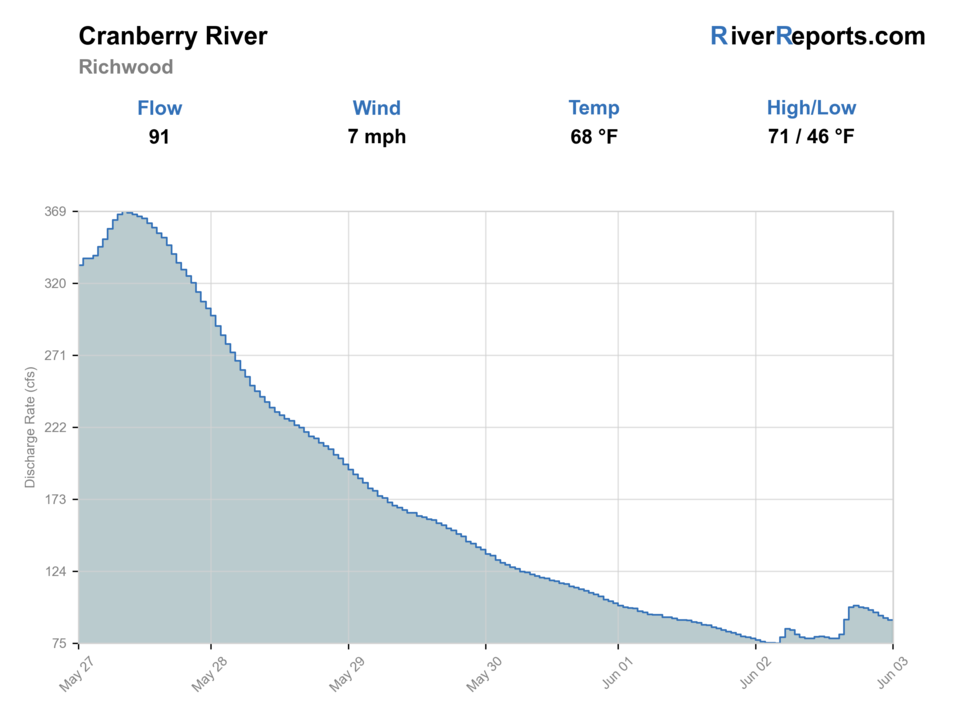
USGS data chart
Official USGS trend
Streamflow over the latest USGS reporting window.
Latest
91 cfs
Jun 3, 4 PM UTC
Weather
River weather report
Weather can change wading safety, road access, water temperature, hatches, and the best time of day to fish.
Live forecast loads as you reach this section
This keeps the report fast while still using the official National Weather Service forecast point.
Hatches and flies
Hatch chart and fly picks
March to April
Blue quills, early caddis, Quill Gordon windows, and cold-water nymphing
Quill Gordon, BWO emerger, caddis pupa, hare's ear, small stonefly nymph
May to June
March Browns, sulphurs, caddis, Light Cahills, and evening spinner falls
March Brown, sulphur emerger, elk hair caddis, Light Cahill, rusty spinner
July to September
Terrestrials, small olives, ants, beetles, and shaded attractor water
Foam ant, beetle, yellow stimulator, small BWO, unweighted nymph
October to February
Midges, BWOs, small stones, and short streamer windows
Zebra midge, BWO nymph, stonefly, olive bugger, soft hackle
Dry flies
Parachute Adams, elk hair caddis, sulphur, ant, beetle
Use on stable clear water when trout rise in seams, pocket tails, and soft banks.
Nymphs
Pheasant tail, hare's ear, perdigon, caddis pupa, zebra midge
The default choice whenever cold water, shade, or pushy current keeps trout down.
Small streamers
Olive bugger, black bugger, sculpin, leech, soft hackle
Best after safe rain bumps or when you need a larger target in deeper runs and plunge pools.
Tactics
How to fish it
Start with the obvious public pools and seams near campsites early, then work away from the busiest pull-ins once the corridor wakes up.
Dry-droppers cover a lot of Cranberry pocket water efficiently, but a single nymph often fishes better when the current is still cold and steady.
Use a small dark streamer on falling post-rain flow or in the deeper bends where the river slows just enough to hold larger fish.
Do not burn energy on unnecessary crossings. The river is long enough that smart bank choice beats bravado.
Rigging
Rod, leader, and setup notes
A 4- or 5-weight floating-line setup covers nearly every public-corridor Cranberry scenario.
Carry 4X to 6X, compact indicators, and a few split-shot sizes because the river changes from pockety to smooth quickly.
A chest pack, rain layer, and extra water fit the reality of long forest-road sessions better than a heavy vest.
Keep a thermometer handy for summer afternoons and shoulder-season campground days.
Access
Access and planning notes
Cranberry Campground
Primary public trout anchorWade / float / trail
Forest Service campground / bank / wade
When to pick it
Start here when the Richwood trend, weather, and current campground conditions support a controlled corridor session.
Caution
Campground access can mean pressure, and it does not make every crossing safe.
Forest Road 76 riverside camps
Longer public-corridor coverageWade / float / trail
Roadside camps / bank / wade
When to pick it
Use it when flow is stable and you want to spread out through multiple legal starts.
Caution
Remote mileage, weather, and exit timing matter more the farther you go.
Lower Richwood approach pull-ins
Quick water and safety checkWade / float / trail
Roadside scout / short wade
When to pick it
Pick this first if you need a fast read on color, speed, and crowding before driving deeper.
Caution
Do not expand from easy pull-ins into unclear private or unsafe water.
The public corridor is an advantage, but it also means campground pressure and roadside competition during prime stocking windows.
Longer days are common here, so plan food, fuel, weather, and the drive home before you wade the first run.
Do not confuse the lower roadside corridor with the different travel demands of the Cranberry Wilderness side of the basin.
Regulations
Check before fishing
Check current West Virginia regulations and special Cranberry River fishing areas before you fish. Public corridor access is strong, but legal limits and managed sections still drive the correct plan.
Primary base
Richwood, Cranberry Campground, and the lower Forest Road 76 river corridor
Best day style
Forest-road trout access, riverside camp pull-ins, and long wading days built around one corridor
Check first
West Virginia regulations, trout stocking updates, the 03187500 trend, Forest Service corridor conditions, and current weather before heading into the mountains
Safety
Remote mileage, cold water, rain-driven rises, limited services, and overestimating what you can hike back after dark
Gear
Helpful gear for this water
4- or 5-weight rod
A balanced choice for dries, nymphs, and the small streamers these rivers reward.
Thermometer
Use it before handling trout in summer and after warm rainy nights.
Wading staff
Mountain cobble, algae, and pushy crossings can look easier from shore than they feel midstream.
Rain shell
Mountain weather swings can turn a good trout day into a dangerous one quickly.
Nearby water
Other water to research
Backup logic
High or stained after rain
Compare Greenbrier West Fork, Elk River, or Second Creek instead of forcing a remote corridor.
Warm trout water
Fish only a short cool window or stop trout pressure.
Campground pressure
Move along confirmed public corridor starts or fish first light rather than crowding obvious pools.
Road, weather, or exit uncertainty
Shorten the day to a lower access check or switch to a less remote West Virginia trout option.
Greenbrier River West Fork
A smaller mountain trout option when you want a tighter wading focus.
Elk River
A larger West Virginia trout plan with a different access rhythm.
Second Creek
A shorter special-regulation trout plan if you need a less remote backup.
FAQ
Fast answers
Is Cranberry River fishable today?
Cranberry River looks very fishable right now. The live score is 96/100, based on current flow, weather, public alerts, and the report's planning context. Recheck the linked gauge and forecast before leaving because conditions can change quickly after rain, heat, access changes, or flow swings.
What flow is best for Cranberry River?
Best when the graph is level or falling gently and the river still shows pocket seams without forcing hard crossings.
When should I skip Cranberry River?
Skip high cold pushes, warm midsummer trout stress, and any day when mountain storms will trap you in a long wet corridor.
Is Cranberry River safe to wade right now?
The fishability score is not a wading guarantee. Wade only where your chosen access has safe edges, clear footing, legal entry, and no forced crossings; high, rising, stained, or storm-affected water should be treated conservatively.
What should I check before fishing the Cranberry River?
Check West Virginia regulations and trout updates first, then compare RiverReports with USGS 03187500 and confirm Forest Service corridor conditions before you commit to the mountain drive.
Where should I start on the Cranberry River?
Start in the lower Forest Road 76 corridor around Cranberry Campground or the numbered riverside campsites, where public access is clearest and the fishing plan is easiest to control.
Can I wade the Cranberry River all day?
Yes on stable moderate flow, but it is still a mountain river. Save energy, limit unnecessary crossings, and keep an exit plan if weather changes.
When should I skip the Cranberry River?
Skip it when heavy rain is still moving water, when the corridor is carrying unsafe push, or when warm summer temperatures make trout handling a poor call.
Sources
Source set for this report
Reviewed 2026-06-03