
Pennsylvania / Northeast
Tionesta Creek
A northwestern Pennsylvania report for the stocked Tionesta Creek main stem around Lynch, Mayburg, Kelletville, and the lower Tionesta mouth corridor, built from PFBC, USGS, weather, and public-access sources.
Image: Generated regional planning image for Tionesta Creek / BlueStreamFly generated; not exact location / BlueStreamFlyFishability now: Tionesta Creek fishability today
GreatData confidence: High96/100
Fishable now because Lynch gauge is falling, weather is usable, and no public alert is active.
Flow observed
5:00 PM UTC
Weather observed
5:00 PM UTC
Score calculated
5:26 PM UTC
Why this rating
Flow
Water temperature
Public alerts
Next 6-12 hours
Improving / hold
A falling gauge and usable weather should keep the next 6-12 hours in play unless tributaries stain or heat builds.
USGS flow
184 cfs
Current trend: flow falling, rating likely holding strong unless weather or clarity changes.
More planning details: flies, flow bands, and live source checks
Fish it today
Start here
Pick one PFBC section or Tionesta Access before rigging instead of trying to cover the whole creek at once.
Best flow clue
Use the Lynch trend as the first filter. Stable or gently falling water with enough clarity is the best starting window.
Skip trigger
Skip or shorten the trip when rain stains the creek, crossings feel pushy, trout water is warm, or lower-creek launch and exit details are unclear.
Flow decision bands
Stable main-stem flow
Stable or gently falling Lynch flow with enough clarity is the best signal for stocked upper and middle seams.
Best section-driven window
Cool nights, readable edge water, and one selected PFBC section make Tionesta most fishable.
High, stained, or boat-margin water
Rain color, pushy crossings, or lower-creek flow that feels like a boat-control problem should shorten the plan or move it elsewhere.
Warm or low
Late-spring and summer warmth can make stocked-trout sections a short early-window call or a reason to choose colder backup water.
USGS flow
184 cfs
Current trend: flow falling, rating likely holding strong unless weather or clarity changes.
Live USGS flow
184 cfs / falling about 20%
Live NWS forecast
76F / Sunny
Live water temperature
65F from USGS
No NWS alert flag
No active NWS alert was returned for this forecast point.
PFBC lists multiple stocked Tionesta Creek sections, including Mayburg Bridge to Kelletville Bridge and a lower dam-breast-to-mouth section that is open year-round under the stocked-trout-waters designation.
Use RiverReports for the quick chart and keep USGS site 03017500 at Lynch open as the named official creek location tied to the RiverReports page.
The lower Tionesta Access is a formal PFBC boat access with free parking, which makes it the cleanest public launch or lower-creek checkpoint on the page.
This report stays focused on main-stem Tionesta Creek. Nearby West Branch and East Branch trout water can be useful backups, but they need their own reach decisions and public-land checks.
Editorial review
How this report is maintained
This report starts with official regulation, access, flow, weather, and public-land sources, then adds practical planning guidance for fly anglers.
Byline
BlueStreamFly editorial desk
Reviewed by
BlueStreamFly source review
Maintained by
BlueStreamFly
Last material review
2026-06-02
Report confidence
Good confidence
87/100
Good confidence: RiverReports, USGS Lynch flow, Pennsylvania regulation and PFBC stocking-section sources, Tionesta Access, Allegheny National Forest context, weather coverage, image disclosure, and route-specific big-creek guidance support the page. Confidence is moderated by large-creek reach variation, bridge-access uncertainty, warm-water timing, and lower-creek float margin.
Regulations
Pennsylvania regulations and PFBC trout-stocking section data support the current rule and stocked-water check path.
Access
PFBC Tionesta Access and named section endpoints support public planning, with unmarked pull-offs and forest-road assumptions still needing field confirmation.
Flow and weather
RiverReports coverage is backed by USGS 03017500 at Lynch, and the National Weather Service point supports storm and weather decisions.
Fishing usefulness
The page now separates section choice, stocked trout timing, lower-creek launch decisions, warm-water restraint, access caution, and backup-water choices.
Fishability dashboard and source review
2026-06-02 / material content or source review
RiverReports, USGS 03017500 at Lynch, Pennsylvania regulations, PFBC trout-stocking section data, PFBC Tionesta Access, Allegheny National Forest access context, image-disclosure, and National Weather Service sources were checked before updating the current-fishability decision layer.
2026-06-02
Updated Tionesta Creek to the current fishability-page standard with Lynch big-creek trend bands, PFBC section access cards, backup cues, stable fishability SEO, and confidence signals.
2026-05-27
Published a new Tionesta Creek report with PFBC section planning, lower-access guidance, and big-creek safety notes.
Angler planning edge
Local details that change the plan
Best for
Stocked trout section checks, big-creek nymphing, mixed wade or lower-river scouting
Wade or float
Wade selected public sections when flow is readable; lower water can become more of a bank, launch, or float-style decision.
Best flows
Use the Lynch trend as the first filter. Stable or gently falling water with enough clarity is the best starting window.
When to skip
Skip or shorten the trip when rain stains the creek, crossings feel pushy, trout water is warm, or lower-creek launch and exit details are unclear.
Local plan
Pick one PFBC section or Tionesta Access before rigging instead of trying to cover the whole creek at once.
Pressure
Stocked sections and bridge water get concentrated pressure after stocking or good weather.
Access nuance
Named PFBC access and section endpoints are the safest public planning anchors; do not assume every forest road or pull-off is legal.
Backup water
Compare Kettle Creek, Pine Creek, or smaller colder tributaries when Tionesta is stained, warm, or too large to wade confidently.
About the river
Setting, character, and why it fishes the way it does.
Tionesta Creek is not a tiny brook-trout puzzle. It is a larger Pennsylvania creek that rewards anglers who think in sections, bridges, and current speed instead of trying to sample every turnout in one afternoon.
PFBC's own stocking layout makes that clear. The agency breaks the creek into named sections such as the Mayburg-to-Kelletville water and the lower dam-breast-to-mouth water, which is a better planning frame than treating Tionesta as one seamless trout report.
The public-access story is strongest where PFBC gives you specific section endpoints and where the water trail gives you a formal launch. That is why this page centers on the Lynch flow read, the SR 666 bridge corridor, and the lower Tionesta access instead of making broad unsupported claims about every roadside pull-off.
Target species
Brown trout
A realistic target in the stocked upper and middle main-stem sections, especially when flow is modest and the deeper outside bends stay cool.
Rainbow trout
Part of the stocked-trout mix on the PFBC sections and often the fish that keeps a stable-flow day from turning into a pure streamer grind.
Golden rainbow trout
PFBC lists golden-rainbow stockings in the main-stem Mayburg and Kelletville sections, so expect some put-and-take opportunity rather than a purely wild-trout profile.
Warmwater fish
The lower creek and mouth corridor can shift toward a mixed-fish day when water warms, especially closer to the reservoir and Allegheny confluence.
Reading the water
Stable moderate flow
Best for covering seam edges, bucket water below boulders, and outside bends with nymphs, wets, or compact streamers.
Low and clear
Fish early, use longer leaders, and work the softer edges first. Tionesta gets harder fast when trout can see you from the first bridge pool.
High or stained
Treat it like a soft-edge and bank-water day, or skip it. This creek gets too wide and pushy to force casual crossings once color and volume rise together.
Warm late-spring or summer afternoons
Carry a thermometer and be ready to shorten the upper-trout plan or move to a colder backup instead of stressing stocked fish in slow warm water.
Best seasons
Early spring
Good for stocked-trout timing, cool water, and light nymph or streamer work before summer warmth complicates the day.
Late spring
A strong all-around window when stockings, modest flow, and cool nights line up and you still have enough water to fish larger seams confidently.
Fall
Often the better big-creek planning window if flow settles and trout water cools back into a safer handling zone.
Winter
Possible in the lower year-round section, but keep the day short and choose only the safest footing and weather windows.
Preferred flow source
Tionesta Creek at Lynch
RiverReports is the preferred chart source when coverage exists. When a matching USGS gauge exists, keep it open as the official backstop for station data and current hydrograph context.
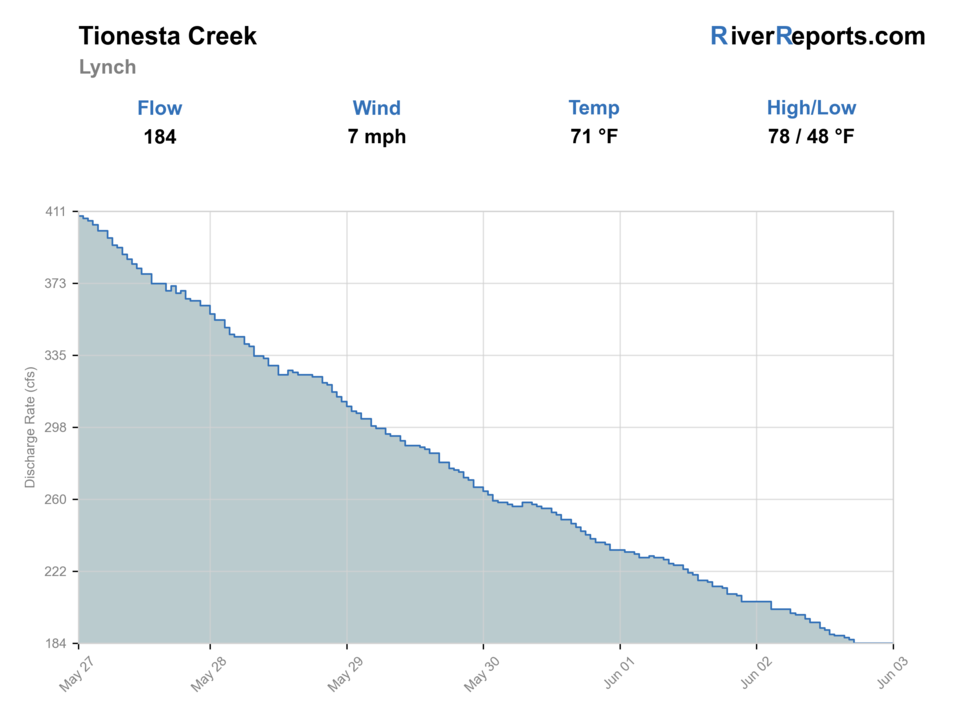
USGS data chart
Official USGS trend
Streamflow over the latest USGS reporting window.
Latest
184 cfs
Jun 3, 5 PM UTC
Weather
River weather report
Weather can change wading safety, road access, water temperature, hatches, and the best time of day to fish.
Live forecast loads as you reach this section
This keeps the report fast while still using the official National Weather Service forecast point.
Hatches and flies
Hatch chart and fly picks
March to April
Midges, little black stones, and early blue-winged olives
Zebra midge, black stonefly, small olive nymph, BWO emerger
April to May
Caddis, Hendricksons, March Browns, and mixed mayflies
Parachute Adams, elk hair caddis, March Brown, pheasant tail
June to July
Caddis, sulfurs in the right windows, and terrestrials starting to matter
Sulfur comparadun, yellow stimulator, caddis pupa, foam ant
Late summer to fall
Terrestrials, BWOs, and streamer windows on broken weather
Foam beetle, ant, RS2, olive bugger, black bugger
Core nymphs
Pheasant tail, hare's ear, prince, zebra midge, caddis pupa
Use as the default big-creek search rig when you need depth and control through mixed-speed seams.
Dry-dropper
Parachute Adams, stimulator, elk hair caddis, foam ant with a small nymph
Best on the calmer edges and shallower runs when flow is readable and trout are willing to move up.
Soft hackles and wets
Partridge and orange, soft-hackle pheasant tail, caddis soft hackle
Useful in broad riffles and transition water where Tionesta fish can be spread across more width than a pocket creek.
Streamers
Olive bugger, black bugger, sculpin-style streamer
A better call when the creek has color, when you want to cover the deepest bends, or when warmwater influence grows downstream.
Tactics
How to fish it
Pick one official section and fish it thoroughly instead of driving bridge to bridge every hour.
In the upper and middle stocked sections, start on the inside seam and tailout before stepping into the main run.
If the creek is wide but gentle enough to read, fish across-current angle changes instead of adding more weight to force the center slot.
The lower dam-to-mouth water can justify a float or at least a launch-oriented scouting day when wading space shrinks and the creek acts more like mixed big water than classic bridge-pool trout water.
When water warms, stop thinking only about trout numbers and start thinking about fish handling, time of day, and whether a cooler backup would be the better use of the trip.
Rigging
Rod, leader, and setup notes
A 4- to 6-weight covers most Tionesta Creek work, with the 6-weight making streamer and lower-creek mixed-water decisions easier.
Start with 4X or 5X on nymphs and dries, then go stronger only when flow or streamer size actually demands it.
Use enough split shot or tungsten to touch the slower seam, not to dredge every drift through the boulder line.
Carry a wading staff if you plan to fish above ankle depth. Big-creek footing and slick banks matter more here than on a tiny stocked run.
Access
Access and planning notes
Lynch gauge
Primary big-creek trendWade / float / trail
RiverReports / USGS gauge / wade
When to pick it
Start here when flow speed, recent rain, and wading margin decide the day.
Caution
The gauge does not identify every legal pull-off or make lower-creek depth safe.
Mayburg to Kelletville section
Upper-middle trout planWade / float / trail
Stocked-trout water / wade
When to pick it
Use this when current PFBC section details, cool water, and stable flow line up.
Caution
Bridge access and stocking pressure can compress anglers into the obvious water.
Tionesta Access and lower section
Lower public anchorWade / float / trail
PFBC access / bank / possible float
When to pick it
Pick this when the lower dam-to-mouth water or launch context fits the day.
Caution
Lower Tionesta can behave like larger moving water, so launch and exit checks matter.
Use PFBC section names and the Tionesta Access site as the public planning anchors first.
The main stem is larger than it looks on a map, so many days are better as a disciplined bridge-to-bridge wade than a wandering roadside session.
The lower creek makes more sense as a launch-oriented or bank-selective day once flow rises or the channel spreads out.
When you branch into nearby national-forest or park water, treat it as a separate access and regulation check instead of assuming the main-stem report covers it.
Regulations
Check before fishing
Recheck current Pennsylvania Fish & Boat Commission regulations and the trout-stocking section details before fishing. The stocked sections, permit requirements, and year-round lower-water rules matter more here than generic statewide assumptions.
Primary base
Lynch, Kelletville, Marienville, or Tionesta depending on the section you want to fish
Best day style
Section-driven wade day with a possible lower-creek launch or float plan
Check first
RiverReports, USGS 03017500, PFBC regulations and stocking sections, the Tionesta Access page, and NWS weather
Safety
Pushy crossings, warming trout water, big-creek depth changes, bridge traffic, and weak margins after rain
Gear
Helpful gear for this water
4- to 6-weight rod
A better fit than an ultralight setup once current width and streamer use start to matter.
Thermometer
Important from late spring through early fall so the upper stocked-trout sections stay a responsible choice.
Wading staff
Useful on any day when the creek looks just a little bigger than your first impression from the bridge.
Compact streamer box
Helps on stained water, lower-creek mixed-fish swings, and fall weather changes.
PFD for float days
The lower creek is safer when treated like real moving water, not an afterthought to a trout wade.
Nearby water
Other water to research
Backup logic
High or stained water
Compare Kettle Creek, Pine Creek, or a smaller colder tributary before forcing Tionesta.
Warm trout water
Fish only the coolest responsible window or pivot to mixed warmwater expectations.
Weak public access plan
Stay with named PFBC sections or Tionesta Access instead of guessing at pull-offs.
Lower-creek float uncertainty
Skip the float-style plan unless flow, launch, takeout, and PFD margin are all clear.
Kettle Creek
Another north-central Pennsylvania option when you want a more classic freestone trout layout and tighter reach choices.
Pine Creek
A larger Pennsylvania corridor when you want more mapped public structure and a clearer destination-style trout trip.
West Branch Tionesta Creek
A colder nearby backup with state-park and national-forest context, but it needs its own reach-specific access and rule check.
FAQ
Fast answers
Is Tionesta Creek fishable today?
Tionesta Creek looks very fishable right now. The live score is 96/100, based on current flow, weather, public alerts, and the report's planning context. Recheck the linked gauge and forecast before leaving because conditions can change quickly after rain, heat, access changes, or flow swings.
What flow is best for Tionesta Creek?
Use the Lynch trend as the first filter. Stable or gently falling water with enough clarity is the best starting window.
When should I skip Tionesta Creek?
Skip or shorten the trip when rain stains the creek, crossings feel pushy, trout water is warm, or lower-creek launch and exit details are unclear.
Is Tionesta Creek safe to wade right now?
The fishability score is not a wading guarantee. Wade only where your chosen access has safe edges, clear footing, legal entry, and no forced crossings; high, rising, stained, or storm-affected water should be treated conservatively.
What flow should I check for Tionesta Creek?
Use RiverReports for the quick chart and keep the USGS Lynch site open as the named creek reference paired with that chart.
Is Tionesta Creek a wade fishery or a float fishery?
Mostly a section-by-section wade plan in the upper and middle stocked water, with a better case for floating or launch-based scouting in the lower dam-to-mouth section.
Where should I start on Tionesta Creek?
Start by choosing one official section. The Mayburg-to-Kelletville trout water is the clearest upper-middle section, while Tionesta Access is the cleanest lower public anchor.
Sources
Source set for this report
Reviewed 2026-06-02