
Oregon / West
Sandy River
A Sandy River report for lower and middle Oregon planning, with Bull Run flows, hatchery and park access, steelhead timing, Chinook context, glacial-color cautions, and weather.
Image: Generated regional planning image for Sandy River / BlueStreamFly generated; not exact location / BlueStreamFlyFishability now: Sandy River fishability today
GreatData confidence: High96/100
Fishable now because the live gauge is stable, weather is mild, and no public alert is active.
Flow observed
2:45 PM UTC
Weather observed
3:00 PM UTC
Score calculated
3:22 PM UTC
Why this rating
Flow
Water temperature
Public alerts
Next 6-12 hours
Hold
Stable live data supports staying with the plan, but recheck the gauge and forecast before leaving.
USGS flow
1,000 cfs
Current trend: flow stable, so weather, temperature, and access checks drive the next change.
More planning details: flies, flow bands, and live source checks
Fish it today
Start here
Base near Troutdale or Sandy, check the gauge before daylight, then commit to either the hatchery corridor or one park-access zone and fish it carefully.
Best flow clue
Green dropping water with enough current to move fish but not so much push that every seam becomes a dangerous crossing problem.
Skip trigger
Skip it when the Sandy is rising, fully dirty, or so crowded around obvious access that you start making rushed casting or wading decisions.
Flow decision bands
Green, stable or dropping flow
This is the best Sandy signal for swing lanes, nymphing seams, and safe edge-based steelhead fishing.
Rising, dirty, or glacial-heavy
A rising trend, poor visibility, or heavy color should move the plan to waiting or a different river.
Low clear pressured water
Fish smaller presentations, quieter approaches, and low-light windows around obvious public access.
Park, hatchery, or crowd issue
Access status, ODFW updates, and crowded banks can weaken the day even when the gauge is workable.
USGS flow
1,000 cfs
Current trend: flow stable, so weather, temperature, and access checks drive the next change.
Live USGS flow
1,000 cfs / stable
Live NWS forecast
58F / Mostly Cloudy
Live water temperature
60F from USGS
No NWS alert flag
No active NWS alert was returned for this forecast point.
ODFW's latest Willamette Zone report says anglers are finding success from the hatchery downstream and that summer steelhead can be found throughout the system.
Glacial tint, rain bumps, and park conditions can change the fishability of the Sandy faster than the map suggests.
This route is scoped to the lower and middle Sandy anglers actually fish on day trips, not every upper tributary or closed water edge.
Wading is possible, but the smartest days stay bank-focused and current-aware instead of chasing mid-river hero crossings.
Editorial review
How this report is maintained
This report starts with official regulation, access, flow, weather, and public-land sources, then adds practical planning guidance for fly anglers.
Byline
BlueStreamFly editorial desk
Reviewed by
BlueStreamFly source review
Maintained by
BlueStreamFly
Last material review
2026-06-02
Report confidence
High confidence
90/100
High confidence: RiverReports, USGS 14142500 below Bull Run River, ODFW Willamette Zone and steelhead sources, Sandy Hatchery access, Metro Oxbow access, weather data, and route-specific Sandy steelhead guidance support the page. Confidence is moderated by glacial color, storm response, park status, crowding, and fish-timing variability.
Regulations
ODFW Willamette Zone, steelhead, and current recreation-report sources support rule and timing checks.
Access
ODFW Sandy Hatchery and Metro Oxbow sources support public access planning, while park status and crowding remain current checks.
Flow and weather
RiverReports, USGS 14142500 below Bull Run River, and the National Weather Service point support live flow and weather decisions.
Fishing usefulness
The page now separates Bull Run flow, glacial color, hatchery and Oxbow access, low-clear pressure, storm skips, and steelhead backup choices.
Fishability dashboard and source review
2026-06-02 / material content or source review
RiverReports, USGS 14142500 below Bull Run River, ODFW Willamette Zone reports and steelhead sources, Sandy Hatchery access information, Metro Oxbow Regional Park information, National Weather Service point data, and lower-river steelhead planning sources were checked before updating the current-fishability decision layer.
2026-06-02
Added the current-fishability dashboard with Bull Run flow bands, hatchery and Oxbow access cards, glacial-color backup cues, stable fishability SEO, and confidence signals.
2026-05-26
Published a new Sandy River report focused on lower- and middle-river steelhead planning, hatchery and park access, glacial-color risk, and safer day-trip decision making.
Angler planning edge
Local details that change the plan
Best for
Close-to-Portland steelhead days, Short edge-based wades, Gauge-driven lower-river decisions
Wade or float
Mostly a wade-and-bank river for this route. Drift support exists in the broader system, but most visiting fly anglers get cleaner results by fishing chosen public edges instead of forcing a float plan.
Best flows
Green dropping water with enough current to move fish but not so much push that every seam becomes a dangerous crossing problem.
When to skip
Skip it when the Sandy is rising, fully dirty, or so crowded around obvious access that you start making rushed casting or wading decisions.
Local plan
Base near Troutdale or Sandy, check the gauge before daylight, then commit to either the hatchery corridor or one park-access zone and fish it carefully.
Pressure
Because the Sandy is close to Portland, the obvious pull-offs and park entries get seen fast. First-light timing and a willingness to walk a little usually matter more than secret flies.
Access nuance
Official public access is one of the Sandy's strengths, but the best-known access points also attract the most anglers, so a legal quiet edge can beat the famous pool.
Backup water
The Crooked, McKenzie, or even a Deschutes plan can be better when the Sandy is blown out, heavily pressured, or carrying too much glacial color to read cleanly.
About the river
Setting, character, and why it fishes the way it does.
The Sandy is one of Oregon's classic close-to-town steelhead rivers, but it still behaves like a mountain river carrying glacial influence and storm response from Mount Hood country. That makes it appealing and humbling at the same time.
For this page, the report stays centered on the lower and middle river anglers actually check after work or on a weekend: the hatchery corridor, Oxbow-area access, and the lower system below Bull Run. That keeps the flow source, access notes, and species expectations aligned.
ODFW uses the Sandy for hatchery, steelhead, Chinook, and visitor-access context, while Metro's Oxbow information is a practical reminder that park conditions and river safety can be part of the go-or-no-go decision. The river is most useful when you plan around both.
Target species
Summer steelhead
The main fly-fishing draw once fish are spread through the system and flows settle into shape.
Winter steelhead
A meaningful seasonal target later in the cycle when the river has fish and conditions support safe access.
Spring Chinook
Present in the system and part of the current ODFW report context, though most fly anglers treat them as a specialized plan.
Resident trout and incidental salmonids
A secondary reason to carry lighter backup flies when you shorten the day or avoid crowding.
Reading the water
Green dropping flow
Best all-around Sandy window for swing lanes, nymphing seams, and safe edge access.
Rising or dirty water
Wait it out or keep the day very short, because the Sandy gets pushy fast.
Low clear periods
Use smaller flies, longer leaders, and quieter approaches around obvious park access.
Warm or crowded afternoons
Shorten the day, fish early or late, and do not overhandle salmonids.
Best seasons
Winter
Winter steelhead water when the river is in shape and access remains safe.
Spring
Spring Chinook context, improving weather, and a useful transition period for lower-river scouting.
Summer
Summer steelhead become the cleaner fly-fishing story once fish are established in the system.
Fall
A good scouting and access season before colder steelhead conditions take over.
Preferred flow source
Sandy River below Bull Run River
RiverReports is the preferred chart source when coverage exists. When a matching USGS gauge exists, keep it open as the official backstop for station data and current hydrograph context.
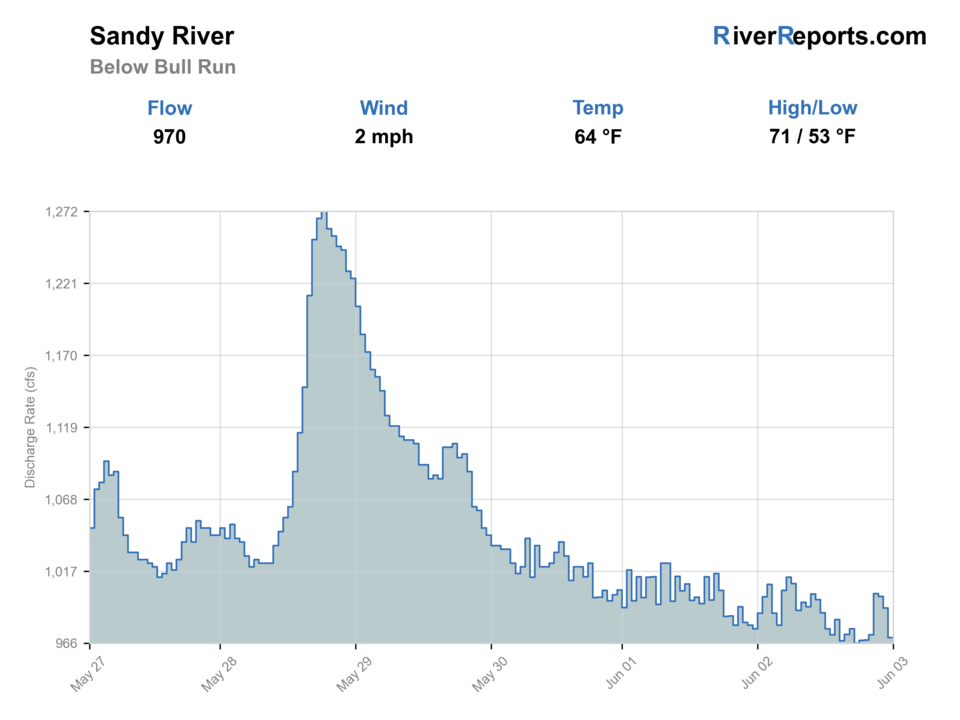
USGS data chart
Official USGS trend
Streamflow over the latest USGS reporting window.
Latest
1,000 cfs
Jun 3, 2 PM UTC
Weather
River weather report
Weather can change wading safety, road access, water temperature, hatches, and the best time of day to fish.
Live forecast loads as you reach this section
This keeps the report fast while still using the official National Weather Service forecast point.
Hatches and flies
Hatch chart and fly picks
January-March
Winter steelhead eggs, stones, and sparse baitfish patterns
Stonefly nymph, small egg, black leech, intruder, marabou jig
April-June
Spring Chinook movement, caddis, March Browns, and summer steelhead build
Stonefly nymph, caddis pupa, soft hackle, sparse swung fly, baitfish streamer
July-September
Summer steelhead swing windows, caddis, and limited terrestrial trout shots
Green Butt Skunk, muddler, caddis, ant, small dry-dropper, olive bugger
October-December
Coho and winter steelhead timing with eggs, stones, and leeches
Egg pattern, black stonefly, leech, intruder, baitfish streamer
Nymphs and eggs
Stonefly nymph, egg pattern, caddis pupa, perdigon, small jig
Fish under an indicator when the Sandy is glacial green and fish are holding in walking-speed seams.
Swing flies
Green Butt Skunk, muddler, sparse intruder, marabou tube, wet fly
Use in tailouts and travel lanes when summer steelhead are moving or light is low.
Warm-season backups
Ant, beetle, caddis, olive bugger, small baitfish streamer
Useful for resident trout or when you shorten the day instead of forcing a salmon-and-steelhead-only plan.
Tactics
How to fish it
Start with the gauge and river color, then choose one access corridor you can fish well rather than bouncing between every park and pull-off.
Fish swing lanes and travel seams first when the river is green and moving, then switch to nymphs or lighter presentations if fish stop traveling.
Around obvious access like Oxbow or the hatchery corridor, assume fish have seen pressure and make the first cast your best one.
If the river gets too dirty or pushy for an honest steelhead game, shorten the day instead of forcing dangerous wading.
Rigging
Rod, leader, and setup notes
A 6- or 7-weight single-hand or light two-hand setup covers most Sandy steelhead and general salmonid planning.
Carry both floating and light sink-tip options so you can adjust to travel lanes, tailouts, and slightly deeper seams.
Use stronger tippet than you would on a trout-only river because current speed and fish size both punish light mistakes here.
Keep a smaller backup box of caddis, ants, and light streamers for resident-fish or low-water backup plans.
Access
Access and planning notes
Bull Run gauge corridor
Lower-river flow decisionWade / float / trail
RiverReports / USGS / steelhead
When to pick it
Start here when flow direction and color decide whether lower-river edges are safe and fishable.
Caution
The gauge does not confirm Oxbow status, hatchery access, or glacial color at every run.
Sandy Hatchery corridor
ODFW-backed access and timingWade / float / trail
Hatchery / trail / wade
When to pick it
Use it when ODFW reports, access, and fish timing support a short focused steelhead plan.
Caution
The most obvious corridor can be pressured; do not force unsafe crossings for space.
Oxbow Regional Park
Metro public accessWade / float / trail
Park / bank / wade edges
When to pick it
Pick it when park status, river color, and safe edge water all line up.
Caution
Park conditions and river safety can change independently of the gauge.
Check park conditions before building the day around Oxbow, because access and river safety advisories can change independently of the gauge.
The hatchery corridor is useful because it combines ODFW access with fish-timing context, but it is also one of the first places other anglers think to start.
Do not let easy parking trick you into unsafe crossings. The Sandy often fishes better from smart edge positions than from aggressive wading.
Regulations
Check before fishing
Use current ODFW guidance before fishing the Sandy, especially for salmon or steelhead tags, Columbia Basin endorsement requirements, and any reach-specific seasonal updates.
Primary base
Troutdale, Sandy, Gresham, or Hoodland area
Best day style
Metro park access, hatchery trails, roadside pull-offs, and short-run wading
Check first
RiverReports, USGS 14142500, ODFW Willamette updates, park status, hatchery access, and the NWS forecast
Safety
Glacial color swings, storm push, cold current, slick gravel bars, and crowd pressure around obvious access
Gear
Helpful gear for this water
6- or 7-weight rod
Handles indicators, swing flies, and the Sandy's bigger open runs.
Floating line and light sink tip
Covers summer steelhead travel lanes plus nymphing or streamer adjustments.
Thermometer
Worth carrying any time trout or incidental salmonid handling might become a warm-water issue.
Wading staff
Helpful on shifting gravel, glacial push, and slick park-side entries.
Nearby water
Other water to research
Backup logic
Blown out or dirty
Wait for the Sandy to green up or compare the Clackamas, Crooked, or McKenzie depending on target species.
Low clear pressure
Fish first light, use smaller flies, or move away from the most obvious access.
Park or hatchery access issue
Use another confirmed public access or switch rivers instead of improvising roadside entries.
Warm or crowded salmonid handling
Shorten the session, release quickly, or choose another day.
Deschutes River
A larger Oregon steelhead and trout river with a more deliberate canyon rhythm.
McKenzie River
A clearer trout-focused backup when you want less glacial color and less lower-river crowding.
Crooked River
A technical trout alternative for days when the Sandy is too dirty or pushy.
FAQ
Fast answers
Is Sandy River fishable today?
Sandy River looks very fishable right now. The live score is 96/100, based on current flow, weather, public alerts, and the report's planning context. Recheck the linked gauge and forecast before leaving because conditions can change quickly after rain, heat, access changes, or flow swings.
What flow is best for Sandy River?
Green dropping water with enough current to move fish but not so much push that every seam becomes a dangerous crossing problem.
When should I skip Sandy River?
Skip it when the Sandy is rising, fully dirty, or so crowded around obvious access that you start making rushed casting or wading decisions.
Is Sandy River safe to wade right now?
The fishability score is not a wading guarantee. Wade only where your chosen access has safe edges, clear footing, legal entry, and no forced crossings; high, rising, stained, or storm-affected water should be treated conservatively.
What should I check first before fishing the Sandy River?
Check the Bull Run gauge trend, current ODFW Willamette update, and the specific park or hatchery access you plan to use. The Sandy can look fishable in one spot and still be a poor or unsafe call in another.
Where should a first-time fly angler start on the Sandy River?
Start with the hatchery-downstream corridor or Oxbow-area public access because both are backed by current official information and let you build a cleaner day than random roadside scouting.
Can I wade the Sandy River?
Yes in selected edges and bars, but the river rewards conservative footing. Treat it as a bank-and-seam river first, especially when color and current start changing fast.
When should I skip the Sandy River?
Skip it when the river is rising, fully dirty, crowded enough to force bad decisions, or carrying too much push for a safe edge-based approach.
Sources
Source set for this report
Reviewed 2026-06-02