New York / Northeast
Battenkill River
A New York Battenkill report focused on technical trout water, DEC reach rules, public fishing access, flows, hatches, and careful presentations.
Image: Generated regional planning image for Battenkill River / BlueStreamFly generated; not exact location / BlueStreamFlyFishability now: Battenkill River fishability today
GreatData confidence: High96/100
Fishable now because Battenville gauge is falling, weather is usable, and no public alert is active.
Flow observed
3:15 PM UTC
Weather observed
4:00 PM UTC
Score calculated
4:21 PM UTC
Why this rating
Flow
Weather
Public alerts
Next 6-12 hours
Improving / hold
A falling gauge and usable weather should keep the next 6-12 hours in play unless tributaries stain or heat builds.
USGS flow
430 cfs
Current trend: flow falling, rating likely holding strong unless weather or clarity changes.
More planning details: flies, flow bands, and live source checks
Fish it today
Start here
Base around Cambridge, Greenwich, Shushan, or Battenville; choose a reach, check DEC rules, then fish low-impact presentations.
Best flow clue
Stable flows with enough depth for cover but enough clarity to present dries, emergers, or light nymphs accurately.
Skip trigger
Skip or scout during hot low-water afternoons, unsafe high water, crowded bridge pools, or unclear access.
Flow decision bands
Stable medium technical flow
Stable Battenville flow is the best sign that dries, emergers, and light nymphs can be presented without exposing trout or anglers.
Low clear meadow water
Low clear water can fish, but long leaders, shade, and fewer casts matter more than moving fast.
Rain stain and fall
Falling stained water can fit small streamers or larger nymphs if banks and crossings remain safe.
Warm bright afternoon
Heat and bright low water should move trout anglers to low-light windows or a different plan.
USGS flow
430 cfs
Current trend: flow falling, rating likely holding strong unless weather or clarity changes.
Live USGS flow
435 cfs / falling about 20%
Live NWS forecast
74F / Sunny
Water temperature not verified
Heat guidance uses weather and river type unless an official water-temperature value is available.
No NWS alert flag
No active NWS alert was returned for this forecast point.
RiverReports is the quick chart, backed by USGS 01329490 Batten Kill below Mill at Battenville, New York.
DEC special trout stream rules vary by reach, including stocked-extended, wild-quality, and catch-and-release sections.
Public Fishing Rights give fishing access where posted or mapped, but they are not general recreation rights.
Low, clear water calls for longer leaders, smaller flies, and more walking than casting.
Editorial review
How this report is maintained
This report starts with official regulation, access, flow, weather, and public-land sources, then adds practical planning guidance for fly anglers.
Byline
BlueStreamFly editorial desk
Reviewed by
BlueStreamFly source review
Maintained by
BlueStreamFly
Last material review
2026-06-02
Report confidence
High confidence
90/100
High confidence: RiverReports, USGS 01329490 below Mill at Battenville, NYSDEC inland trout special regulations, Public Fishing Rights sources, freshwater fishing regulations, weather coverage, generated media disclosure, and route-specific Battenkill technical-trout guidance support the page. Confidence is moderated by exact reach category, private meadow banks, low clear pressure, warm afternoons, and access-easement limits.
Regulations
NYSDEC special trout stream and freshwater regulation sources support current reach-rule checks.
Access
NYSDEC Public Fishing Rights sources support mapped fishing access, while legal parking and private-bank boundaries remain trip-specific.
Flow and weather
RiverReports, USGS 01329490 at Battenville, and the National Weather Service point support live flow and weather decisions.
Fishing usefulness
The page now separates technical low-water tactics, DEC reach rules, PFR access limits, meadow-bank caution, warm-water stops, and New York backup waters.
Fishability dashboard and source review
2026-06-02 / material content or source review
RiverReports and USGS 01329490 Battenville flow, NYSDEC inland trout special regulations, Public Fishing Rights sources, freshwater fishing regulations, National Weather Service data, and route-specific technical meadow-stream guidance were checked before updating the current-fishability decision layer.
2026-06-02
Updated the Battenkill River with technical-trout flow bands, DEC access cards, backup cues, and confidence signals.
2026-05-26
Published a new Battenkill River report with reach-rule reminders, flow planning, access cautions, hatches, and technical trout tactics.
Angler planning edge
Local details that change the plan
Best for
Technical dry-fly planning, Clear-water trout tactics, DEC reach-rule checks
Wade or float
Plan around careful wading and bank access. Do not assume broad bank travel outside signed or mapped public fishing access.
Best flows
Stable flows with enough depth for cover but enough clarity to present dries, emergers, or light nymphs accurately.
When to skip
Skip or scout during hot low-water afternoons, unsafe high water, crowded bridge pools, or unclear access.
Local plan
Base around Cambridge, Greenwich, Shushan, or Battenville; choose a reach, check DEC rules, then fish low-impact presentations.
Pressure
Obvious access sees pressure. Walk, rest fish after refusals, and avoid repeated casting over visible trout.
Access nuance
Public Fishing Rights are limited fishing easements. Stay on signed access and respect private land.
Backup water
Schroon River, West Branch Ausable, or Delaware East Branch pages help when the Battenkill is too low, warm, or crowded.
About the river
Setting, character, and why it fishes the way it does.
The Battenkill is one of the Northeast's classic trout streams, flowing through Vermont into New York farm country before joining the Hudson River system. Its New York reaches combine meadow banks, riffles, pools, and a long public-access history.
This is not a stream where more casts automatically help. Clear water, educated trout, bank shadows, and private-property edges make presentation and access discipline part of the fishing.
Because DEC manages different reaches under different trout categories, a useful Battenkill plan starts with the exact reach, current rules, and water conditions before fly selection.
Target species
Brown trout
The main technical trout target, especially in stable flows and low light.
Brook trout
More relevant in colder tributary influence and upper-corridor context.
Rainbow trout
Part of regional trout planning; verify current DEC stocking and reach rules before harvest assumptions.
Reading the water
Low and clear
Lengthen leaders, downsize flies, stay low, and fish shade or broken surface texture.
Stable medium flow
Best all-around window for dry-fly, emerger, and light nymph fishing.
Stained after rain
Fish softer banks with small streamers or larger nymphs, but avoid unsafe crossings.
Warm afternoon
Shift to early mornings, stop if trout stress is likely, and consider another water type.
Best seasons
Spring
Prime hatch and nymph window when flows are fishable and not too high.
Early summer
Good dry-fly and terrestrial starts before heat narrows the daily window.
Late summer
Often technical and temperature-limited; fish mornings and cooler weather.
Fall
Low-light streamers and small mayflies can matter, but reach rules still control the plan.
Preferred flow source
Batten Kill below Mill at Battenville
RiverReports is the preferred chart source when coverage exists. When a matching USGS gauge exists, keep it open as the official backstop for station data and current hydrograph context.
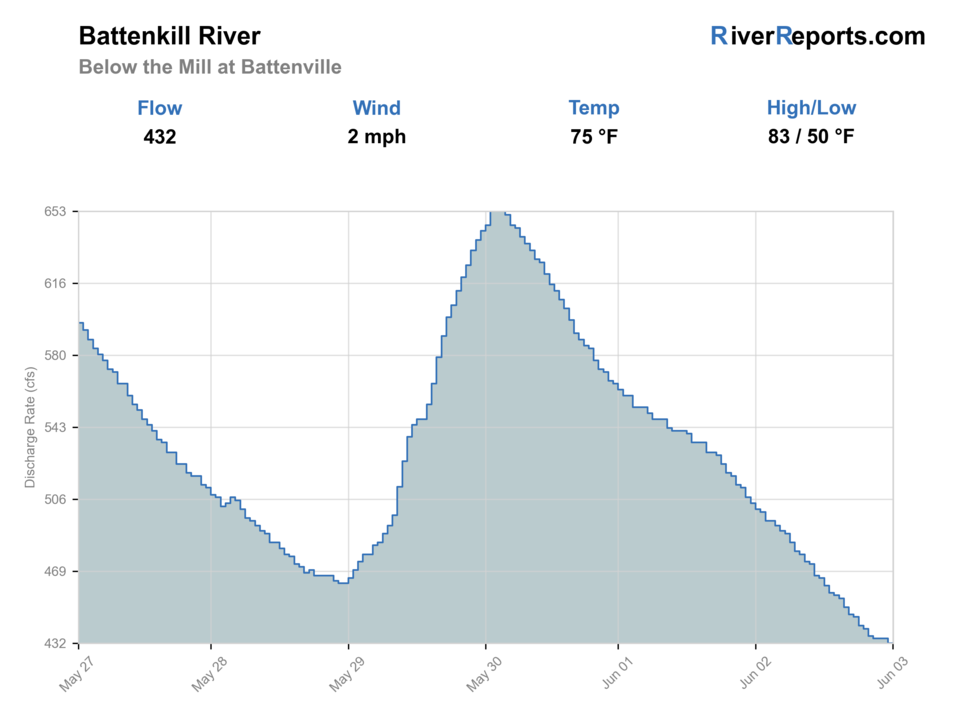
USGS data chart
Official USGS trend
Streamflow over the latest USGS reporting window.
Latest
430 cfs
Jun 3, 4 PM UTC
Weather
River weather report
Weather can change wading safety, road access, water temperature, hatches, and the best time of day to fish.
Live forecast loads as you reach this section
This keeps the report fast while still using the official National Weather Service forecast point.
Hatches and flies
Hatch chart and fly picks
April-May
Midges, BWOs, Hendrickson-style mayflies, stoneflies
BWO emerger, pheasant tail, hare's ear, small black stone
May-June
Caddis, March brown-style mayflies, sulphur-style mayflies
Elk hair caddis, comparadun, soft hackle, parachute Adams
July-August
Terrestrials, caddis, small olives
Ant, beetle, small hopper, X-caddis, BWO emerger
September-October
BWOs, caddis, midges
BWO dry, soft hackle, zebra midge, small olive bugger
Technical dries
Comparadun, parachute Adams, BWO, ant, beetle
Water is clear and trout are feeding in smooth glides or soft edges.
Sparse nymphs
Pheasant tail, hare's ear, caddis pupa, perdigon
No steady surface activity is visible but flows remain clear.
Small streamers
Olive bugger, black leech, small sculpin
Low light, slight color, or higher water gives trout cover.
Tactics
How to fish it
Pick a reach first, then confirm DEC rules for that reach before rigging.
Use longer leaders and sidearm or reach casts to keep line off clear, slow water.
Walk past obvious bridge water if it is crowded or visibly pressured.
Fish one good drift at a time. Repeated poor drifts educate fish quickly on this river.
Rigging
Rod, leader, and setup notes
A 4- or 5-weight rod with a smooth drag is ideal for dries, emergers, and light nymphs.
Use 9- to 12-foot leaders, with 5X or 6X for clear low water and 4X for larger flies or stained flows.
A dry-dropper works well in riffle edges; a small indicator or tight-line setup is better in deeper runs.
Carry a thermometer and stop fishing for trout when water temperature or handling stress becomes the main issue.
Access
Access and planning notes
Battenville gauge area
Flow and reach checkWade / float / trail
Gauge / road scout / walk-wade
When to pick it
Start here when the flow trend and visible clarity support the exact reach you plan to fish.
Caution
Gauge-area roads and bridges do not replace legal parking or mapped access.
Washington County PFR reaches
Legal fishing accessWade / float / trail
DEC Public Fishing Rights / walk-wade
When to pick it
Use them when mapped access and signs support a low-impact meadow-stream session.
Caution
Public Fishing Rights are fishing easements, not general recreation access.
State-line corridor
Rule-change awarenessWade / float / trail
Reach comparison / boundary context
When to pick it
Pick it when you are moving between managed reaches and need to confirm the current rule category.
Caution
Reach-specific trout rules can change faster than the water character does.
DEC Public Fishing Rights are for fishing access, not camping, picnicking, or general recreation.
Meadow banks can be fragile. Use existing paths where available and avoid cutting banks or trampling posted areas.
Private-property boundaries matter. If access is not clearly public, keep moving.
Regulations
Check before fishing
DEC lists special trout stream regulations for Batten Kill reaches. Confirm the reach you plan to fish before choosing harvest, tackle, or season assumptions.
Primary base
Cambridge, Greenwich, Shushan, or Battenville
Best day style
Public fishing rights, signed access, bridge-area scouting, and careful meadow-stream wading
Check first
RiverReports, USGS 01329490, DEC trout stream regulations, DEC PFR access tools, and NWS weather
Safety
Private-property edges, slick meadow banks, warm-water trout stress, thunderstorms, and reach-specific rules
Gear
Helpful gear for this water
4- or 5-weight rod
Best balance for long leaders, dries, and light nymphs.
Long leaders
Useful in low, clear, technical water.
Thermometer
Important during summer and low-flow periods.
Low-profile pack
Helps when walking meadow access and fishing cautiously.
Nearby water
Other water to research
Backup logic
Low warm water
Fish a short cool window, scout, or move to Schroon, West Branch Ausable, or Delaware East Branch.
Crowded bridge water
Use another mapped PFR reach rather than repeating casts over visible pressured trout.
Stained or unsafe banks
Stay on softer legal edges or wait for the Battenville trend to clear.
Reach-rule uncertainty
Confirm DEC special trout stream rules before choosing harvest, tackle, or season assumptions.
Ausable River, West Branch
A larger Adirondack trout option with different access and flow character.
Schroon River
A nearby Adirondack-side alternative when Battenkill water is too low or warm.
Delaware River, East Branch
A more tailwater-influenced New York plan with separate hatches and flows.
FAQ
Fast answers
Is Battenkill River fishable today?
Battenkill River looks very fishable right now. The live score is 96/100, based on current flow, weather, public alerts, and the report's planning context. Recheck the linked gauge and forecast before leaving because conditions can change quickly after rain, heat, access changes, or flow swings.
What flow is best for Battenkill River?
Stable flows with enough depth for cover but enough clarity to present dries, emergers, or light nymphs accurately.
When should I skip Battenkill River?
Skip or scout during hot low-water afternoons, unsafe high water, crowded bridge pools, or unclear access.
Is Battenkill River safe to wade right now?
The fishability score is not a wading guarantee. Wade only where your chosen access has safe edges, clear footing, legal entry, and no forced crossings; high, rising, stained, or storm-affected water should be treated conservatively.
What gauge should I use for the Battenkill?
Use RiverReports for the quick view and USGS 01329490 below Mill at Battenville for the official gauge reference.
Does the Battenkill have special rules?
Yes. DEC lists reach-specific trout stream regulations, so verify your exact section before fishing.
Is this a beginner-friendly river?
It can teach a lot, but it is technical. New anglers should focus on riffles, legal access, and short accurate drifts rather than smooth, pressured pools.
Sources
Source set for this report
Reviewed 2026-06-02