Montana / West
Jefferson River
A practical Jefferson River page for deciding when the broad headwaters valley has enough cool, clear, structured water to deserve a trout day.
Image: Generated regional planning image for Jefferson River / BlueStreamFly generated; not exact location / BlueStreamFlyFishability now: Jefferson River fishability today
GreatData confidence: High96/100
Fishable now because the live gauge is falling, weather is mild, and no public alert is active.
Flow observed
4:15 PM UTC
Weather observed
5:00 PM UTC
Score calculated
5:25 PM UTC
Why this rating
Flow
Water temperature
Public alerts
Next 6-12 hours
Improving / hold
A falling gauge and usable weather should keep the next 6-12 hours in play unless tributaries stain or heat builds.
USGS flow
3,560 cfs
Current trend: flow falling, rating likely holding strong unless weather or clarity changes.
More planning details: flies, flow bands, and live source checks
Fish it today
Start here
Start near Twin Bridges with the gauge and closure page, then decide whether one short confirmed-public float is worth it. If the river looks flat or warm by midmorning, leave early for colder water.
Best flow clue
Use RiverReports and USGS 06026500 near Twin Bridges together. Stable moderate flow with enough clarity to read shelves and cutbanks is the best signal; muddy tributary color, hot low water, or a flat exposed river should end the trout plan early.
Skip trigger
Skip or pivot when warm-season closures are active, muddy water or hot weather strip away trout-safe shape, wind ruins the float, or the entire plan depends on uncertain public access.
Flow decision bands
Low but still possible
Low clear Jefferson water can still fish, but exposed banks, warm afternoons, and broad shallow runs should keep the day to cool windows and careful trout handling.
Best steady valley window
Stable Twin Bridges flow with enough color control to define shelves and cutbanks is the cleanest signal for a short float-focused trout day.
Muddy, windy, or pushy
Tributary mud, a hard wind, or current that leaves no clean slow-water lanes should move the day to a different river.
Heat and closure caution
A fishable graph does not override hot lower-valley weather, active closures, or a float plan that depends on uncertain public access.
USGS flow
3,560 cfs
Current trend: flow falling, rating likely holding strong unless weather or clarity changes.
Live USGS flow
3,560 cfs / falling about 12%
Live NWS forecast
68F / Sunny
Live water temperature
55F from USGS
No NWS alert flag
No active NWS alert was returned for this forecast point.
RiverReports is used for the quick chart, backed by USGS 06026500 Jefferson River near Twin Bridges for the official flow reference.
Montana FWP's Jefferson drainage material calls out drought management, flow targets, and the importance of spawning tributaries in the basin.
Public access is centered on known fishing access sites and bridge corridors; Montana stream access law does not create parking or bank-entry rights on private ground.
Check Montana regulations and any current waterbody closures or hoot-owl restrictions before fishing warm-season trout water.
Editorial review
How this report is maintained
This Jefferson River report is maintained from RiverReports and USGS Twin Bridges flow data, Montana FWP fishing regulations, current waterbody closure sources, Jefferson drainage planning material, fishing-access and stream-access-law sources, weather, generated-image disclosure, and warm-sensitive valley trout planning sources.
Byline
BlueStreamFly editorial team
Reviewed by
BlueStreamFly source review
Maintained by
Mountain Brook Run LLC
Last material review
2026-05-31
Report confidence
Good confidence
88/100
Good confidence: RiverReports, USGS Twin Bridges flow, Montana FWP regulations, current closures, Jefferson drainage planning material, fishing-access and stream-access-law sources, weather, and generated-image disclosure are present. Confidence is moderated by warm-season closure risk, tributary color, wind, broad-valley heat, and limited developed access.
Regulations
Montana FWP regulations and current closure pages are linked for current Jefferson checks.
Flow support
RiverReports Jefferson River near Twin Bridges is backed by USGS 06026500.
Access support
Fishing-access and stream-access-law sources support planning, but long stretches still depend on exact public launch and parking choices.
Weather and safety
The National Weather Service point resolved and the page calls out heat, wind, muddy tributary color, and float logistics.
Angler usefulness
The page separates flow shape, closures, access, float planning, and backup-water decisions.
Editorial review
A public correction path, source standards page, generated-image disclosure, and public review history are included.
Fishability source review
2026-05-31 / material content or source review
RiverReports Twin Bridges flow support, USGS 06026500, Montana FWP fishing regulations, current waterbody closure pages, Jefferson drainage planning material, fishing-access and stream-access-law sources, the National Weather Service point, and image disclosure were rechecked before adding the Pine Creek-standard current-fishability layer.
2026-05-31
Upgraded the page to the Pine Creek fishability standard with reviewed route profile, Jefferson decision bands, access cards, backup logic, and a top-page current-fishability answer.
2026-05-26
Initial source-reviewed report published with Jefferson flows, access, tactics, regulations, and FAQs.
Angler planning edge
Local details that change the plan
Best for
Condition-dependent valley-river days when Twin Bridges flow, clarity, and cool enough weather still leave the Jefferson worth fishing, Float-first plans built around named public access, bridge corridors, and a realistic read on warm-season closures, Early, late, and fall windows when cutbanks, slower shelves, and low-light streamer or nymphing water show back up, Anglers comparing the Jefferson with the Beaverhead, Big Hole, or Madison before forcing a broad warm-sensitive river
Wade or float
Treat the Jefferson as float-first valley trout water with selective wading only where public entry is obvious. The river is broad enough that access, heat, and color usually matter more than hatch excitement.
Best flows
Use RiverReports and USGS 06026500 near Twin Bridges together. Stable moderate flow with enough clarity to read shelves and cutbanks is the best signal; muddy tributary color, hot low water, or a flat exposed river should end the trout plan early.
When to skip
Skip or pivot when warm-season closures are active, muddy water or hot weather strip away trout-safe shape, wind ruins the float, or the entire plan depends on uncertain public access.
Local plan
Start near Twin Bridges with the gauge and closure page, then decide whether one short confirmed-public float is worth it. If the river looks flat or warm by midmorning, leave early for colder water.
Pressure
Pressure is lighter than on the better-known nearby rivers, but obvious public launch points can still bunch boats when conditions finally look good.
Access nuance
Fishing access and stream-access-law sources support planning, but they do not create parking rights on private land or erase long gaps between public launch options.
Backup water
If the Jefferson is warm, muddy, windy, or too flat, move upstream to the Beaverhead or Big Hole, or pivot to the Madison or another colder and more stable option.
About the river
Setting, character, and why it fishes the way it does.
The Jefferson begins near Twin Bridges where major southwest Montana trout drainages come together, then moves through a broad agricultural valley before joining the Madison and Gallatin to form the Missouri.
That geography makes it a river of windows. It has real brown-trout potential, but it also reflects irrigation demand, summer heat, wind, and tributary color more than many destination anglers expect.
The most useful Jefferson plan starts with conditions, not a famous access name. If the river has shape and trout-safe temperatures, cover banks and buckets carefully. If it does not, save the day for cooler water.
Target species
Brown trout
The primary trout target around cutbanks, buckets, shelves, and low-light streamer water.
Rainbow trout
Present in the system, especially where cooler tributary influence and better oxygen line up.
Mountain whitefish
Common enough to be part of the honest nymphing picture on slower trout days.
Reading the water
Stable moderate flow
Best for floating and for reading banks, inside seams, and midriver shelves.
Low warm water
Fish only early if temperatures are safe, then stop instead of pressuring stressed trout.
Rising dirty water
Use bigger dark nymphs or streamers only if visibility remains workable; otherwise wait.
Cool fall flow
A better streamer and nymph window when pressure drops and fish use banks more confidently.
Best seasons
Spring
Can fish before heavy runoff or after the river settles, especially with nymphs and streamers.
Early summer
Good when flows are still healthy but not too high to read from a boat.
Late summer
Condition-dependent. Fish early only when temperatures and closure rules allow.
Fall
Often the cleanest combination of trout-safe temperatures, lower pressure, and streamer potential.
Preferred flow source
Jefferson River near Twin Bridges
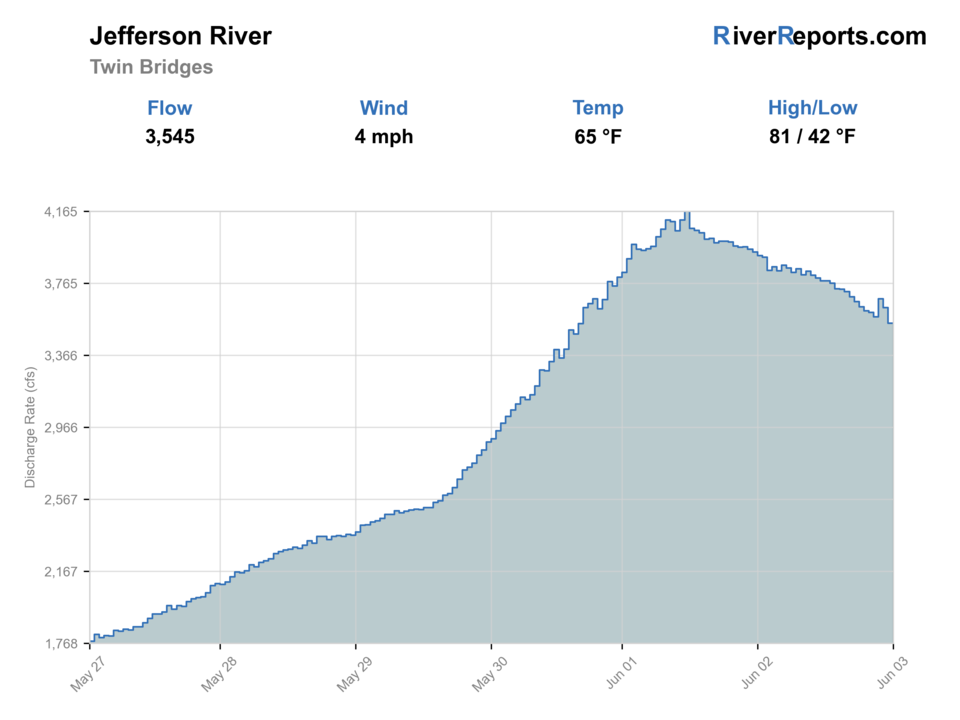
RiverReports is the preferred chart source when coverage exists. When a matching USGS gauge exists, keep it open as the official backstop for station data and current hydrograph context.
USGS data chart
Official USGS trend
Streamflow over the latest USGS reporting window.
Latest
3,560 cfs
Jun 3, 4 PM UTC
Weather
River weather report
Weather can change wading safety, road access, water temperature, hatches, and the best time of day to fish.
Live forecast loads as you reach this section
This keeps the report fast while still using the official National Weather Service forecast point.
Hatches and flies
Hatch chart and fly picks
Spring
Midges, BWOs, early caddis
Zebra midge, BWO emerger, caddis pupa
Early summer
PMDs, caddis, yellow sallies
PMD emerger, sparkle caddis, yellow sally nymph
Summer
Tricos, caddis, terrestrials
Trico spinner, hopper, ant, beetle
Fall
BWOs, midges, streamer windows
Parachute BWO, zebra midge, olive sculpin
Jefferson nymphs
Perdigon, pheasant tail, caddis pupa, small stonefly
You need to cover buckets and shelves without waiting for surface activity.
Low-light streamers
Olive bugger, black leech, tan sculpin
Clouds, fall weather, or a little stain gives bigger fish a reason to move.
Summer bank dries
Hopper, ant, beetle, elk hair caddis
The river is cool enough and fish are willing to use banks and soft edges.
Tactics
How to fish it
Decide first whether the Jefferson has trout-safe temperature and enough clarity to read structure.
On float days, fish the best banks and buckets slowly instead of treating every mile as equal.
If you wade, use only obvious legal entries and avoid stepping onto private banks to move around obstacles.
In summer, carry a thermometer and stop when water temperature or closure rules make the ethical call clear.
Rigging
Rod, leader, and setup notes
A 5- or 6-weight rod with a floating line covers most nymph, dry-dropper, and terrestrial work.
Carry a streamer line or sink-tip only when clarity and weather make that choice realistic.
Use 3X through 5X for nymphs and streamers, and 4X through 6X when dry-fly windows get technical.
Boat anglers should rig for wind, long banks, and quick adjustments between nymphs, dries, and streamers.
Access
Access and planning notes
Twin Bridges gauge check
Primary Jefferson decisionWade / float / trail
Gauge / float
When to pick it
Start here when the valley-river trend decides whether the Jefferson belongs in the day's trout rotation at all.
Caution
The gauge does not settle tributary color, wind, or exact launch spacing farther downstream.
Named public access and bridge corridor
Legal entry backboneWade / float / trail
Fishing access / bridge access / short wade
When to pick it
Use it when you need a defensible public framework instead of treating every roadside bend like open access.
Caution
Public on-water use does not make private field crossings, parking pullouts, or every bank edge public.
Short confirmed-public float
Condition-based river planWade / float / trail
Launch / drift / takeout
When to pick it
Pick this when the flow, weather, and closures still support one compact float instead of a long exposed day.
Caution
Do not force a long float if wind, heat, or weak clarity already point toward a different river.
The Jefferson has useful public access, but long stretches run through private agricultural land. Legal entry and parking matter as much as the water itself.
Montana stream access law applies after lawful access to the water. It does not authorize crossing private land or using private banks as a trail.
Floating is usually the better way to fish meaningful Jefferson water, especially when the best structure is spread across long open reaches.
Regulations
Check before fishing
Check Montana's current fishing regulations, FishMT waterbody details, and current waterbody closures before fishing. Warm-water restrictions can matter on the Jefferson.
Primary base
Twin Bridges, Whitehall, or Dillon
Best day style
Float-first and bridge-access planning, with selective wading only where public entry and parking are clear
Check first
RiverReports trend, USGS 06026500, Montana regulations, current waterbody closures, and the Twin Bridges forecast
Safety
Summer heat, low oxygen stress, private-land access mistakes, wind exposure, and long shuttle spacing
Gear
Helpful gear for this water
5- or 6-weight rod
Useful for bigger open-water casts, dry-dropper rigs, and fall streamers.
Thermometer
Essential during warm Jefferson windows when ethical fishing depends on water temperature.
Boat safety and shuttle plan
Important because public access points are spread out and wind can change the day.
Terrestrial and streamer box
Covers the river's best summer-bank and fall low-light opportunities.
Nearby water
Other water to research
Backup logic
Muddy tributary color
Leave the Jefferson as soon as color control fails and move to colder or clearer water instead of hoping the lower valley cleans up mid-day.
Heat or closures
Treat hoot-owl, closure, or hot-water signals as full stop signs and pivot to cooler water before trout handling gets questionable.
Wind
Turn a windy Jefferson day into a short early check or abandon the float entirely before boat control becomes the whole trip.
Access issue
Use only confirmed public access and pivot if launch, parking, or shuttle details remain vague.
Beaverhead River at Twin Bridges
A lower-river comparison just upstream of the Jefferson headwaters.
Big Hole River
A colder freestone backup when the Jefferson is too warm or low.
Madison River
A more consistent nearby destination when you want stronger trout infrastructure.
FAQ
Fast answers
Is Jefferson River fishable today?
Jefferson River looks very fishable right now. The live score is 96/100, based on current flow, weather, public alerts, and the report's planning context. Recheck the linked gauge and forecast before leaving because conditions can change quickly after rain, heat, access changes, or flow swings.
What flow is best for Jefferson River?
Use RiverReports and USGS 06026500 near Twin Bridges together. Stable moderate flow with enough clarity to read shelves and cutbanks is the best signal; muddy tributary color, hot low water, or a flat exposed river should end the trout plan early.
When should I skip Jefferson River?
Skip or pivot when warm-season closures are active, muddy water or hot weather strip away trout-safe shape, wind ruins the float, or the entire plan depends on uncertain public access.
Is Jefferson River safe to wade right now?
The fishability score is not a wading guarantee. Wade only where your chosen access has safe edges, clear footing, legal entry, and no forced crossings; high, rising, stained, or storm-affected water should be treated conservatively.
Is the Jefferson River good for fly fishing?
Yes, but it is highly condition-dependent. It is best when flows are stable, water is cool enough, and clarity lets you fish banks, shelves, and buckets effectively.
Should I wade or float the Jefferson River?
A float usually makes more sense because the best structure is spread out. Wade only from obvious public access where parking and entry are legal.
What should I check before fishing the Jefferson?
Check RiverReports, USGS 06026500, Montana regulations, current waterbody closures, weather, and water temperature before committing.
Sources
Source set for this report
Reviewed 2026-05-31