
Maine / Northeast
Kennebec River
A release-aware Kennebec page for anglers who need to decide whether the Harris Station to The Forks water is a smart wade, drift, or skip call.
Image: Generated regional planning image for Kennebec River at The Forks / BlueStreamFly generated; not exact location / BlueStreamFlyFishability now: Kennebec River fishability today
GreatData confidence: High96/100
Fishable now because The Forks gauge is stable, weather is usable, and no public alert is active.
Flow observed
5:00 PM UTC
Weather observed
5:00 PM UTC
Score calculated
5:26 PM UTC
Why this rating
Flow
Weather
Public alerts
Next 6-12 hours
Hold
Stable live data supports staying with the plan, but recheck the gauge and forecast before leaving.
USGS flow
5,440 cfs
Current trend: flow stable, so weather, temperature, and access checks drive the next change.
More planning details: flies, flow bands, and live source checks
Fish it today
Start here
Check the release picture first, pick either Harris Station or the lower The Forks side, fish one clear access plan, and leave if the river is bigger than your margin.
Best flow clue
Release levels that leave defined bank structure and manageable edge water instead of wall-to-wall push.
Skip trigger
Skip when the river is too heavy for safe edge fishing, when rafting traffic dominates your window, or when access does not match your day style.
Flow decision bands
Fishable release shape
Stable The Forks flow with defined edges is the best signal for a wadeable or controlled drift plan.
High rafting release
Heavy release volume should move the day to float-only or no-go logic rather than casual wading.
Cold controlled edge water
Cold moderate flow can fish well along banks and current transitions when access and footing line up.
Access mismatch
Even a good chart is not enough if the available access, traffic, or daylight does not match the release window.
USGS flow
5,440 cfs
Current trend: flow stable, so weather, temperature, and access checks drive the next change.
Live USGS flow
5,440 cfs / stable
Live NWS forecast
78F / Sunny
Water temperature not verified
Heat guidance uses weather and river type unless an official water-temperature value is available.
No NWS alert flag
No active NWS alert was returned for this forecast point.
RiverReports and USGS 01042500 at The Forks are the first checks because release-driven volume dictates whether you are really planning a wade day, a float day, or a skip day.
Maine's current special-law page lists the Dead River stretch down to The Forks confluence as artificial-lures-only with a two-brook-trout daily limit and fall release-only rules from October 1 through November 30.
Maine's whitewater guidance treats the Kennebec between Harris Station and The Forks as a rapidly flowing river and notes the Harris Station staircase as a recreation access point.
The Upper Kennebec management plan warns that high flows from upstream dam releases and limited road access beyond Route 201 are central constraints for anglers here.
Editorial review
How this report is maintained
This report uses official regulation, flow, weather, access, and public-land sources first, then adds practical planning guidance for fly anglers.
Byline
BlueStreamFly editorial desk
Reviewed by
BlueStreamFly source review
Maintained by
BlueStreamFly
Last material review
2026-06-02
Report confidence
Good confidence
89/100
Good confidence: RiverReports, USGS 01042500 at The Forks, Maine special fishing laws, Maine whitewater boating guidance, Upper Kennebec management-plan access context, weather coverage, generated media disclosure, and route-specific release-river guidance support the page. Confidence is moderated by hydro release timing, rafting traffic, exact reach rules, limited road access, and wade-versus-float assumptions.
Regulations
Maine special-law sources support artificial-lure, brook-trout, and seasonal reach checks, but exact reach timing should be confirmed before each trip.
Access
Maine whitewater guidance and Upper Kennebec management-plan sources support Harris Station, The Forks, and Route 201 planning, with release safety still day-specific.
Flow and weather
RiverReports, USGS 01042500 at The Forks, and the National Weather Service point support live flow and weather decisions.
Fishing usefulness
The page now separates release shape, Harris Station access, Route 201 scouting, rafting traffic, cold-water wading, special-law checks, and safer Maine backups.
Fishability dashboard and source review
2026-06-02 / material content or source review
RiverReports and USGS 01042500 The Forks flow, Maine special fishing laws, Maine whitewater boating guidance, Upper Kennebec Region management-plan access context, National Weather Service data, and route-specific release-river wade-versus-float guidance were checked before updating the current-fishability decision layer.
2026-06-02
Updated the Kennebec River at The Forks to the current fishability standard with release-river trend bands, access cards, backup cues, stable fishability SEO, and confidence signals.
2026-05-26
Published a new Kennebec at The Forks report with release-aware planning, access context, and wade-versus-float guidance.
Angler planning edge
Local details that change the plan
Best for
Release-river planning, Cool-water salmonid days, Anglers who can skip bad flow windows
Wade or float
Both, but let the gauge decide. Many days are clearly float-focused or no-go for wading.
Best flows
Release levels that leave defined bank structure and manageable edge water instead of wall-to-wall push.
When to skip
Skip when the river is too heavy for safe edge fishing, when rafting traffic dominates your window, or when access does not match your day style.
Local plan
Check the release picture first, pick either Harris Station or the lower The Forks side, fish one clear access plan, and leave if the river is bigger than your margin.
Pressure
Pressure is less about crowding every seam and more about whether outfitters, drifters, and anglers are sharing the same release window.
Access nuance
Route 201 gives you scouting, but true useful access is still concentrated and shaped by release safety.
Backup water
The Dead River or a smaller trout-and-salmon plan is the better pivot if the Kennebec is running too hard for your objective.
About the river
Setting, character, and why it fishes the way it does.
At The Forks, the Kennebec is not a small trout stream. It is a cold, release-shaped river with serious current, broad runs, and a long history of rafting and salmonid fishing.
That mix is what makes the reach good and what makes sloppy planning expensive. A successful day here depends on respecting flow schedule, launch reality, and the difference between fishable edges and unfishable volume.
This page is focused on the Harris Station to The Forks personality, not on the entire Kennebec watershed.
Target species
Brook trout
A core coldwater target in the upper Kennebec region and the species most clearly reflected in Maine's special-law wording for nearby reaches.
Landlocked salmon
Part of the upper Kennebec draw when flow and season line up.
Brown trout
Less common than brook trout and salmon but still part of the fishery mix in this region.
Rainbow trout
Present in lower numbers and best treated as a bonus rather than the whole plan.
Reading the water
Moderate release with defined edges
Best for structured drift fishing, safe edge wading, and fishing obvious seams instead of brute-force current.
High release volume
Usually a float or no-go decision rather than a wade plan.
Cool fall flow
Often the best mix of temperature and fish movement, but always confirm the current fall rules first.
Warm bright midday
Still better than many rivers because the water is cold, but glare and release pace can make the fishing feel smaller than the river looks.
Best seasons
Spring
Strong when flows are controlled enough to let you fish seams and travel lanes without unsafe wading.
Summer
Can still be good because of cold releases, but rafting traffic and big volume may dominate some days.
Fall
Often the cleanest fishing window if release levels and current special laws cooperate.
Late fall
Useful for release-only windows, but cold weather and flow discipline matter.
Preferred flow source
Kennebec River at The Forks
RiverReports is the preferred chart source when coverage exists. When a matching USGS gauge exists, keep it open as the official backstop for station data and current hydrograph context.
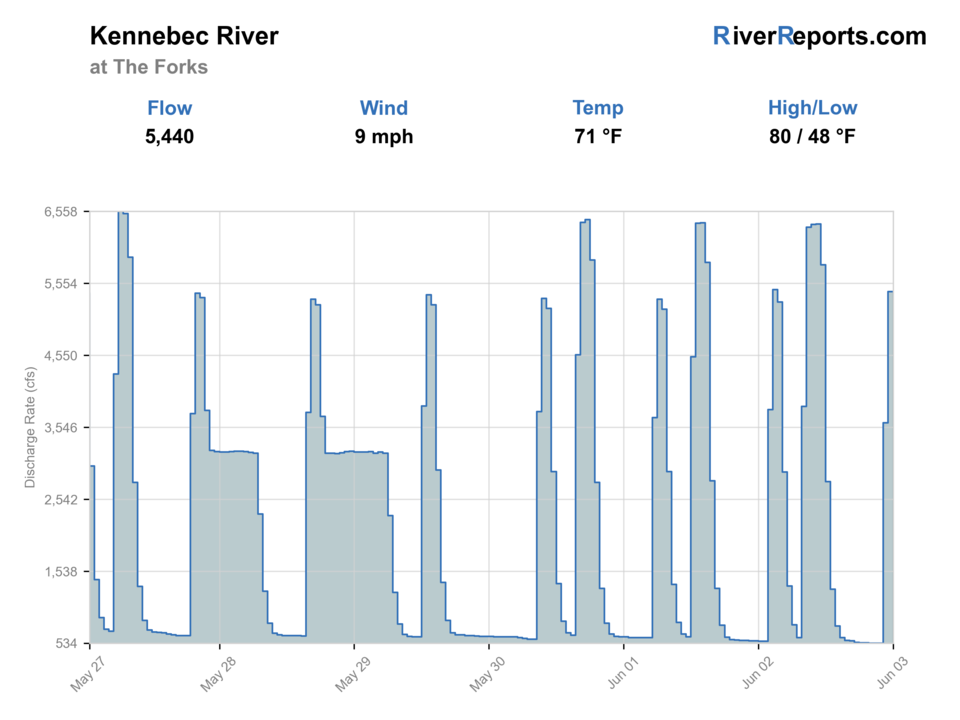
USGS data chart
Official USGS trend
Streamflow over the latest USGS reporting window.
Latest
5,440 cfs
Jun 3, 5 PM UTC
Weather
River weather report
Weather can change wading safety, road access, water temperature, hatches, and the best time of day to fish.
Live forecast loads as you reach this section
This keeps the report fast while still using the official National Weather Service forecast point.
Hatches and flies
Hatch chart and fly picks
Spring
Midges, BWOs, and caddis
Zebra midge, BWO emerger, caddis pupa, soft hackle
Early summer
Caddis, stones, and mayflies
Elk hair caddis, stonefly nymph, sulphur-style mayfly patterns
Summer
Caddis and attractor windows
Stimulator, caddis dry, soft hackle, hare's ear
Fall
BWOs, caddis, and streamer windows
Parachute BWO, caddis emerger, olive bugger
Seam nymphs
Pheasant tail, hare's ear, caddis pupa, stonefly nymph
The river has enough structure to fish edges and current transitions cleanly.
Soft hackles and emergers
Soft hackle wet, BWO emerger, caddis emerger
Fish are moving in softer water or during evening activity.
Streamers
Olive bugger, black bugger, slim baitfish patterns
Cloud cover or higher push favors bigger presentations along defined banks.
Tactics
How to fish it
Read the gauge before you decide whether the day is a wade, float, or full skip.
Fish defined banks, slower edge water, and current transitions rather than trying to overpower the central push.
If the river is release-heavy enough to feel like a rafting corridor first, do not talk yourself into marginal wades.
A short high-quality session near a known access point beats a long day spent trying to solve the whole river.
Rigging
Rod, leader, and setup notes
A 5- or 6-weight floating-line setup is the cleanest default for this reach.
Carry split shot, longer leaders, and stout tippet because the river's edge water can still be powerful.
Have one nymph setup and one streamer setup ready rather than rebuilding at the river every stop.
A wading staff is useful, but disciplined access choices matter more than gear here.
Access
Access and planning notes
Harris Station staircase
Upper release referenceWade / float / trail
Recreation access / wade-or-float context
When to pick it
Use it when release shape and access timing support a defined upper-river plan.
Caution
Release changes can turn a reasonable edge into unsafe current quickly.
The Forks lower reach
Downstream anchorWade / float / trail
Access / edge-water planning
When to pick it
Pick it when the lower reach gives you a clearer bank or drift plan than upstream water.
Caution
Confluence-area water still has release-driven power and cold current.
Route 201 corridor
Scout and logistics spineWade / float / trail
Road corridor / planning
When to pick it
Use it to compare release effects and choose a realistic access plan before rigging.
Caution
Road scouting does not create safe wading access away from named points.
This is a release river with limited road access away from the Route 201 corridor. Named access matters.
Wading safety changes dramatically with release volume, so treat no-go decisions as part of the plan.
Float planning and fishing planning are tightly linked here; choose the day style before you rig up.
Regulations
Check before fishing
Check Maine's current special-law page before fishing. Nearby upper Kennebec and Dead River sections around The Forks use artificial-lures-only rules, two-fish brook-trout limits, and seasonal fall release-only windows that must be matched to the exact reach.
Primary base
The Forks or West Forks
Best day style
Named release-river access, roadside Route 201 scouting, and wade-or-float planning built around flow discipline
Check first
RiverReports trend, USGS 01042500, Maine special laws, and current release/weather picture
Safety
Release-driven current, rafting traffic, limited road access, cold water, and slick rock
Gear
Helpful gear for this water
5- or 6-weight rod
A practical fit for heavy seams, larger nymph rigs, and small streamers.
Wading staff
Important on a release river where edge depth changes quickly.
Layered shell system
Weather shifts and cold water can make the river feel much harsher than the parking lot.
Compact boat or float prep kit
Useful if the gauge turns the day into a drift decision instead of a wade decision.
Nearby water
Other water to research
Backup logic
High release
Switch to a proper float plan, fish a safer Maine outlet, or skip the Kennebec until edges return.
Rafting traffic
Shift timing, shorten to bank water, or choose a less congested coldwater option.
Rule uncertainty
Verify Maine special laws for the exact reach before fishing fall or artificial-lure windows.
Cold water or footing concern
Stay bank-first or move to a smaller backup rather than forcing crossings.
Dead River
A nearby The Forks-area comparison water when flow and rule timing line up better for your day.
Kennebec River East Outlet
A more specialized salmon-and-brook-trout option if you want outlet-style structure and are ready for stricter rules.
Rapid River
Another Maine destination when you want a more classic trout-and-salmon focus than the big release water at The Forks.
FAQ
Fast answers
Is Kennebec River fishable today?
Kennebec River looks very fishable right now. The live score is 96/100, based on current flow, weather, public alerts, and the report's planning context. Recheck the linked gauge and forecast before leaving because conditions can change quickly after rain, heat, access changes, or flow swings.
What flow is best for Kennebec River?
Release levels that leave defined bank structure and manageable edge water instead of wall-to-wall push.
When should I skip Kennebec River?
Skip when the river is too heavy for safe edge fishing, when rafting traffic dominates your window, or when access does not match your day style.
Is Kennebec River safe to wade right now?
The fishability score is not a wading guarantee. Wade only where your chosen access has safe edges, clear footing, legal entry, and no forced crossings; high, rising, stained, or storm-affected water should be treated conservatively.
What should I check first on the Kennebec at The Forks?
Check RiverReports and USGS 01042500 first, because the release-driven flow tells you whether the day is really wadeable or should be treated as a float-only or no-go plan.
Is this reach beginner friendly?
Not usually. It is a big cold release river, and beginner anglers are better off choosing safer, smaller water unless flows are especially forgiving.
Where is the cleanest access context?
Start with Harris Station or The Forks access context and use Route 201 for scouting instead of improvising entries.
Sources
Source set for this report
Reviewed 2026-06-02