
Idaho / West
Teton River
A Driggs-focused Teton River planning page for anglers who care more about upper-valley meadow cutthroat water, bridge access rhythm, and the South Leigh Creek gauge than about the lower basin.
Image: Generated regional planning image for Teton River at Driggs / BlueStreamFly generated; not exact location / BlueStreamFlyFishability now: Teton River fishability today
GreatData confidence: High96/100
Fishable now because the live gauge is falling, weather is mild, and no public alert is active.
Flow observed
4:45 PM UTC
Weather observed
5:00 PM UTC
Score calculated
5:25 PM UTC
Why this rating
Flow
Weather
Public alerts
Next 6-12 hours
Improving / hold
A falling gauge and usable weather should keep the next 6-12 hours in play unless tributaries stain or heat builds.
USGS flow
510 cfs
Current trend: flow falling, rating likely holding strong unless weather or clarity changes.
More planning details: flies, flow bands, and live source checks
Fish it today
Start here
Start with Bates or Rainey, fish hard through the coolest part of the day, and keep the full-river or Henry's Fork page ready as a backup if the meadow looks thin.
Best flow clue
Moderate upper-valley flows that still hold clean undercut seams and keep side channels from turning into disconnected weed lanes.
Skip trigger
Skip when wind makes casting feel random, when low water flattens the banks, or when heat pushes the upper meadow into a short-window fishery.
Flow decision bands
Healthy upper-meadow flow
Stable South Leigh gauge flow is the best sign that undercut banks, side seams, and upper-valley bridge water still have shape.
Low clear technical water
Low clear water can fish in the coolest windows, but long leaders, stealth, and quick releases matter.
Weedy or warm meadow water
Weeds, low late-summer flow, or warm afternoons should shorten the session or move the plan.
Valley wind
Strong wind can make the Driggs reach poor even when the gauge looks acceptable.
USGS flow
510 cfs
Current trend: flow falling, rating likely holding strong unless weather or clarity changes.
Live USGS flow
510 cfs / falling about 26%
Live NWS forecast
69F / Sunny
Water temperature not verified
Heat guidance uses weather and river type unless an official water-temperature value is available.
No NWS alert flag
No active NWS alert was returned for this forecast point.
USGS 13052200 above South Leigh Creek is the right upper-basin check for this page and should be paired with the RiverReports trend before you commit.
Idaho Fish and Game's planner flags the Teton as recommended fishing water and notes current main-stem rules that protect cutthroat while allowing unlimited rainbow and hybrid harvest.
The Upper Snake access guide lists Bates Bridge, Cache Bridge, and Rainey Bridge as the most useful public anchors for this upper-river route.
IDFG's Teton drainage survey identifies the Nickerson and Breckenridge monitoring reaches in this valley section, reinforcing that upper-river fish numbers and warm-season stress are both real planning factors here.
Editorial review
How this report is maintained
This report uses official regulation, flow, weather, access, and public-land sources first, then adds practical planning guidance for fly anglers.
Byline
BlueStreamFly editorial desk
Reviewed by
BlueStreamFly source review
Maintained by
BlueStreamFly
Last material review
2026-06-02
Report confidence
High confidence
90/100
High confidence: RiverReports, USGS 13052200 South Leigh flow, Idaho Fish and Game Teton rules, Bates Bridge and Upper Snake access-guide sources, Teton drainage background, weather coverage, generated media disclosure, and route-specific upper-valley guidance support the page. Confidence is moderated by wind, weeds, private meadows, low clear flow, warm afternoons, and bridge-to-bridge access details.
Regulations
Idaho Fish and Game Teton River sources support current cutthroat no-harvest, rainbow and hybrid harvest, and tributary-closure checks.
Access
IDFG Bates Bridge and Upper Snake access-guide sources support upper-valley bridge planning, while private meadows and exact entries still need day-of discipline.
Flow and weather
RiverReports, USGS 13052200 above South Leigh Creek near Driggs, and the National Weather Service point support live flow and weather decisions.
Fishing usefulness
The page now separates South Leigh gauge context, upper-valley bridge access, wind, weeds, cutthroat handling, low-water technical fishing, and nearby backup routes.
Fishability dashboard and source review
2026-06-02 / material content or source review
RiverReports and USGS 13052200 above South Leigh Creek near Driggs, Idaho Fish and Game Teton rules, Bates Bridge access, the Upper Snake access guide, Teton drainage survey context, National Weather Service data, and route-specific upper-valley meadow guidance were checked before updating the current-fishability decision layer.
2026-06-02
Updated the Teton River at Driggs to the current fishability standard with South Leigh trend bands, upper-valley bridge access cards, backup cues, stable fishability SEO, and confidence signals.
2026-05-26
Published a new Driggs-area Teton River report with upper-valley bridge access planning and meadow-river timing guidance.
Angler planning edge
Local details that change the plan
Best for
Upper-valley cutthroat sessions, Bridge-to-bridge wade plans, Anglers who value presentation over sheer river miles
Wade or float
Wade first and float second. This reach shines when you can slow down around one bridge corridor and fish the best banks carefully.
Best flows
Moderate upper-valley flows that still hold clean undercut seams and keep side channels from turning into disconnected weed lanes.
When to skip
Skip when wind makes casting feel random, when low water flattens the banks, or when heat pushes the upper meadow into a short-window fishery.
Local plan
Start with Bates or Rainey, fish hard through the coolest part of the day, and keep the full-river or Henry's Fork page ready as a backup if the meadow looks thin.
Pressure
Bridge accesses concentrate anglers faster than the river's size implies, so the first and last light windows are often cleaner than the midmorning shuffle.
Access nuance
Public bridge entries are dependable, but the appealing water between them often crosses private ground. Stay disciplined about where you enter and exit.
Backup water
If the Driggs reach looks too low or too windy, slide to the full-river Teton page, Henry's Fork, or the South Fork of the Snake after checking conditions there.
About the river
Setting, character, and why it fishes the way it does.
The Driggs reach is the Teton many traveling anglers imagine first: broad valley views, low-gradient meadow bends, bridge access, and trout that reward careful water reading more than blind coverage.
Its weakness is that it can look bigger and more durable than it fishes. Once the meadow gets thin, weedy, or wind-beaten, the day turns technical very fast.
That is why this route is better treated as a precision upper-basin report than a promise that every mile between Tetonia and Driggs will produce the same quality.
Target species
Yellowstone cutthroat trout
The core upper-valley draw and the fish most worth protecting through careful handling and honest temperature decisions.
Rainbow trout
Common enough that the current rule set allows unlimited rainbow and hybrid harvest on the main stem.
Cutbow trout
Present in the upper valley and part of the management pressure on native cutthroat.
Brook trout
A regular upper-basin fish that shows up in cooler tributary influence and mixed-bag meadow days.
Reading the water
Healthy meadow flow
The best case for dry-dropper, bank nymphing, and moving methodically between named accesses.
Low clear technical water
Fish finer tippet, smaller bugs, and the first or last light rather than the high sun window.
Weedy late-summer flow
Expect fewer clean drifts and more value from short focused sessions instead of all-day mileage.
Strong valley wind
Downsize the plan or postpone it because upper-Teton drift control disappears quickly.
Best seasons
Late spring
A top window after runoff falls into shape and tributary closures no longer constrain the plan.
Early summer
Often the best blend of volume, insect activity, and upper-valley mobility.
Summer
Still worthwhile in cooler parts of the day if the river keeps shape and wind stays modest.
Fall
Excellent when overnight lows cool the meadow water and the river regains a crisp technical feel.
Preferred flow source
Teton River above South Leigh Creek near Driggs
RiverReports is the preferred chart source when coverage exists. When a matching USGS gauge exists, keep it open as the official backstop for station data and current hydrograph context.
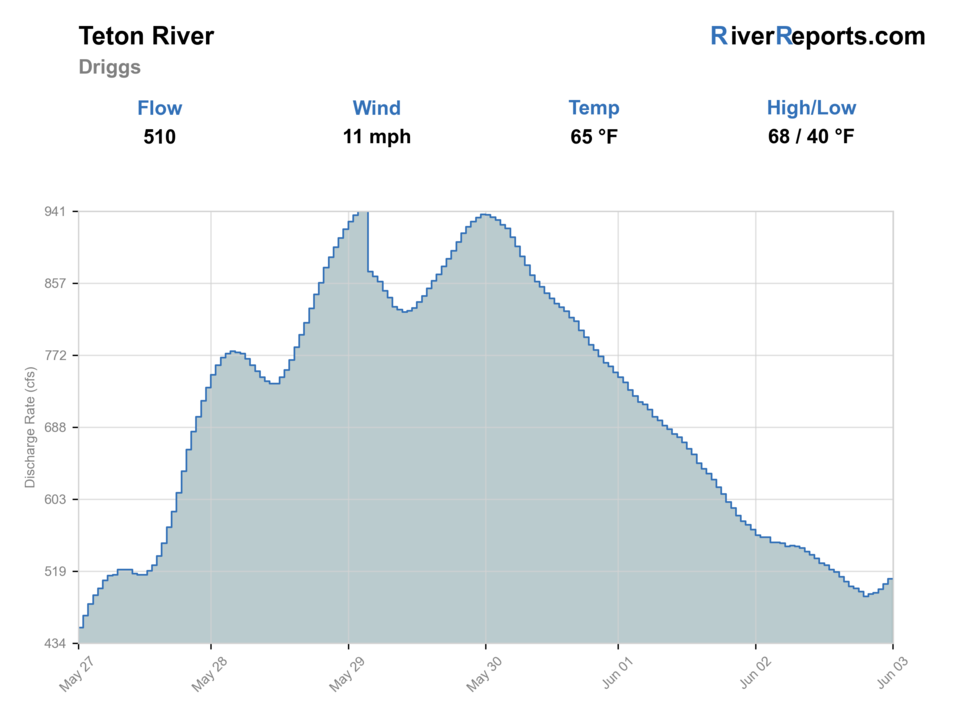
USGS data chart
Official USGS trend
Streamflow over the latest USGS reporting window.
Latest
510 cfs
Jun 3, 4 PM UTC
Weather
River weather report
Weather can change wading safety, road access, water temperature, hatches, and the best time of day to fish.
Live forecast loads as you reach this section
This keeps the report fast while still using the official National Weather Service forecast point.
Hatches and flies
Hatch chart and fly picks
Spring
BWOs, midges, and early caddis
BWO emerger, zebra midge, caddis pupa, small soft hackle
Early summer
PMDs, caddis, sallies, and attractor days
PMD sparkle dun, elk hair caddis, yellow stimulator, pheasant tail
Summer
Hoppers, ants, beetles, and evening caddis
Foam hopper, ant, beetle, caddis emerger
Fall
BWOs, midges, and slim streamers
Parachute BWO, RS2, zebra midge, olive streamer
Upper-valley nymphs
Pheasant tail, hare's ear, perdigon, zebra midge
Best for undercut banks and deeper meadow slots when fish are not visibly rising.
Dry-dropper
Small chubby, stimulator, hopper, ant, tungsten dropper
Ideal when the river has enough shape to suspend a second fly cleanly beside the grass.
Technical dries
PMD, BWO, spinner, caddis, ant
Most useful during softer wind windows and evening slicks.
Light streamers
Micro sculpin, bugger, leech
A backup play in shoulder season or under cloud cover, not the first reason to fish this route.
Tactics
How to fish it
Fish one named bridge reach thoroughly before moving to the next because upper-Teton quality is often bend-specific.
Work the outside meadow banks, undercuts, and current tongues first, then cover soft center water only after the prime edges are spent.
If the wind picks up, switch to shorter drifts and heavier dry-dropper control instead of trying to preserve long technical presentations.
Use the first warm-water signal as a stop sign, not as a prompt to chase deeper holes harder.
Rigging
Rod, leader, and setup notes
A 4- or 5-weight floating-line rod is the cleanest all-day tool on the Driggs reach.
Carry long leaders in 4X to 6X because upper-valley slicks expose poor drifts immediately.
One short indicator setup and one dry-dropper leader usually beat carrying multiple redundant rods.
Pack light enough to move access to access without turning the day into a gear shuttle.
Access
Access and planning notes
Bates Bridge
Primary Driggs anchorWade / float / trail
IDFG access / wade / small craft
When to pick it
Start here when the South Leigh trend, wind, and water temperature support an upper-valley session.
Caution
Bridge access concentrates anglers and does not make adjoining private meadow banks public.
Rainey Bridge
Upper reach comparisonWade / float / trail
Access-guide bridge / wade
When to pick it
Use it when Bates is crowded or the reach needs a different bend and wind angle.
Caution
Check the current access guide and private-property boundaries before moving between bridges.
Cache Bridge corridor
Secondary bridge planWade / float / trail
Access-guide bridge / scout
When to pick it
Pick it when the upper river still has shape but the first bridge water is pressured or slow.
Caution
Low water and weeds can make extra bridge-hopping less productive than waiting for a better window.
Upper-river access is strong by meadow-river standards, but the useful water still clusters around named bridge corridors.
Bridge access makes it easy to move. That does not mean you should move early; better upper-Teton days usually come from reading one reach well.
This page is a better wade-first guide than a promise of easy every-day floating.
Regulations
Check before fishing
Use the Idaho Fish and Game Teton River planner for current rules. The main stem allows no harvest of cutthroat trout and unlimited harvest of rainbow trout or trout hybrids, while nearby tributaries follow separate seasonal and June-closure restrictions.
Primary base
Driggs or Tetonia, with Victor and the broader Teton Valley as lodging and backup-weather options
Best day style
Upper-valley bridge access, walk-wade banks, and selective small-boat days when the meadow channel still has enough depth to stay efficient
Check first
RiverReports, USGS 13052200, IDFG Teton rules, bridge-access wind exposure, and morning water temperature
Safety
Wind exposure, slick grassy banks, warm late-summer water, and private meadows between public crossings
Gear
Helpful gear for this water
4- or 5-weight rod
A precise fit for dry-dropper work and technical meadow presentations.
Long leaders and fine tippet
Important when clear upper-valley slicks punish splashy drifts.
Thermometer
Needed because this reach can look ideal while late-day temperatures slide the fishery the wrong way.
Good glasses and light layers
Wind, glare, and subtle bankside structure all reward better visibility.
Nearby water
Other water to research
Backup logic
Low or warm water
Fish the first cool window only, then compare the full Teton page, Henry's Fork, or South Fork Snake.
Wind
Shorten to protected bends or choose a less exposed river instead of forcing long meadow presentations.
Weeds
Use cleaner short drifts or move to a larger backup with less fouling.
Access uncertainty
Stay with documented bridge access and avoid walking private meadows between public entries.
Main-stem Teton River
Use the full-river page when you need lower-valley access and St. Anthony gauge context too.
South Fork of the Snake River
A bigger, more structured float backup when upper-Teton wind or weeds become the whole story.
Henry's Fork of the Snake River
A stronger hatch-driven option when you want more predictable public infrastructure.
FAQ
Fast answers
Is Teton River fishable today?
Teton River looks very fishable right now. The live score is 96/100, based on current flow, weather, public alerts, and the report's planning context. Recheck the linked gauge and forecast before leaving because conditions can change quickly after rain, heat, access changes, or flow swings.
What flow is best for Teton River?
Moderate upper-valley flows that still hold clean undercut seams and keep side channels from turning into disconnected weed lanes.
When should I skip Teton River?
Skip when wind makes casting feel random, when low water flattens the banks, or when heat pushes the upper meadow into a short-window fishery.
Is Teton River safe to wade right now?
The fishability score is not a wading guarantee. Wade only where your chosen access has safe edges, clear footing, legal entry, and no forced crossings; high, rising, stained, or storm-affected water should be treated conservatively.
Which gauge matters most for the Driggs Teton?
Use RiverReports and USGS 13052200 above South Leigh Creek near Driggs because that gauge best matches the upper-valley meadow water on this page.
Is the Driggs reach better for wading or floating?
Usually wading first. Float only when flows, weeds, and wind all line up well enough to make the upper meadow channel efficient.
When should I leave the upper Teton alone?
Leave it alone when the South Leigh gauge is low enough that the river loses shape, when the afternoon gets too warm, or when valley wind ruins presentation control.
Sources
Source set for this report
Reviewed 2026-06-02