Colorado / West
Blue River
A Silverthorne-focused Blue River report for Dillon Dam releases, technical trout tactics, strict regulations, access, hatches, and flow checks.
Image: Blue River, Colorado / CC BY 4.0 / Jeffrey BeallFishability now: Blue River fishability today
GreatData confidence: High96/100
Fishable now because the live gauge is falling, weather is mild, and no public alert is active.
Flow observed
4:15 PM UTC
Weather observed
5:00 PM UTC
Score calculated
5:24 PM UTC
Why this rating
Flow
Water temperature
Public alerts
Next 6-12 hours
Improving / hold
A falling gauge and usable weather should keep the next 6-12 hours in play unless tributaries stain or heat builds.
USGS flow
54 cfs
Current trend: flow falling, rating likely holding strong unless weather or clarity changes.
More planning details: flies, flow bands, and live source checks
Fish it today
Start here
Choose the section before tying on flies: the Silverthorne town water for a quick technical session, the SWA-mapped access points when you want clearer public-boundary confidence, or the lower Blue only after confirming that separate reach's flow and rules.
Best flow clue
Use the below-Dillon trend more than a single target number. Stable or gently rising releases are the cleanest read for technical nymphing and dry-dropper work; a sudden push should move you to softer banks, shorter wades, or a different reach.
Skip trigger
Skip the Silverthorne plan when icy banks remove safe footing, when section-specific rules are unclear, when town pressure has every visible seam occupied, or when higher releases turn a simple crossing into risky tailwater current.
Flow decision bands
Low but fishable
Low stable tailwater flow can fish technically when trout handling, ice, and public boundaries all support a short session.
Best Silverthorne tailwater window
Stable below-Dillon releases with mild weather and manageable pressure create the best small-fly signal.
Release push or ice unsafe
Rising releases, shelf ice, or slick winter banks should shrink the plan or move it elsewhere.
Crowd and rule caution
Town pressure and reach-specific rules can make a good-looking flow less useful.
USGS flow
54 cfs
Current trend: flow falling, rating likely holding strong unless weather or clarity changes.
Live USGS flow
54 cfs / falling about 48%
Live NWS forecast
71F / Mostly Sunny
Live water temperature
42F from USGS
No NWS alert flag
No active NWS alert was returned for this forecast point.
Use the below-Dillon gauge for Silverthorne flow and release context.
Start with small midges, baetis, mysis-style patterns, and light tippet.
Check CPW reach language because Blue River rules change by section.
Expect crowds near town and private-property complexity outside obvious public access.
Editorial review
How this report is maintained
This report starts with official regulation, access, flow, weather, and public-river sources, then adds practical planning guidance for anglers.
Byline
BlueStreamFly editorial desk
Reviewed by
BlueStreamFly source review
Maintained by
BlueStreamFly
Last material review
2026-05-31
Report confidence
High confidence
90/100
High confidence: RiverReports, USGS below-Dillon flow, CPW Blue River context, Colorado special-regulation sources, Summit County pathway context, CPW SWA map, and weather data support the page. Confidence is moderated by town pressure, winter ice, private boundaries, and reach-specific rule differences.
Regulations
Colorado special-regulation sources and CPW Blue River context support the legal-check path.
Access
Summit County pathway context and the CPW Blue River SWA map provide strong public-boundary planning support, with posted signs still requiring current checks.
Flow and weather
RiverReports, USGS 09050700, and the National Weather Service point are attached to the route.
Fishing usefulness
The page now separates Silverthorne tailwater releases, town pressure, ice, access boundaries, lower-Blue separation, and backup-water decisions.
Fishability dashboard and source review
2026-05-31 / material content or source review
RiverReports, USGS Blue River below Dillon flow data, Colorado Parks and Wildlife Blue River information, Colorado special-regulation sources, Summit County pathway context, CPW Blue River SWA map, and the National Weather Service point were checked before updating the current fishability guidance.
2026-05-31
Updated Blue River with below-Dillon release guidance, Silverthorne access cards, winter and crowd cautions, backup cues, stable fishability SEO, and confidence signals.
2026-05-29
Added a page-specific report-confidence meter for Blue River flow, Silverthorne tailwater access, special-regulation checks, SWA boundaries, weather, and technical tailwater planning.
2026-05-28
Added editorial review signals, a public verification note, and original angler-planning guidance covering best trip fit, section choice, wade-versus-float framing, skip triggers, crowd timing, and backup-water decisions after source review.
Angler planning edge
Local details that change the plan
Best for
Technical tailwater anglers who want a short-session trout plan near Silverthorne, Trips built around stable Dillon releases instead of freestone runoff timing, Walk-and-wade days where small flies, clean drifts, and exact section rules matter, Anglers willing to leave crowded town water for another reach instead of forcing one famous pool
Wade or float
Treat the Blue below Dillon as a wade-first page. The Silverthorne reach fishes best as a short bank-and-wade tailwater plan, while the lower Blue near Green Mountain is a separate river day with different access, flow, and regulation decisions.
Best flows
Use the below-Dillon trend more than a single target number. Stable or gently rising releases are the cleanest read for technical nymphing and dry-dropper work; a sudden push should move you to softer banks, shorter wades, or a different reach.
When to skip
Skip the Silverthorne plan when icy banks remove safe footing, when section-specific rules are unclear, when town pressure has every visible seam occupied, or when higher releases turn a simple crossing into risky tailwater current.
Local plan
Choose the section before tying on flies: the Silverthorne town water for a quick technical session, the SWA-mapped access points when you want clearer public-boundary confidence, or the lower Blue only after confirming that separate reach's flow and rules.
Pressure
The easiest in-town pulls get crowded fast, especially on weekends and during stable winter or shoulder-season flows. Early starts, midweek windows, and a willingness to walk away from the obvious bridge pools matter more than swapping among tiny fly patterns.
Access nuance
Blue River access looks simple on a map but changes by section. Public town walks, SWA parcels, and private gaps sit close together, so use the CPW map and the exact special-regulation reach before assuming a clean public corridor.
Backup water
If the Silverthorne water is too crowded or pushy, pivot to the upper Colorado for a broader public-river day or to another clearly posted Blue reach only after checking that reach's separate rules and release context.
About the river
Setting, character, and why it fishes the way it does.
The Blue River is a high-profile Colorado tailwater and freestone system that runs through Summit County before joining the Colorado River.
This report focuses on the Silverthorne reach below Dillon Reservoir because that is the most searched and easiest-to-misread fishery.
The river is valuable but not simple. Public access, seasonal closures, catch-and-release sections, and lower Blue differences all need current CPW checks.
Target species
Rainbow trout
A primary tailwater target in the Silverthorne reach.
Brown trout
Often tied to deeper slots, banks, and low-light streamer windows.
Cutthroat trout context
Possible in the basin, but keep exact target guidance tied to current CPW reach data.
Whitefish context
Part of broader Colorado River basin trout-water planning in some connected reaches.
Reading the water
Low clear release
Use small flies, long leaders, and sight-fishing patience.
Stable medium release
Nymph riffles, slots, and drop-offs; dry-dropper rigs work in shallower lanes.
High release
Skip risky crossings and fish banks, softer seams, and protected edges.
Winter ice
Expect shelf ice, slow takes, and small midge-focused windows.
Best seasons
Winter
Midges and mysis-style nymphs can work, but ice and crowding limit comfort.
Spring
Baetis and changing releases make careful daily gauge checks important.
Summer
Tailwater temperatures can stay cold, but pressure and reach rules matter.
Fall
Cooler weather, BWOs, and streamer windows can improve the plan when flows are steady.
Preferred flow source
Blue River below Dillon
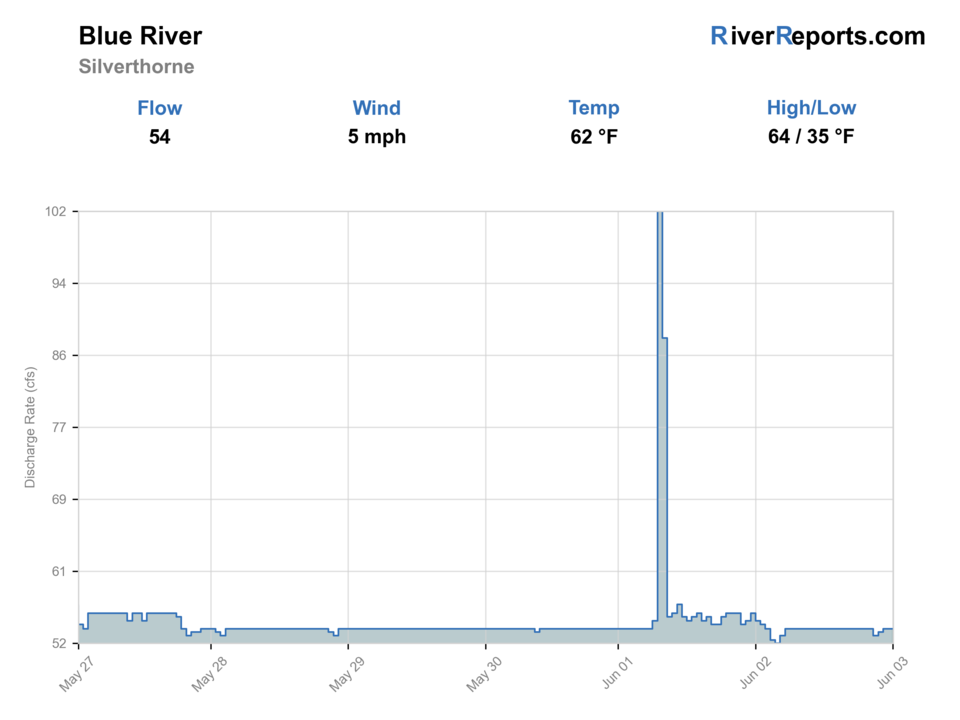
RiverReports is the preferred chart source when coverage exists. When a matching USGS gauge exists, keep it open as the official backstop for station data and current hydrograph context.
USGS data chart
Official USGS trend
Streamflow over the latest USGS reporting window.
Latest
54 cfs
Jun 3, 4 PM UTC
Weather
River weather report
Weather can change wading safety, road access, water temperature, hatches, and the best time of day to fish.
Live forecast loads as you reach this section
This keeps the report fast while still using the official National Weather Service forecast point.
Hatches and flies
Hatch chart and fly picks
Winter
Midges, mysis-style food, small baetis
Zebra midge, black beauty, mysis shrimp, RS2
Spring
BWOs, midges, caddis
BWO emerger, foam back emerger, caddis pupa, perdigon
Summer
PMDs, caddis, yellow sallies, terrestrials
PMD, elk hair caddis, yellow sally, ant, small hopper
Fall
BWOs, midges, small baitfish
BWO dry, zebra midge, RS2, small streamer
Tailwater nymphs
Zebra midge, RS2, black beauty, mysis shrimp, perdigon
Use in clear town water and cold tailwater seams.
Mayflies and caddis
BWO, PMD, caddis pupa, soft hackle
Use during spring, summer, and fall hatch windows.
Dry flies
Parachute Adams, BWO, PMD, elk hair caddis, ant
Use on visible risers and soft edge water.
Streamers
Small leech, sculpin, bugger
Use around higher flows, low light, or less-pressured lower water.
Tactics
How to fish it
Fish one lane thoroughly before changing pools.
Use smaller indicators or tight-line rigs in clear pressured water.
Watch for seasonal closures and spawning fish before stepping into gravel.
Do not assume the lower Blue has the same rules as Silverthorne.
Move to less-crowded access rather than lining up behind every visible fish.
Rigging
Rod, leader, and setup notes
A 9-foot 5-weight is the main Blue River rod.
Use 5X to 7X for small tailwater flies in clear water.
Keep a streamer leader for cloudy days or higher releases.
Carry split shot from tiny to medium for quick depth changes.
Use warm gloves and traction in winter.
Access
Access and planning notes
Silverthorne town water
Quick technical tailwater sessionWade / float / trail
Walk / wade / bank
When to pick it
Use it when below-Dillon releases are stable and crowding is manageable.
Caution
Town access does not remove private-boundary or posted-rule checks.
Blue River SWA access
Public-boundary confidenceWade / float / trail
SWA / walk-and-wade
When to pick it
Pick mapped SWA access when you want clearer legal edges.
Caution
Confirm current SWA rules and do not assume every nearby path is open to fishing.
Lower Blue comparison
Separate reach decisionWade / float / trail
Road / map / gauge check
When to pick it
Use this only when intentionally shifting away from the Silverthorne tailwater.
Caution
The lower Blue has separate access, flow, and rule decisions.
Read CPW reach language before applying one rule to the whole river.
Town access is easy, but fish see heavy pressure.
Private property and no-public-access areas appear in the broader Blue River corridor.
Winter ice can make simple wading dangerous.
Regulations
Check before fishing
CPW lists multiple Blue River special-regulation sections, including Silverthorne catch-and-release water and seasonal or reach-specific rules. Verify the exact section before fishing.
Primary base
Silverthorne
Best day style
Town tailwater, trail access, SWA parcels, and private-land gaps
Check first
Release flow, seasonal closures, public access, and CPW special rules
Safety
Cold dam releases, ice, crowding, and fast pocket water
Gear
Helpful gear for this water
Fine tippet
5X to 7X is common when flows are clear and fish are pressured.
Small nymph box
Midges, baetis, mysis-style flies, and perdigons are core patterns.
Warm layers
Cold releases and Summit County weather can make winter fishing sharp.
Polarized glasses
Helpful for spotting fish and avoiding spawning gravel.
Nearby water
Other water to research
Backup logic
High water
Stay to soft banks, wait for steadier releases, or compare the upper Colorado.
Heat
Cold tailwater helps, but check temperature and reduce pressure when trout handling becomes questionable.
Storms or ice
Treat shelf ice, snow, and slick paths as hard safety inputs.
Access issue
Use mapped SWA or clearly signed public access rather than guessing at town-bank boundaries.
Colorado River
The upper Colorado near Parshall is the natural next big-river option.
Arkansas River at Salida
A freestone alternative when you want a less technical big-river day.
Boulder Creek
A shorter Front Range option when Summit County weather is difficult.
FAQ
Fast answers
Is Blue River fishable today?
Blue River looks very fishable right now. The live score is 96/100, based on current flow, weather, public alerts, and the report's planning context. Recheck the linked gauge and forecast before leaving because conditions can change quickly after rain, heat, access changes, or flow swings.
What flow is best for Blue River?
Use the below-Dillon trend more than a single target number. Stable or gently rising releases are the cleanest read for technical nymphing and dry-dropper work; a sudden push should move you to softer banks, shorter wades, or a different reach.
When should I skip Blue River?
Skip the Silverthorne plan when icy banks remove safe footing, when section-specific rules are unclear, when town pressure has every visible seam occupied, or when higher releases turn a simple crossing into risky tailwater current.
Is Blue River safe to wade right now?
The fishability score is not a wading guarantee. Wade only where your chosen access has safe edges, clear footing, legal entry, and no forced crossings; high, rising, stained, or storm-affected water should be treated conservatively.
What section does this Blue River report cover?
It focuses on the Silverthorne reach below Dillon Reservoir, with lower Blue context where it affects planning.
Why is the Blue River technical?
The water is clear, cold, heavily fished, and governed by reach-specific rules, so small flies and clean drifts matter.
What gauge should I use?
Use RiverReports and USGS 09050700 below Dillon for the Silverthorne tailwater.
Can I fish the same way below Green Mountain?
Not safely without a separate check. The lower Blue has different access, flow, and regulation context.
Sources
Source set for this report
Reviewed 2026-05-31