California / West
Klamath River
A lower and middle Klamath report for salmon and steelhead rule checks, post-dam-removal context, flow planning, access, and careful fly tactics.
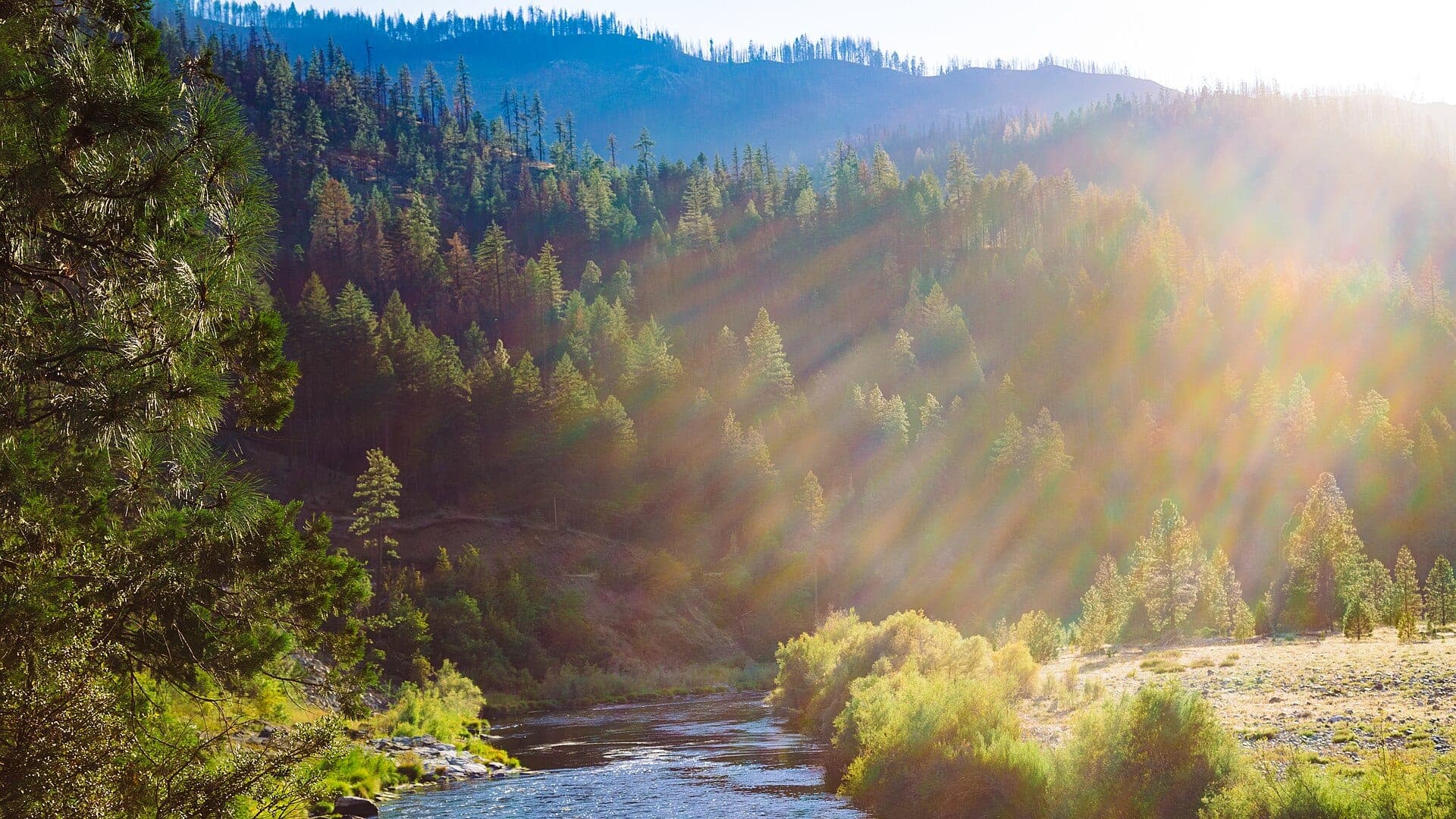
Image: Klamath River in Siskiyou County, California (40521984611) / CC BY 2.0 / Tony Webster from Minneapolis, Minnesota, United StatesFishability now: Klamath River fishability today
GreatData confidence: High96/100
Fishable now because the live gauge is stable, weather is mild, and no public alert is active.
Flow observed
4:15 PM UTC
Weather observed
5:00 PM UTC
Score calculated
5:24 PM UTC
Why this rating
Flow
Weather
Public alerts
Next 6-12 hours
Hold
Stable live data supports staying with the plan, but recheck the gauge and forecast before leaving.
USGS flow
1,250 cfs
Current trend: flow stable, so weather, temperature, and access checks drive the next change.
More planning details: flies, flow bands, and live source checks
Fish it today
Start here
Choose the objective first: an upper-river swing or nymph day near the Iron Gate and Seiad corridor, or a separate lower-river trip covered by the lower Klamath page. Once that is clear, match the flies and travel plan to one corridor instead of assuming the whole basin is fishing the same way.
Best flow clue
Use the Iron Gate trend as upper-river context rather than as permission by itself. Stable or slowly dropping flows are the better fit for swinging or nymphing broad travel lanes, while rising color, hot water, or rapid quota pressure should move the plan toward another river or another species.
Skip trigger
Skip the Klamath when salmon or steelhead rules are unclear, when in-season quota changes could turn a long drive into guesswork, when warm water makes salmonid handling questionable, or when restoration and access conditions make the reach you wanted more complicated than productive.
Flow decision bands
Open and fishable
The best signal is current CDFW open status, legal species timing, cool enough water, and stable or falling flow below Iron Gate.
Best swing window
Clearing, walking-speed water with mild weather supports steelhead or salmonid travel-lane tactics when the reach and species are legal.
Pushy or stained
Rising or dirty flow should move anglers to safe banks, another reach, or another river rather than risky crossings.
Rule or quota hard stop
Quota, emergency, report-card, and closure updates can override an otherwise fishable flow.
USGS flow
1,250 cfs
Current trend: flow stable, so weather, temperature, and access checks drive the next change.
Live USGS flow
1,250 cfs / stable
Live NWS forecast
65F / Mostly Sunny
Water temperature not verified
Heat guidance uses weather and river type unless an official water-temperature value is available.
No NWS alert flag
No active NWS alert was returned for this forecast point.
CDFW announced 2026 Klamath Basin salmon opportunity after a three-year closure, with season dates, bag limits, and quotas.
Check current steelhead, salmon, and report-card requirements before fishing.
Use RiverReports and USGS 11516530 for upper California flow context, then match the exact reach you plan to fish.
Treat restoration areas, tribal lands, private property, and posted closures with care.
Editorial review
How this report is maintained
This Klamath River report is maintained from current rule, flow, weather, and restoration sources so anglers can plan the upper California Klamath with post-dam-removal context instead of leaning on stale salmon or steelhead assumptions.
Byline
BlueStreamFly editorial team
Reviewed by
BlueStreamFly source review
Maintained by
Mountain Brook Run LLC
Last material review
2026-05-31
Report confidence
Good confidence
86/100
Good confidence: RiverReports, USGS Iron Gate flow, CDFW Klamath-Trinity rule sources, salmon reopening material, restoration context, and weather data support the page. Confidence is moderated by rule volatility, quota status, post-dam-removal access changes, temperature stress, and broad reach scope.
Regulations
CDFW Klamath-Trinity and salmon regulation sources support the legal-check path.
Access
Restoration and reach-planning sources support public context, but exact access, tribal/private boundaries, and restoration closures need current confirmation.
Flow and weather
RiverReports, USGS 11516530, and the National Weather Service point are attached to the route.
Fishing usefulness
The page now separates open-status checks, stable swing windows, temperature skips, restoration access, and backup choices.
Fishability dashboard and source review
2026-05-31 / material content or source review
RiverReports, USGS Klamath River below Iron Gate flow, CDFW Klamath-Trinity fishing pages, CDFW salmon regulation and reopening material, restoration monitoring context, and the National Weather Service point were checked before updating the current-fishability decision layer.
2026-05-31
Updated Klamath River to the current fishability-page standard with rule-first salmonid guidance, post-dam-removal access cautions, backup cues, stable fishability SEO, and confidence signals.
2026-05-28
Added quota-aware trip-fit guidance, wade-versus-drift framing, post-dam-removal access nuance, warm-water skip cues, pressure timing, backup-water suggestions, stronger editorial review signals, and a page-specific report-confidence meter after source review.
2026-05-24
Initial source-reviewed report published with flows, weather, hatches, flies, tactics, access, regulations, and FAQs.
Angler planning edge
Local details that change the plan
Best for
Anglers who will check the current Klamath-Trinity rule set before choosing salmon, steelhead, or trout-style water, Upper-basin trips where dam-removal changes, restoration context, and flow trend matter as much as fly selection, Mixed wade or boat planning on a big river when cool stable conditions line up, Northern California road trips that need a fallback when quotas, temperatures, or closures shift quickly
Wade or float
Treat the upper California Klamath as a mixed wade-or-drift page with a strong rules-first bias. There is enough river to cover efficiently from a boat in some windows, but many anglers will be better served by picking one legal public corridor and fishing it on foot once the current rule set and water temperature pass the basic test.
Best flows
Use the Iron Gate trend as upper-river context rather than as permission by itself. Stable or slowly dropping flows are the better fit for swinging or nymphing broad travel lanes, while rising color, hot water, or rapid quota pressure should move the plan toward another river or another species.
When to skip
Skip the Klamath when salmon or steelhead rules are unclear, when in-season quota changes could turn a long drive into guesswork, when warm water makes salmonid handling questionable, or when restoration and access conditions make the reach you wanted more complicated than productive.
Local plan
Choose the objective first: an upper-river swing or nymph day near the Iron Gate and Seiad corridor, or a separate lower-river trip covered by the lower Klamath page. Once that is clear, match the flies and travel plan to one corridor instead of assuming the whole basin is fishing the same way.
Pressure
The Klamath spreads anglers out geographically, but the best-known legal access and salmon-season windows can stack people fast when reopening news is fresh. Early-day starts, midweek timing, and a willingness to fish less obvious public water often matter more than cycling through every classic fly in the box.
Access nuance
Post-dam-removal Klamath planning still starts with boundaries. Restoration work, tribal land, private property, and long travel distances mean an open season does not automatically create easy bank access everywhere you can see the river.
Backup water
If the Klamath is too warm, too crowded, or too rule-sensitive for a confident day, pivot to the Trinity for a separate steelhead-style plan or to the McCloud if you need a trout-focused northern California backup.
About the river
Setting, character, and why it fishes the way it does.
The Klamath River runs from southern Oregon through northern California to the Pacific and is central to salmon, steelhead, tribal, restoration, and recreational fishing conversations.
Recent dam removals reopened historic habitat and changed how anglers should think about access, restoration, sediment, and fish movement.
CDFW's 2026 news reported Chinook fishing reopening in the Klamath River Basin after a three-year closure, with specific season dates, limits, and quota management.
Because the river is long and rule-sensitive, this page focuses on careful trip planning rather than pretending one live report can describe every reach.
Target species
Chinook salmon
A major Klamath species with 2026 reopening context, quota limits, and season details that must be checked before fishing.
Steelhead
A core fly-fishing target requiring current report-card, season, and reach checks.
Coho salmon
A conservation-sensitive salmonid; do not target or handle illegally.
Resident trout and native fish
Relevant in upper and tributary contexts, with rules that differ from lower anadromous planning.
Reading the water
Cool stable flow
Swing flies through tailouts, riffle buckets, and travel lanes with careful fish handling.
Warm water
Avoid stressing salmonids. Fish early, check temperatures, or choose another plan.
High or stained
Focus on safe banks and softer edges. Avoid dangerous crossings on a large river.
Quota-sensitive season
Check CDFW status before fishing for salmon because closures can happen when quotas are reached.
Best seasons
Late spring to summer
Late spring-run Chinook opportunity is rule-dependent and must be checked against CDFW's current Klamath page.
Late summer to fall
Fall-run Chinook and early steelhead context can matter, with quota and temperature checks.
Winter
Steelhead planning can be relevant, but storms, flows, access, and regulations decide the day.
Spring
Rising water, restoration context, and changing rules make official sources essential.
Preferred flow source
Klamath River below Iron Gate Dam
RiverReports is the preferred chart source when coverage exists. When a matching USGS gauge exists, keep it open as the official backstop for station data and current hydrograph context.
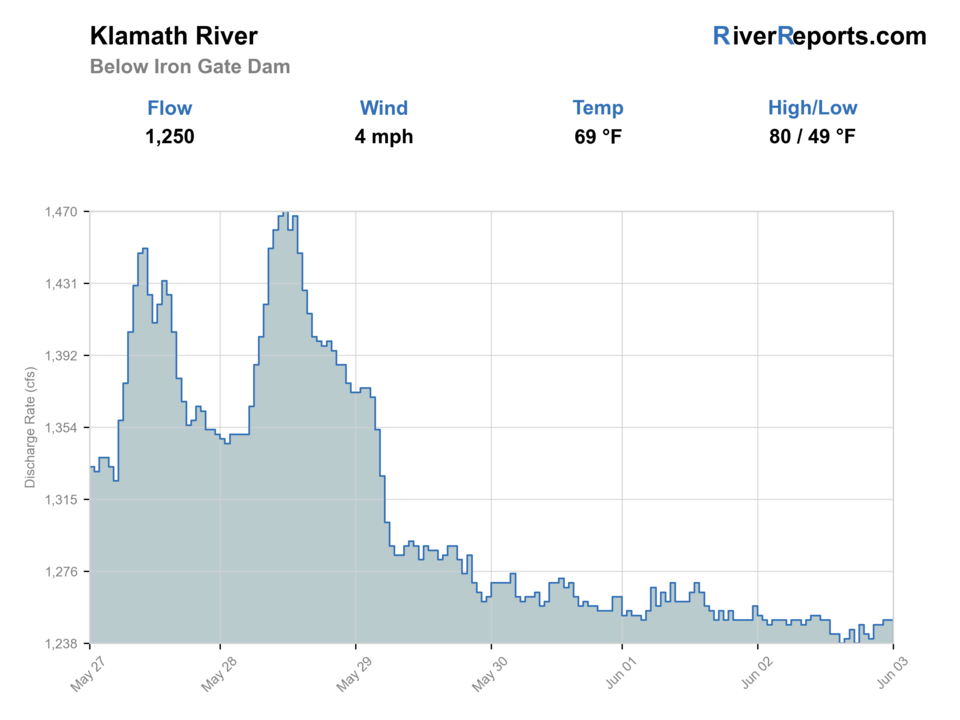
USGS data chart
Official USGS trend
Streamflow over the latest USGS reporting window.
Latest
1,250 cfs
Jun 3, 4 PM UTC
Weather
River weather report
Weather can change wading safety, road access, water temperature, hatches, and the best time of day to fish.
Live forecast loads as you reach this section
This keeps the report fast while still using the official National Weather Service forecast point.
Hatches and flies
Hatch chart and fly picks
Winter
Steelhead nymph and swing context
Intruder, leech, egg, stonefly nymph, prince
Spring
Stoneflies, caddis, mayflies
Stonefly nymph, soft hackle, caddis pupa, BWO
Summer
Caddis, terrestrials, salmon travel windows
Skater, muddler, caddis, small wet fly, sparse leech
Fall
Caddis, mayflies, salmon and steelhead movement
Traditional steelhead wet, egg, leech, muddler, BWO
Steelhead swing flies
Green-butt skunk, muddler, intruder, leech, polar shrimp
Use in cool, legal steelhead water with enough flow for a clean swing.
Nymphs
Stonefly, prince, copper john, egg, caddis pupa
Use in deeper travel lanes and winter or spring conditions where legal.
Dry and skater
Muddler, bomber, skater, large caddis
Use in warm-season steelhead surface windows only when water temperature and rules are appropriate.
Trout and tributary basics
Caddis, BWO, hare's ear, pheasant tail, soft hackle
Use only where current rules allow trout-style fishing and access is legal.
Tactics
How to fish it
Read the current CDFW Klamath-Trinity page before choosing a species or reach.
Check quota status, report-card requirements, and emergency closures before salmon fishing.
Use the gauge for trend context, then account for tributaries, distance, and local access.
Swing flies through walking-speed tailouts when water is cool enough for ethical salmonid fishing.
Do not trespass on tribal or private land and do not enter restoration closure areas.
Handle fish quickly, keep them wet, and stop fishing when water temperature makes release unsafe.
Rigging
Rod, leader, and setup notes
A 7-weight or 8-weight single-hand or two-hand setup is practical for steelhead and salmon context.
Use floating, intermediate, and sink-tip options to match flow and depth.
Carry strong leaders for anadromous fish and lighter leaders only for legal trout-style water.
Bring a thermometer, wading staff, and conservative wading plan.
Keep report cards, license, and regulation notes accessible in the field.
Access
Access and planning notes
Below former Iron Gate Dam
Upper California flow contextWade / float / trail
Bank / swing / restoration scout
When to pick it
Start here when current restoration, CDFW, and flow information all match the plan.
Caution
Dam-removal restoration context makes older access assumptions risky.
Seiad and middle river
Reach comparisonWade / float / trail
Bank / travel-lane scout
When to pick it
Use it when temperature, clarity, and access are better than upper or lower alternatives.
Caution
Private, tribal, and remote-road boundaries need respect.
Orleans and lower comparison
Backup reach logicWade / float / trail
Bank / large-river scout
When to pick it
Compare lower reaches when upper flow, heat, or rules do not line up.
Caution
Lower-river rules, temperatures, and access can differ from Iron Gate context.
CDFW's Klamath-Trinity pages and emergency updates should be checked before fishing.
Dam-removal restoration has changed habitat and access context; avoid closed restoration areas.
Some river corridors involve tribal lands, private property, and limited public access.
Fire season, smoke, and remote roads can affect northern California access.
Large-river wading can be dangerous at flows that look manageable from the road.
Regulations
Check before fishing
Verify current CDFW Klamath River Basin salmon, steelhead, report-card, quota, and emergency-closure rules before fishing. CDFW announced 2026 Chinook opportunities with specific dates and quotas, but in-season changes can close or alter fishing.
Primary base
Yreka, Hornbrook, Orleans, or Klamath, California
Best day style
Large-river access with quota and closure checks
Check first
CDFW Klamath rules, quotas, emergency updates, flow, and weather
Safety
Swift water, restoration changes, quotas, tribal and private access, fire season
Gear
Helpful gear for this water
Two-hand or 8-weight setup
Useful for swinging larger water and controlling sink tips.
Thermometer
Water temperature can decide whether salmonid fishing is ethical.
Wading staff
Important on a big, pushy river with uneven rocks.
Regulation and report-card kit
Keep current CDFW requirements ready before targeting salmon or steelhead.
Nearby water
Other water to research
Backup logic
High water
Wait for a falling trend or compare the Trinity, McCloud, or Hat Creek depending on target species.
Heat
Stop salmonid pressure when water is stressful and move to colder trout water or another day.
Rule uncertainty
Do not fish until CDFW Klamath-Trinity, quota, and emergency notices are clear.
Access issue
Avoid restoration, tribal, or private areas and choose a signed public plan or another river.
Hat Creek
A technical trout stream when Klamath salmonid rules, temperatures, or flows do not line up.
Fall River
A northern California spring-creek trout plan with very different access and flow issues.
Tsiu River
A remote Alaska coho context if you are researching salmon-focused travel water.
FAQ
Fast answers
Is Klamath River fishable today?
Klamath River looks very fishable right now. The live score is 96/100, based on current flow, weather, public alerts, and the report's planning context. Recheck the linked gauge and forecast before leaving because conditions can change quickly after rain, heat, access changes, or flow swings.
What flow is best for Klamath River?
Use the Iron Gate trend as upper-river context rather than as permission by itself. Stable or slowly dropping flows are the better fit for swinging or nymphing broad travel lanes, while rising color, hot water, or rapid quota pressure should move the plan toward another river or another species.
When should I skip Klamath River?
Skip the Klamath when salmon or steelhead rules are unclear, when in-season quota changes could turn a long drive into guesswork, when warm water makes salmonid handling questionable, or when restoration and access conditions make the reach you wanted more complicated than productive.
Is Klamath River safe to wade right now?
The fishability score is not a wading guarantee. Wade only where your chosen access has safe edges, clear footing, legal entry, and no forced crossings; high, rising, stained, or storm-affected water should be treated conservatively.
Is the Klamath River open for salmon in 2026?
CDFW announced 2026 Klamath Basin Chinook opportunities after a three-year closure, but anglers must check current season dates, quotas, and closures before fishing.
What gauge should I use?
Use RiverReports and USGS 11516530 below the former Iron Gate Dam area for upper California flow context, then match the exact reach.
What flies should I bring?
Bring steelhead swing flies, intruders, leeches, stonefly nymphs, caddis, eggs, muddlers, and sink-tip options.
Has dam removal changed the river?
Yes. Dam removal reopened habitat and changed access and restoration context. Use current official sources before assuming old conditions still apply.
Sources
Source set for this report
Reviewed 2026-05-31