Arkansas / Ozarks
Spring River
An Arkansas Spring River report for cold spring-influenced trout and warmwater planning, RiverReports flow, USGS data, AGFC sources, weather, hatches, flies, and access notes.
Image: Generated regional planning image for Spring River / BlueStreamFly generated; not exact location / BlueStreamFlyFishability now: Spring River fishability today
GreatData confidence: High96/100
Fishable now because the live gauge is falling, weather is usable, and no public alert is active.
Flow observed
5:00 PM UTC
Weather observed
5:00 PM UTC
Score calculated
5:23 PM UTC
Why this rating
Flow
Weather
Public alerts
Next 6-12 hours
Improving / hold
A falling gauge and usable weather should keep the next 6-12 hours in play unless tributaries stain or heat builds.
USGS flow
469 cfs
Current trend: flow falling, rating likely holding strong unless weather or clarity changes.
More planning details: flies, flow bands, and live source checks
Fish it today
Start here
Check AGFC updates, review RiverReports/USGS, pick a less crowded access, and start with trout nymphs or soft hackles.
Best flow clue
Stable, clear spring flow with enough room to fish without crowding.
Skip trigger
Skip when storms color the river, footing is unsafe, or heavy canoe traffic ruins the fishing window.
Flow decision bands
Low but fishable
Clear spring flow can still fish well, but use lighter trout rigs and avoid crowding obvious stocked water.
Best trout window
Stable clear spring flow with manageable canoe traffic is the best signal for nymphs, soft hackles, and small streamers.
Pushy or unsafe
High or colored water reduces footing and visibility; treat wading conservatively.
Crowd pressure
A good gauge reading can still be a poor day if canoe traffic or access pressure blocks clean fishing.
USGS flow
469 cfs
Current trend: flow falling, rating likely holding strong unless weather or clarity changes.
Live USGS flow
469 cfs / falling about 16%
Live NWS forecast
78F / Sunny
Water temperature not verified
Heat guidance uses weather and river type unless an official water-temperature value is available.
No NWS alert flag
No active NWS alert was returned for this forecast point.
Use RiverReports for the quick chart and USGS 07069305 as the official flow source.
AGFC Spring River information and current fishing reports should be checked before relying on trout assumptions.
Cold water, slick footing, and canoe traffic affect fly-fishing quality and safety.
Carry both trout nymphs/streamers and smallmouth or panfish flies for mixed water.
Editorial review
How this report is maintained
This report uses official regulation, flow, weather, access, and public-source material first, then adds practical angler planning guidance without replacing current rules.
Byline
BlueStreamFly editorial desk
Reviewed by
BlueStreamFly source review
Maintained by
BlueStreamFly
Last material review
2026-05-31
Report confidence
Good confidence
88/100
Good confidence: RiverReports, USGS Spring River flow, National Weather Service data, AGFC Spring River trout material, Arkansas fishing reports, and regulation sources support the report. Confidence is moderated by recreation traffic, stocked-site details, and exact access status.
Regulations
AGFC trout, general regulation, and fishing-report sources support the legal and current-info checks.
Access
AGFC Spring River material supports public access and stocking-site context, with exact site status and crowding requiring current checks.
Flow and weather
RiverReports, USGS 07069305, and the National Weather Service point are attached to the route.
Fishing usefulness
The page now separates trout versus mixed-water plans, flow checks, canoe traffic, slick footing, and backup choices.
Fishability dashboard and source review
2026-05-31 / material content or source review
Official regulation, emergency-order, flow, weather, access, safety, and fishability guidance sources were checked before updating the current-fishability decision layer.
2026-05-31
Updated to the current fishability-page standard with route-specific dashboard guidance, flow bands, access cards, backup cues, source timing, and confidence signals.
Angler planning edge
Local details that change the plan
Best for
Arkansas trout-oriented fly fishing, Cold spring-influenced water, Anglers who want a trout option near Ozark smallmouth rivers
Wade or float
Both can work, but wading requires slick-rock caution and floating must account for recreation traffic.
Best flows
Stable, clear spring flow with enough room to fish without crowding.
When to skip
Skip when storms color the river, footing is unsafe, or heavy canoe traffic ruins the fishing window.
Local plan
Check AGFC updates, review RiverReports/USGS, pick a less crowded access, and start with trout nymphs or soft hackles.
Pressure
Can be busy around access and recreation seasons. Early starts help.
Access nuance
Coldwater trout planning and lower mixed-species planning are different; match access to your target.
Backup water
Buffalo, Kings, and Eleven Point reports give smallmouth-style alternatives when Spring River is crowded.
About the river
Setting, character, and why it fishes the way it does.
Spring River begins at Mammoth Spring and is one of Arkansas' best-known cold spring-influenced fisheries. The cold, steady source helps support trout opportunities, while lower sections can mix in warmwater species.
AGFC publishes Spring River and trout-related information, but anglers should still check current statewide rules, reports, and any local updates before fishing.
A useful fly plan balances trout tactics with real river use: access points, canoe traffic, slick rock, cold water, and flow that may not behave like a freestone smallmouth stream.
Target species
Rainbow trout
Primary fly target in the coldwater sections; nymphs, streamers, and soft hackles are useful.
Brown trout
Possible in some contexts; use current AGFC information before assuming location or harvest rules.
Smallmouth bass
More relevant in warmer/lower contexts and around structure.
Sunfish
Good light-tackle targets around slower banks and summer mixed water.
Reading the water
Stable spring flow
Best for trout nymphing, swinging soft hackles, and streamer work.
High or colored water
Use caution; visibility and footing drop quickly.
Low clear water
Use lighter tippet, smaller nymphs, and stealth around pressured trout.
Busy recreation periods
Fish early, late, or less obvious access to avoid canoe traffic.
Best seasons
March to May
Good for Ozark smallmouth movement, streamers, crayfish, and early topwater when flows and clarity line up.
June to August
Fish early, carry poppers and small baitfish patterns, and watch warm-water recreation traffic.
September to November
Often the cleanest smallmouth window: lower pressure, better temperatures, and streamer or crawfish patterns.
December to February
Slow warmwater fishing, but trout water such as Spring River can stay relevant when access and flows are safe.
Preferred flow source
Spring River
RiverReports is the preferred chart source when coverage exists. When a matching USGS gauge exists, keep it open as the official backstop for station data and current hydrograph context.
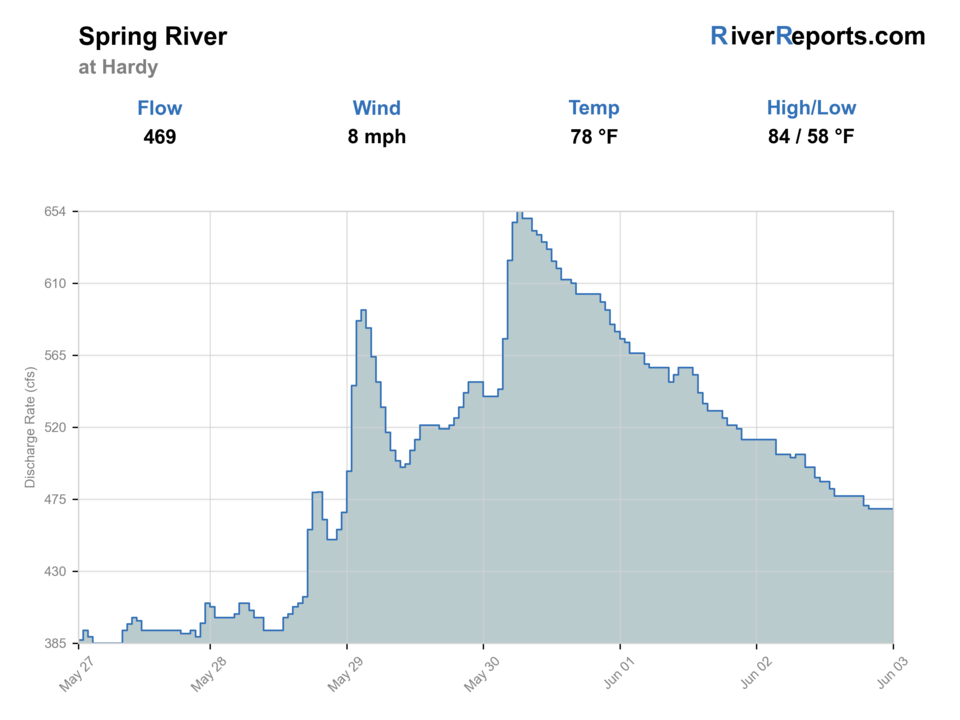
USGS data chart
Official USGS trend
Streamflow over the latest USGS reporting window.
Latest
469 cfs
Jun 3, 5 PM UTC
Weather
River weather report
Weather can change wading safety, road access, water temperature, hatches, and the best time of day to fish.
Live forecast loads as you reach this section
This keeps the report fast while still using the official National Weather Service forecast point.
Hatches and flies
Hatch chart and fly picks
March to April
Midges, small mayflies, crayfish movement, baitfish
Small clouser, bugger, hare's ear, pheasant tail
May to June
Caddis, mayflies, dragonflies, crayfish, hellgrammites
Elk hair caddis, rubber-leg nymph, crayfish, popper
July to September
Terrestrials, baitfish, crawfish, damselflies
Foam hopper, deer-hair bug, small streamer, crayfish
October to winter
Midges, small mayflies, baitfish, slow nymph windows
Midge pupa, soft hackle, small bugger, clouser
Topwater
Foam popper, slider, Sneaky Pete, deer-hair bug, small hopper
Use in summer shade, low light, and stable smallmouth flows.
Streamers
Clouser minnow, bugger, sculpin, crayfish, hellgrammite, small baitfish
Use along ledges, boulder shade, undercut banks, and deeper green pools.
Nymphs
Hare's ear, pheasant tail, rubber-leg stone, caddis pupa, perdigon
Use in trout sections, shoals, cold springs, and deeper runs when fish are not chasing.
Soft hackles
Partridge and orange, soft hackle pheasant tail, caddis soft hackle
Swing through riffle tails and soft seams when small bugs or caddis are active.
Tactics
How to fish it
Nymph riffles and runs with small mayfly, caddis, and midge patterns.
Swing soft hackles through tailouts when trout are not taking dries.
Use small streamers near deeper banks and structure when water has a little color.
Carry poppers or small baitfish flies if you move into warmer mixed-species water.
Rigging
Rod, leader, and setup notes
A 4- or 5-weight is comfortable for trout sections; a 6-weight helps with bass flies.
Use floating line for most nymph, soft-hackle, and dry/dropper work.
Carry split shot or weighted flies, but keep rigs simple around canoe traffic.
Bring wading staff or studs if conditions are slick.
Access
Access and planning notes
Mammoth Spring / upper river
Coldwater trout checkWade / float / trail
Wade / bank / access scout
When to pick it
Start here when the goal is trout-oriented fishing in the cold spring-influenced water.
Caution
Check current AGFC rules, trout permit needs, and access signs.
Hardy area
Recreation-aware planningWade / float / trail
Wade / float / scout
When to pick it
Use it when you need services and can work around canoe traffic.
Caution
Busy warm-weather river use can make fishing inefficient even when flows are fine.
Public river accesses
Float and stocking-site contextWade / float / trail
Access / wade / float
When to pick it
Pick a public access when flow, crowding, and your target species all match.
Caution
Use current signs and AGFC guidance; do not assume every bank is open.
Canoe traffic can be the biggest user-experience issue during warm months.
Cold water and slick rock make safe footwear more important than on many Ozark smallmouth streams.
Check current AGFC reports and rules before making trout harvest or method assumptions.
Regulations
Check before fishing
Check Arkansas trout and general fishing regulations plus current AGFC updates before fishing Spring River. Method, limit, stocking/report, and access details can change.
Primary base
Mammoth Spring, Hardy, or Cherokee Village
Best day style
Public access, canoe/kayak traffic, wade windows, and trout/warmwater mixes
Check first
AGFC trout and general rules, RiverReports, USGS 07069305, NWS weather, and access/canoe traffic
Safety
Cold spring flow, slick rock, canoe traffic, storms, and changing trout-stock/report details
Gear
Helpful gear for this water
4- or 5-weight trout rod
Good for nymphs, soft hackles, and small streamers.
Trout nymph box
Midges, pheasant tails, hare's ears, caddis, and small streamers matter.
Grip-focused wading shoes
Spring River rock can be slick.
Light rain and sun kit
Useful for long days around access and canoe traffic.
Nearby water
Other water to research
Backup logic
High water
Avoid slick, colored wades and compare Buffalo, Kings, or Eleven Point for a warmer smallmouth plan.
Heat
The spring source helps, but still fish early and handle trout quickly during hot recreation periods.
Storms or stain
Let color and footing recover before committing to trout nymphing.
Access issue
Move to a signed public access or another Arkansas river instead of forcing crowded or uncertain banks.
Eleven Point River
A nearby border-region plan where reach and state rules matter.
Buffalo River
A warmer smallmouth float alternative.
Kings River
A northwest Arkansas smallmouth option when trout water is crowded.
FAQ
Fast answers
Is Spring River fishable today?
Spring River looks very fishable right now. The live score is 96/100, based on current flow, weather, public alerts, and the report's planning context. Recheck the linked gauge and forecast before leaving because conditions can change quickly after rain, heat, access changes, or flow swings.
What flow is best for Spring River?
Stable, clear spring flow with enough room to fish without crowding.
When should I skip Spring River?
Skip when storms color the river, footing is unsafe, or heavy canoe traffic ruins the fishing window.
Is Spring River safe to wade right now?
The fishability score is not a wading guarantee. Wade only where your chosen access has safe edges, clear footing, legal entry, and no forced crossings; high, rising, stained, or storm-affected water should be treated conservatively.
Is Spring River a trout river?
Yes, the cold spring-influenced sections support trout fishing, but check current AGFC rules and reports before relying on any specific stocking or harvest assumption.
What flies should I start with?
Start with small nymphs, soft hackles, and streamers for trout, then carry poppers or baitfish flies for mixed warmwater sections.
Which flow source should I use?
Use the RiverReports Spring River chart for quick context and USGS 07069305 as the official flow source.
Sources
Source set for this report
Reviewed 2026-05-31