
Pennsylvania / Northeast
Valley Creek
A Valley Creek report for anglers planning the Valley Forge limestone corridor around wild brown trout, catch-and-release rules, trail access, and low-clear-water tactics.
Image: Generated regional planning image for Valley Creek / BlueStreamFly generated; not exact location / BlueStreamFlyFishability now: Valley Creek fishability today
GreatData confidence: High96/100
Fishable now because Valley Forge gauge is stable, weather is usable, and no public alert is active.
Flow observed
4:30 PM UTC
Weather observed
5:00 PM UTC
Score calculated
5:25 PM UTC
Why this rating
Flow
Water temperature
Public alerts
Next 6-12 hours
Hold
Stable live data supports staying with the plan, but recheck the gauge and forecast before leaving.
USGS flow
16 cfs
Current trend: flow stable, so weather, temperature, and access checks drive the next change.
More planning details: flies, flow bands, and live source checks
Fish it today
Start here
Start from Valley Forge public access, check clarity and temperature, then make one precise trout plan before making repeated casts.
Best flow clue
Use the Valley Forge trend with water clarity. Stable low to medium flow can fish well when the creek is cool and not crowded.
Skip trigger
Skip when storm flow stains the creek, footing is unsafe, trail pressure is heavy, water is warm, or catch-and-release rules are not confirmed.
Flow decision bands
Low but fishable
Stable low to medium flow can be fishable if stealth, long leaders, and careful first casts match the clear limestone water.
Best technical window
A slight color bump, cool weather, and checked catch-and-release rules give the strongest Valley Forge trout signal.
Pushy or stained
Storm flow, poor clarity, slick banks, or unsafe undercut edges should shorten the plan or move it elsewhere.
Warm or crowded
Hot afternoons, heavy trail pressure, or visibly stressed trout can make the creek a poor choice even at a friendly gauge level.
USGS flow
16 cfs
Current trend: flow stable, so weather, temperature, and access checks drive the next change.
Live USGS flow
16 cfs / stable
Live NWS forecast
79F / Sunny
Live water temperature
61F from USGS
No NWS alert flag
No active NWS alert was returned for this forecast point.
The National Park Service says Valley Creek supports naturally breeding brown trout in a limestone stream setting.
NPS also states that Valley Creek is catch-and-release only with tackle restrictions, and that anglers age 16 and older need a Pennsylvania fishing license.
Valley Forge has more than 35 miles of designated trails, including the Valley Creek Trail, which makes access simple but also concentrates angler traffic.
This is a stream where stable low or medium flow can still fish small, clear, and technical enough to punish rushed presentations.
Editorial review
How this report is maintained
This report starts with official regulation, access, flow, weather, and public-land sources, then adds practical planning guidance for fly anglers.
Byline
BlueStreamFly editorial desk
Reviewed by
BlueStreamFly source review
Maintained by
BlueStreamFly
Last material review
2026-06-02
Report confidence
High confidence
91/100
High confidence: RiverReports, USGS Valley Forge flow, National Park Service fish and trail sources, Pennsylvania regulations and permit pages, weather coverage, image disclosure, and route-specific limestone-trout guidance support the page. Confidence is moderated by low-clear-water pressure, warm afternoons, catch-and-release details, and small-stream access crowding.
Regulations
National Park Service Valley Creek fish guidance plus Pennsylvania trout, license, and regulation sources support the current rule-check path.
Access
Valley Forge trail and park sources support a strong public access framework, with crowding and official parking still requiring trip-day judgment.
Flow and weather
RiverReports coverage is backed by USGS 01473169 near Valley Forge, and the National Weather Service point supports weather and storm decisions.
Fishing usefulness
The page now separates technical limestone tactics, low-clear flow, trail pressure, warm-water restraint, catch-and-release rules, and backup-water choices.
Fishability dashboard and source review
2026-06-02 / material content or source review
RiverReports, USGS 01473169 near Valley Forge, Valley Forge fish and trail sources, Pennsylvania regulations, trout-regulation and permit pages, image-disclosure, and National Weather Service sources were checked before updating the current-fishability decision layer.
2026-06-02
Updated Valley Creek to the current fishability-page standard with Valley Forge limestone trend bands, trail-access cards, pressure-aware backup cues, stable fishability SEO, and confidence signals.
2026-05-26
Published a new Valley Creek report with catch-and-release planning, trail-access notes, limestone-trout tactics, and clear-water caution.
Angler planning edge
Local details that change the plan
Best for
Technical limestone trout, short careful wades, low-profile dry-dropper or nymph work
Wade or float
Walk and wade only. Keep the plan short, careful, and tied to official park access.
Best flows
Use the Valley Forge trend with water clarity. Stable low to medium flow can fish well when the creek is cool and not crowded.
When to skip
Skip when storm flow stains the creek, footing is unsafe, trail pressure is heavy, water is warm, or catch-and-release rules are not confirmed.
Local plan
Start from Valley Forge public access, check clarity and temperature, then make one precise trout plan before making repeated casts.
Pressure
Easy trail and bridge access means pressured fish; first casts and low-light timing matter.
Access nuance
Stay inside official Valley Forge access and avoid assuming private edges outside the park are open.
Backup water
Compare Yellow Breeches Creek, Little Juniata River, or Spring Creek when Valley Creek is too low, warm, crowded, or stained.
About the river
Setting, character, and why it fishes the way it does.
Valley Creek is one of southeastern Pennsylvania's best-known limestone trout streams because it combines naturally reproducing browns, suburban access, and a rare spring-creek feel close to a major metro corridor.
The Valley Forge section matters because it gives anglers one of the cleanest public access paths on the stream. That does not make the fishing easy. It just removes the guesswork about where you can legally walk and park.
This page stays focused on the Valley Forge corridor instead of trying to stretch into every branch and tributary. That keeps the guidance aligned with the NPS fish page, the Valley Creek Trail, and the public gauge near the park.
Target species
Brown trout
The main target, with naturally reproducing fish that reward small precise presentations.
Small forage fish
Present throughout the creek and part of why streamer windows can still matter.
Warmwater species downstream
More relevant toward larger connected water than in the core trout plan.
Reading the water
Low and clear
Fish smaller flies, longer leaders, and the first clean drift instead of repeated false casts.
Stable medium flow
The best all-around window for nymphs, soft hackles, and occasional dry-fly shots.
Light stain after rain
A useful bump if clarity stays fishable; cover more water with nymphs and small streamers.
Hot bright summer afternoons
Fish early, handle trout carefully, and stop if the water warms beyond a responsible trout plan.
Best seasons
Spring
Prime time for technical nymphing, caddis, and mayfly windows.
Early summer
Good dry-dropper and sulphur-style timing when water temperature stays trout-friendly.
Summer
Morning and evening are better than the middle of the day, and stealth matters more than fly quantity.
Fall
Cooling water and lighter foliage can produce some of the year's best nymph and streamer sessions.
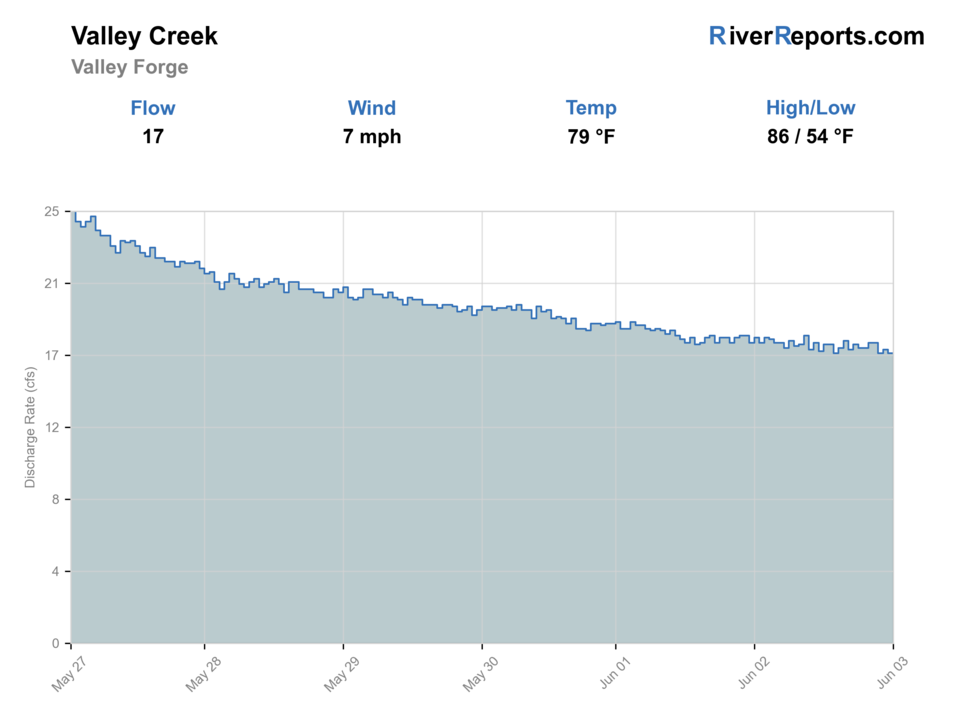
Preferred flow source
Valley Creek at Valley Forge
RiverReports is the preferred chart source when coverage exists. When a matching USGS gauge exists, keep it open as the official backstop for station data and current hydrograph context.
USGS data chart
Official USGS trend
Streamflow over the latest USGS reporting window.
Latest
16 cfs
Jun 3, 4 PM UTC
Weather
River weather report
Weather can change wading safety, road access, water temperature, hatches, and the best time of day to fish.
Live forecast loads as you reach this section
This keeps the report fast while still using the official National Weather Service forecast point.
Hatches and flies
Hatch chart and fly picks
March-April
Midges, blue-winged olives, early caddis
Zebra midge, RS2, small olive dry, caddis pupa
April-June
Caddis, sulphur-style mayflies, olives
Sulphur emerger, soft hackle, pheasant tail, elk hair caddis
June-August
Terrestrials, caddis, midges
Foam ant, beetle, small caddis, tiny nymphs
September-November
BWOs, midges, streamer windows
BWO dry, zebra midge, olive bugger, small scud
Small nymphs
Pheasant tail, zebra midge, scud, perdigon
The creek is clear and you need a clean controlled drift.
Emergers and soft hackles
RS2, sulphur emerger, olive soft hackle
Fish start suspending or show subtle head-and-tail rises.
Dries and terrestrials
Parachute Adams, small olive, ant, beetle
Use only when trout give you a clear reason to go on top.
Small streamers
Olive bugger, black bugger, slim baitfish
Best on cloud cover, after a bump in flow, or late in the day.
Tactics
How to fish it
Approach each run as if the first cast is the only cast that matters.
Fish from below and from the bank whenever possible because Valley Creek trout slide off the feed quickly when you crowd them.
Use light two-fly nymph rigs or a single weighted fly before adding more shot than the drift can handle.
If the creek is crowded, shorten your water and look for overlooked side seams instead of waiting for the obvious bend to open up.
Rigging
Rod, leader, and setup notes
A 3- or 4-weight with a long leader fits most Valley Creek work.
Carry 5X through 7X tippet and be ready to downsize flies before changing water.
Split shot should be minimal; too much weight ruins drifts in shallow limestone slots.
A thermometer and landing net help with ethical fish handling during warmer weather.
Access
Access and planning notes
Valley Forge gauge
Technical flow trendWade / float / trail
RiverReports / USGS gauge / wade
When to pick it
Start here when trend, clarity, and safe low-profile wading decide the day.
Caution
The gauge does not solve trout pressure, water temperature, or catch-and-release rule checks.
Valley Creek Trail
Public walk-in corridorWade / float / trail
Trail / wade / bank
When to pick it
Use it when official park access and a short careful session are the plan.
Caution
Easy access also means pressured trout and crowded bridge water.
Park lots and crossings
Short session startsWade / float / trail
Park access / wade
When to pick it
Pick these when the legal public corridor and current park rules are clear.
Caution
Stay in official access and avoid assuming private edges outside the park are open.
Public access is a major strength here, but it also means pressured fish near the easiest trail entries.
Stay on signed trails, use official parking, and avoid trespass assumptions once you leave the obvious park corridor.
The creek looks gentle, but slick banks and undercut edges still punish sloppy footing.
Regulations
Check before fishing
The National Park Service says Valley Creek is catch-and-release only with tackle restrictions. Recheck current Pennsylvania special regulations, license needs, and trout-permit requirements before fishing.
Primary base
Valley Forge, King of Prussia, Malvern, or a short southeast Pennsylvania day trip
Best day style
Walk-in park and trail access with careful approach, short drifts, and high-pressure trout etiquette
Check first
RiverReports, USGS 01473169, Valley Forge fish and trail pages, Pennsylvania regulations, and the NWS forecast
Safety
Low clear water, bank-side crowding, warm-weather trout stress, slick banks, and the temptation to over-wade small slots
Gear
Helpful gear for this water
3- or 4-weight rod
Best for small-fly control and delicate drifts in technical water.
Long leaders
Mandatory when the creek is clear and fish are pressured.
Thermometer
Useful for deciding when to shorten or skip the trout plan in hot weather.
Rubber-mesh net
Helps with quick releases on a catch-and-release-only stream.
Nearby water
Other water to research
Backup logic
Low, bright, or crowded
Compare Yellow Breeches Creek, Little Juniata River, or Spring Creek for more room or a different limestone window.
Warm trout water
Stop trout-focused fishing and choose a cooler responsible window or colder backup.
Storm stain
Wait for clarity to settle or move to a larger, better-buffered trout option.
Access or rule uncertainty
Confirm Valley Forge and Pennsylvania special-regulation requirements before fishing.
Yellow Breeches Creek
Another Pennsylvania limestone-style option with more room and a different access profile.
Little Juniata River
A bigger central Pennsylvania wild-trout benchmark when you want more current and more space.
Spring Creek
A classic technical limestone backup if you are willing to travel for a steadier trout focus.
FAQ
Fast answers
Is Valley Creek fishable today?
Valley Creek looks very fishable right now. The live score is 96/100, based on current flow, weather, public alerts, and the report's planning context. Recheck the linked gauge and forecast before leaving because conditions can change quickly after rain, heat, access changes, or flow swings.
What flow is best for Valley Creek?
Use the Valley Forge trend with water clarity. Stable low to medium flow can fish well when the creek is cool and not crowded.
When should I skip Valley Creek?
Skip when storm flow stains the creek, footing is unsafe, trail pressure is heavy, water is warm, or catch-and-release rules are not confirmed.
Is Valley Creek safe to wade right now?
The fishability score is not a wading guarantee. Wade only where your chosen access has safe edges, clear footing, legal entry, and no forced crossings; high, rising, stained, or storm-affected water should be treated conservatively.
Is Valley Creek catch and release?
Yes. The National Park Service says Valley Creek is catch-and-release only and includes tackle restrictions, so check current Pennsylvania special regulations before fishing.
What gauge should I use for Valley Creek?
Start with RiverReports for the quick chart and use USGS 01473169 at the PA Turnpike bridge near Valley Forge as the official flow reference.
What makes Valley Creek hard?
Clear limestone water, naturally breeding brown trout, short public runs, and steady angling pressure make good presentation more important than aggressive coverage.
Sources
Source set for this report
Reviewed 2026-06-02