Montana / West
Stillwater River
A Stillwater River report for anglers deciding whether the Absarokee-Columbus freestone has safe flows, useful clarity, and enough public access to fish well.
Image: Generated regional planning image for Stillwater River / BlueStreamFly generated; not exact location / BlueStreamFlyFishability now: Stillwater River fishability today
GreatData confidence: High96/100
Fishable now because the live gauge is falling, weather is mild, and no public alert is active.
Flow observed
3:15 PM UTC
Weather observed
4:00 PM UTC
Score calculated
4:20 PM UTC
Why this rating
Flow
Water temperature
Public alerts
Next 6-12 hours
Improving / hold
A falling gauge and usable weather should keep the next 6-12 hours in play unless tributaries stain or heat builds.
USGS flow
2,550 cfs
Current trend: flow falling, rating likely holding strong unless weather or clarity changes.
More planning details: flies, flow bands, and live source checks
Fish it today
Start here
Start with the Absarokee gauge, confirm access-site status, then pick either a short pocket-water wade or a conservative float based on the flow.
Best flow clue
Dropping, clearing flows after runoff and moderate summer levels that leave pocket water readable without warming the river too much.
Skip trigger
Skip during heavy runoff, muddy water, dangerous wading, active closures, or hot afternoons that stress trout.
Flow decision bands
Dropping clear freestone flow
Stable or falling Absarokee flow after runoff is the best sign that pocket water, banks, and float decisions can fish well.
High runoff push
High or rising water should move the plan away from wading and toward waiting, scouting, or a technical float-only decision.
Low warm summer water
Low clear flow can fish early, but trout-safe temperatures and closure checks matter more than covering water.
Cool fall clarity
Clear cool fall flow is a strong nymph and streamer window if access sites are open and wading stays reasonable.
USGS flow
2,550 cfs
Current trend: flow falling, rating likely holding strong unless weather or clarity changes.
Live USGS flow
2,550 cfs / falling about 24%
Live NWS forecast
61F / Sunny
Live water temperature
50F from USGS
No NWS alert flag
No active NWS alert was returned for this forecast point.
RiverReports is used for the quick visual chart, with USGS 06205000 near Absarokee as the official flow reference.
Montana FWP lists fishing access resources and current regulations that should be checked before using public sites.
High spring runoff can make the river unsafe to wade and difficult to fish, while hot low water requires trout-safe timing.
Public access is good by Montana standards, but individual sites can have closures, repairs, fees, or seasonal limits.
Editorial review
How this report is maintained
This report uses official regulation, flow, weather, access, and public-land sources first, then adds practical planning guidance for fly anglers.
Byline
BlueStreamFly editorial desk
Reviewed by
BlueStreamFly source review
Maintained by
BlueStreamFly
Last material review
2026-06-02
Report confidence
High confidence
90/100
High confidence: RiverReports, USGS 06205000 near Absarokee, Montana FWP regulations, current closure sources, fishing access, stream-access law, weather coverage, generated media disclosure, and route-specific Stillwater freestone guidance support the page. Confidence is moderated by runoff volatility, site-specific closures, wading difficulty, heat, and float skill assumptions.
Regulations
Montana FWP regulations and closure sources support current rule and warm-water restriction checks.
Access
Montana FWP fishing access and stream-access law sources support legal public-entry planning.
Flow and weather
RiverReports, USGS 06205000 near Absarokee, and the National Weather Service point support live flow and weather decisions.
Fishing usefulness
The page now separates post-runoff shape, boulder-pocket wading, FWP access status, closure checks, heat stops, float decisions, and Montana backup waters.
Fishability dashboard and source review
2026-06-02 / material content or source review
RiverReports and USGS 06205000 Absarokee flow, Montana FWP regulations, current waterbody closures, fishing access, stream-access law, National Weather Service data, and route-specific freestone safety guidance were checked before updating the current-fishability decision layer.
2026-06-02
Updated the Stillwater River with freestone flow bands, Montana access cards, backup cues, and confidence signals.
2026-05-26
Published a new Stillwater River report with Absarokee flow checks, freestone safety guidance, access cautions, hatch timing, and practical trout tactics.
Angler planning edge
Local details that change the plan
Best for
Post-runoff freestone fishing, Pocket-water dry-dropper days, Fall streamer windows
Wade or float
Both can work, but wading is flow-sensitive and floating requires technical judgment around fast water and public takeouts.
Best flows
Dropping, clearing flows after runoff and moderate summer levels that leave pocket water readable without warming the river too much.
When to skip
Skip during heavy runoff, muddy water, dangerous wading, active closures, or hot afternoons that stress trout.
Local plan
Start with the Absarokee gauge, confirm access-site status, then pick either a short pocket-water wade or a conservative float based on the flow.
Pressure
Popular access points can get busy after the river drops, but the fast freestone character spreads anglers better than tiny creeks.
Access nuance
A legal river does not make every bank or pullout public. Use FWP sites and clearly lawful entries.
Backup water
Shift to the Yellowstone or another lower-elevation option when Stillwater runoff is too high, or to cooler mountain water when summer heat becomes the limiter.
About the river
Setting, character, and why it fishes the way it does.
The Stillwater drops out of the Beartooth front into a boulder-strewn freestone corridor before joining the Yellowstone near Columbus.
Despite the name, it is not a slow river. Fast current, pocket water, shelves, and pushy riffles define many of the better fishing decisions.
This page focuses on the Absarokee-Columbus planning zone because the USGS gauge, access options, and common fly-fishing day plans are tied to that lower river corridor.
Target species
Rainbow trout
A common target in riffles, pocket water, and faster seams when flows are in shape.
Brown trout
Often better around banks, deeper slots, and lower-light streamer water.
Mountain whitefish
Part of the freestone catch mix and common in deeper nymphing lanes.
Reading the water
Dropping post-runoff flow
Often the best large-fly and nymph window when clarity returns but the river still has power.
Clear summer flow
Fish early, use dry-dropper rigs, and watch temperature during bright afternoons.
High spring runoff
Usually a safety and clarity problem. Wait for the river to drop and define softer edges.
Cool fall water
Good for streamers, baetis, and nymphing deeper slots with less recreational pressure.
Best seasons
Late spring
Condition-dependent because runoff can make the river high and dirty.
Early summer
Strong after the river drops into shape and before full heat dominates.
Summer mornings
Best with dry-dropper and terrestrial work when temperatures stay trout-safe.
Fall
A strong lower-pressure window for streamers, nymphs, and blue-winged olives.
Preferred flow source
Stillwater River near Absarokee
RiverReports is the preferred chart source when coverage exists. When a matching USGS gauge exists, keep it open as the official backstop for station data and current hydrograph context.
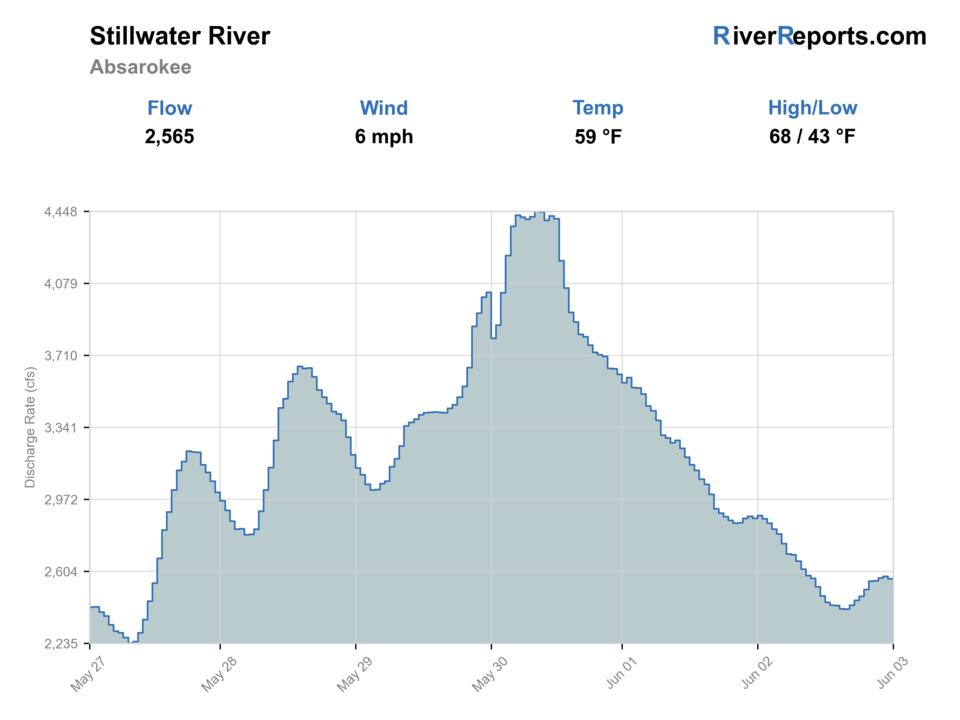
USGS data chart
Official USGS trend
Streamflow over the latest USGS reporting window.
Latest
2,550 cfs
Jun 3, 4 PM UTC
Weather
River weather report
Weather can change wading safety, road access, water temperature, hatches, and the best time of day to fish.
Live forecast loads as you reach this section
This keeps the report fast while still using the official National Weather Service forecast point.
Hatches and flies
Hatch chart and fly picks
Spring
Midges, BWOs, early stoneflies
Zebra midge, BWO emerger, stonefly nymph
Post-runoff
Salmonflies, golden stones, caddis
Chubby, pat's rubber legs, elk hair caddis
Summer
Caddis, PMDs, terrestrials
Hopper-dropper, PMD cripple, ant, beetle
Fall
BWOs, midges, streamer windows
Parachute BWO, zebra midge, olive bugger
Freestone dry-dropper
Chubby, hopper, caddis dry, perdigon dropper
The river is clear and fish are using riffle edges and pocket water.
Stillwater nymphs
Pat's rubber legs, pheasant tail, caddis pupa, prince nymph
You need weight and profile in fast seams or post-runoff pockets.
Boulder-bank streamers
Sculpin, olive bugger, black leech
Fall weather, low light, or a little stain gives brown trout cover.
Tactics
How to fish it
Start with flow and clarity. If you cannot safely wade or read the pocket water, wait for the river to settle.
Fish short accurate casts through boulder pockets, shelf edges, and softer banks instead of blind-casting the heaviest current.
On float days, plan around public access and boat handling. The river can be technical when flows are pushy.
During summer, fish early and stop when water temperature or closure guidance makes continued trout fishing a bad idea.
Rigging
Rod, leader, and setup notes
A 5-weight rod works for most wade days; a 6-weight helps with larger dries, weighted nymphs, and streamers from a boat.
Use 3X through 5X for dry-dropper and nymph setups that need to survive fast pocket water.
Carry split shot, tungsten nymphs, and buoyant dry flies because depth changes quickly around boulders.
Studded boots and a wading staff are smart when the river is even moderately pushy.
Access
Access and planning notes
Absarokee area
Gauge-area decision pointWade / float / trail
Roadside / access-site planning
When to pick it
Start here when you want the closest connection between the flow chart and a practical first stop.
Caution
Fast boulder current can be unsafe even when the gauge looks fishable.
Montana FWP access sites
Legal public entriesWade / float / trail
Fishing access / wade / float
When to pick it
Use them when site status, closures, and flow all support a lawful river plan.
Caution
Confirm current site status, fees, closures, and lawful entry before committing.
Columbus lower corridor
Longer float or scoutWade / float / trail
Lower-river access context
When to pick it
Pick it when the lower river has shape and a float plan makes more sense than short wading.
Caution
Do not let a shuttle plan outrun current, closure, or heat guidance.
The Stillwater has several public access opportunities, but site status matters. Check FWP access details and closure pages before committing to a shuttle.
Montana stream access law still requires lawful entry. Do not cross private land to reach a promising bank.
High water makes wading dangerous and can also complicate boat handling around boulders, bridges, and fast bends.
Regulations
Check before fishing
Check Montana fishing regulations and current waterbody closures before fishing. The Stillwater can be affected by runoff, warm-water stress, site closures, and changing access conditions.
Primary base
Absarokee, Nye, or Columbus
Best day style
Freestone float-and-wade planning from public fishing access sites, with high-water caution in the boulder reaches
Check first
RiverReports trend, USGS 06205000, Montana regulations, current waterbody closures, access site status, and local forecast
Safety
Pushy freestone current, slippery boulders, high runoff, warm summer afternoons, and public-access site status
Gear
Helpful gear for this water
5- or 6-weight rod
Covers pocket-water dries, weighted nymphs, and streamers around banks.
Studded boots and wading staff
Helpful on slick boulders and pushy freestone edges.
Thermometer
Important for warm summer afternoons and ethical trout handling.
Buoyant dry flies
Needed for dry-dropper work over broken pocket water.
Nearby water
Other water to research
Backup logic
Runoff too high
Wait for the river to drop or choose Yellowstone, Boulder, or another safer Montana option.
Warm afternoon or closure concern
Fish early only, check Montana FWP closures, or move to colder water.
Access site issue
Use a different confirmed FWP site rather than crossing private land.
Technical wading
Stay bank-first, use a wading staff, or switch to a conservative float plan with proper skill.
Yellowstone River
A larger nearby freestone option when Stillwater flows are too small or too technical.
Boulder River
A smaller mountain-front alternative with similar runoff timing and boulder-pocket character.
Madison River
A more established destination option when you want stronger access infrastructure.
FAQ
Fast answers
Is Stillwater River fishable today?
Stillwater River looks very fishable right now. The live score is 96/100, based on current flow, weather, public alerts, and the report's planning context. Recheck the linked gauge and forecast before leaving because conditions can change quickly after rain, heat, access changes, or flow swings.
What flow is best for Stillwater River?
Dropping, clearing flows after runoff and moderate summer levels that leave pocket water readable without warming the river too much.
When should I skip Stillwater River?
Skip during heavy runoff, muddy water, dangerous wading, active closures, or hot afternoons that stress trout.
Is Stillwater River safe to wade right now?
The fishability score is not a wading guarantee. Wade only where your chosen access has safe edges, clear footing, legal entry, and no forced crossings; high, rising, stained, or storm-affected water should be treated conservatively.
When is the Stillwater River best for fly fishing?
It is usually best after runoff drops into shape, during cool summer mornings, and through fall when water temperatures and clarity are favorable.
Is the Stillwater River safe to wade?
It can be safe at moderate flows, but it is a fast bouldery freestone. High water, slick rocks, and pushy pockets make wading risky.
What should I check before fishing the Stillwater?
Check RiverReports, USGS 06205000 near Absarokee, Montana regulations, current closure notices, access site status, and the weather forecast.
Sources
Source set for this report
Reviewed 2026-06-02