Montana / West
Boulder River
A freestone Boulder River planning page for anglers who need to know whether the Big Timber gauge, Main Boulder access, and current weather justify a wade-focused day.
Image: Generated regional planning image for Boulder River / BlueStreamFly generated; not an exact location photo / BlueStreamFlyFishability now: Boulder River fishability today
GreatData confidence: High96/100
Fishable now because Big Timber gauge is falling, weather is mild, and no public alert is active.
Flow observed
4:00 PM UTC
Weather observed
5:00 PM UTC
Score calculated
5:24 PM UTC
Why this rating
Flow
Weather
Public alerts
Next 6-12 hours
Improving / hold
A falling gauge and usable weather should keep the next 6-12 hours in play unless tributaries stain or heat builds.
USGS flow
2,030 cfs
Current trend: flow falling, rating likely holding strong unless weather or clarity changes.
More planning details: flies, flow bands, and live source checks
Fish it today
Start here
Start with the Big Timber trend and one Main Boulder corridor section. Fish the first real pocket-water sequence hard, then let clarity, weather, and footing decide whether to move farther up the valley.
Best flow clue
Use RiverReports and USGS 06200000 at Big Timber together. Stable post-runoff flow with clear edges and defined pocket water is the best signal; a rising muddy river or a broad heavy push should end the plan early.
Skip trigger
Skip or pivot when runoff spikes, thunderstorms muddy the river, wading feels marginal from the first entry, or cold spring weather turns the corridor into a survival project instead of a fishing day.
Flow decision bands
Low but still fishable
Lower summer Boulder water can still fish, but spooky trout, thin side channels, and temperature swings should keep the plan focused on cool hours and short precise drifts.
Best stable freestone window
Stable or slowly dropping Big Timber flow with clear pocket water is the strongest signal for dry-dropper, nymph, and short streamer fishing through the public corridor.
Pushy or muddy
Runoff spikes, thunderstorm color, or current that turns every entry into one fast sheet should move the day to another river.
Storm and wading caution
A fishable graph does not override lightning, cold spring weather, soft banks, or a reach where footing already feels borderline.
USGS flow
2,030 cfs
Current trend: flow falling, rating likely holding strong unless weather or clarity changes.
Live USGS flow
2,000 cfs / falling about 30%
Live NWS forecast
63F / Sunny
Water temperature not verified
Heat guidance uses weather and river type unless an official water-temperature value is available.
No NWS alert flag
No active NWS alert was returned for this forecast point.
RiverReports is the quick chart, backed by USGS 06200000 at Big Timber for official streamflow context.
Montana's statewide regulations and stream-access law set the legal frame: use legal public entries and stay within the ordinary high-water mark once you are on the river.
Custer Gallatin National Forest maintains Main Boulder, Chippy Park, and Falls Creek public recreation sites that anchor a practical upper-corridor access plan.
This is a runoff-sensitive freestone, so success usually comes from timing and wading judgment, not from trying to force a day after weather has already moved the river.
Editorial review
How this report is maintained
This Boulder River report is maintained from RiverReports and USGS Big Timber flow data, Montana FWP fishing regulations, stream-access law, Custer Gallatin National Forest Main Boulder and campground access pages, weather, generated-image disclosure, and runoff-sensitive freestone trout planning sources.
Byline
BlueStreamFly editorial team
Reviewed by
BlueStreamFly source review
Maintained by
Mountain Brook Run LLC
Last material review
2026-05-31
Report confidence
Good confidence
88/100
Good confidence: RiverReports, USGS Big Timber flow, Montana FWP regulations, stream-access law, Custer Gallatin National Forest access pages, weather, and generated-image disclosure are present. Confidence is moderated by freestone runoff swings, thunderstorm color, corridor-specific footing, and the use of a regional generated planning image.
Regulations
Montana FWP regulations and stream-access-law guidance are linked for current river-use checks.
Flow support
RiverReports Boulder River at Big Timber is backed by USGS 06200000.
Access support
Main Boulder, Chippy Park, and Falls Creek public pages provide concrete corridor-planning anchors.
Weather and safety
The National Weather Service point resolved and the page calls out runoff, storms, cold water, soft banks, and freestone wading risk.
Angler usefulness
The page separates runoff timing, public corridor access, safe wading, weather, and backup-water decisions.
Editorial review
A public correction path, source standards page, generated-image disclosure, and public review history are included.
Fishability source review
2026-05-31 / material content or source review
RiverReports Big Timber flow support, USGS 06200000, Montana FWP fishing regulations, stream-access law, Custer Gallatin National Forest Main Boulder, Chippy Park, and Falls Creek access pages, the National Weather Service point, and image disclosure were rechecked before adding the Pine Creek-standard current-fishability layer.
2026-05-31
Upgraded the page to the Pine Creek fishability standard with reviewed route profile, freestone decision bands, access cards, backup logic, and a top-page current-fishability answer.
2026-05-26
Initial source-reviewed report published with Boulder River flows, access, tactics, regulations, and FAQs.
Angler planning edge
Local details that change the plan
Best for
Freestone anglers timing runoff carefully instead of forcing the Boulder on a calendar, Wade-first trips built around the Main Boulder corridor, public campgrounds, and weather that keeps the river readable, Summer and early-fall pocket-water plans when the river is cool, clear enough, and not storm-flushed, Anglers deciding whether the Boulder is worth the drive or whether a larger and more stable river is the smarter call
Wade or float
Treat the Boulder as a wade-first freestone report. The public road and campground corridor matter more than a long float plan, and safe footwork decides the day before fly choice does.
Best flows
Use RiverReports and USGS 06200000 at Big Timber together. Stable post-runoff flow with clear edges and defined pocket water is the best signal; a rising muddy river or a broad heavy push should end the plan early.
When to skip
Skip or pivot when runoff spikes, thunderstorms muddy the river, wading feels marginal from the first entry, or cold spring weather turns the corridor into a survival project instead of a fishing day.
Local plan
Start with the Big Timber trend and one Main Boulder corridor section. Fish the first real pocket-water sequence hard, then let clarity, weather, and footing decide whether to move farther up the valley.
Pressure
Pressure is usually lighter than on Montana's marquee rivers, but fair-weather weekends still cluster anglers around easy roadside and campground access.
Access nuance
Montana stream-access law helps only after a legal entry. Build the day around named public corridor points and campgrounds instead of assuming every roadside bend is a safe and legal option.
Backup water
If the Boulder is blown out, muddy, or too cold and pushy to wade cleanly, move to a larger river with steadier flow support instead of trying to outguess a freestone already saying no.
About the river
Setting, character, and why it fishes the way it does.
The Boulder River drains steep country south of Big Timber and behaves like a classic Montana freestone: visually appealing, honest, and unforgiving when runoff takes over.
Its public value comes from the Main Boulder road corridor, Forest Service campgrounds, and Montana's stream-access framework rather than from one single famous named reach.
The river rewards anglers who want moving water, pocket structure, and clear bank-reading more than those looking for tailwater stability.
Target species
Brown trout
A realistic target in the lower-to-middle freestone runs, especially once flows settle.
Rainbow trout
Part of the main river mix and often visible when the river is stable and clear enough to fish cleanly.
Mountain whitefish
A useful sign that the run is fishable when trout feel less obvious.
Cutthroat trout
Possible higher in the drainage and in colder tributary influence, depending on section.
Reading the water
Post-runoff drop
Usually the best mix of current, clarity, and bank definition for a full freestone day.
Stable summer flow
Good for pocket-water nymphing, attractor dries, and covering one corridor stretch well.
Fresh color after storms
Worth considering only if edges still read cleanly; otherwise wait for the river to settle.
Heavy runoff
A clear skip signal because wading value and trout visibility both collapse quickly.
Best seasons
Late spring
Only after the runoff surge backs off enough to expose real seams and safe entries.
Summer
Usually the prime season once flows stabilize and the road-corridor access is fully usable.
Early fall
A strong technical window with cooler weather, cleaner flows, and lighter recreational pressure.
Late fall
Still useful on stable weather patterns, but shorter sessions and colder mornings matter.
Preferred flow source
Boulder River at Big Timber
RiverReports is the preferred chart source when coverage exists. When a matching USGS gauge exists, keep it open as the official backstop for station data and current hydrograph context.
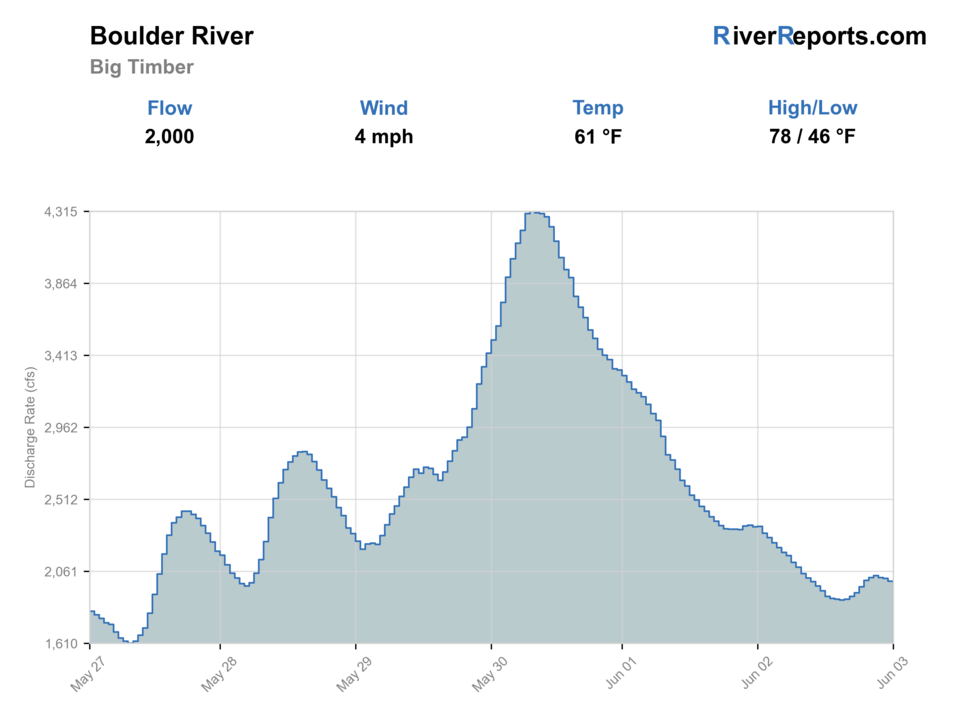
USGS data chart
Official USGS trend
Streamflow over the latest USGS reporting window.
Latest
2,000 cfs
Jun 3, 4 PM UTC
Weather
River weather report
Weather can change wading safety, road access, water temperature, hatches, and the best time of day to fish.
Live forecast loads as you reach this section
This keeps the report fast while still using the official National Weather Service forecast point.
Hatches and flies
Hatch chart and fly picks
Late spring
Stoneflies, caddis, and early mayflies
Stonefly nymph, elk hair caddis, pheasant tail
Summer
Golden stones, PMDs, caddis, and terrestrials
Chubby Chernobyl, PMD cripple, ant, beetle
Late summer
Caddis and hopper windows
Tan caddis, small hopper, dropper nymph
Fall
BWOs and streamer windows
Parachute BWO, RS2, olive bugger
Freestone nymphs
Stonefly nymph, perdigon, pheasant tail, hare's ear
You need to cover fast pocket water and heavier current slots.
Attractor dries
Chubby Chernobyl, stimulator, elk hair caddis
Summer surface activity or bank-side stonefly windows make the river feel alive.
Short streamer box
Olive bugger, sculpin pattern, black streamer
Water has a little color, clouds move in, or bigger fish slide onto the edges.
Tactics
How to fish it
Check the Big Timber gauge first, then fish only if the river still shows enough clarity and side-pocket shape to read confidently.
Work one public corridor section carefully instead of trying to leapfrog every turnout on the Main Boulder road.
On moderate water, start with heavier nymphs in pockets and switch to attractor dries or dry-dropper rigs once fish tell you they are willing to rise.
If the river keeps climbing or browning during the day, cut the session short and move rather than forcing bad freestone odds.
Rigging
Rod, leader, and setup notes
A 4- to 6-weight floating-line rod is the standard Boulder setup for nymphs, dries, and light streamers.
Carry 3X through 5X tippet so you can jump from stonefly-dropper rigs to smaller mayfly or caddis presentations.
Keep split shot and one larger indicator handy because the best runs often need quick depth changes.
Studded boots and a wading staff matter here more than on softer tailwater bottoms.
Access
Access and planning notes
Big Timber gauge check
Primary freestone decisionWade / float / trail
Gauge / wade
When to pick it
Start here when runoff timing decides whether the Boulder is worth the drive at all.
Caution
The gauge does not settle upper-corridor clarity, thunderstorm color, or exact footing at your chosen access point.
Main Boulder corridor
Primary public corridorWade / float / trail
Road scout / short wade
When to pick it
Use it when you want the clearest public road-and-river plan instead of guessing at random entry spots.
Caution
Roadside visibility is not the same thing as safe entry, stable banks, or legal parking everywhere.
Chippy Park and Falls Creek campgrounds
Known public anchorsWade / float / trail
Campground access / short session
When to pick it
Pick them when one defined public anchor is smarter than overdriving a stormy or pushy river in search of perfect water.
Caution
Campground access still does not make every nearby bank or pullout the right choice when the river is high.
Montana stream access helps once you enter legally, but the real trip-planning value comes from the named public corridor and campground entries.
The Main Boulder road gives you useful coverage, but this is still better as a one-section freestone day than a constant stop-and-go sprint.
Road and weather conditions can tighten the access window quickly in shoulder seasons, so check current conditions before a long drive south of Big Timber.
Regulations
Check before fishing
Use Montana's current fishing regulations for any district exceptions, then apply the stream-access law correctly: enter from legal public points and stay within the ordinary high-water mark rather than crossing posted private land.
Primary base
Big Timber
Best day style
Mostly wade-first freestone fishing with bridge and public-corridor access rather than one big float plan
Check first
RiverReports trend, USGS 06200000, Montana regulations, stream-access basics, and same-day weather
Safety
Runoff spikes, slick freestone rocks, cold water, fast weather shifts, and long stretches between services in the upper corridor
Gear
Helpful gear for this water
4- to 6-weight rod
The right range for freestone nymphing, attractor dries, and small streamers.
Wading staff and studs
Important because the Boulder gets pushy and slick before it looks dangerous from shore.
Rain shell
Mountain weather can turn a decent day into a cold freestone slog quickly.
Compact roadside lunch and repair kit
Useful because the best corridor fishing often means staying with one productive section instead of running back to town.
Nearby water
Other water to research
Backup logic
High water
Leave the Boulder alone when runoff is still pushy and move to a larger and more stable river instead of trying to hero-wade a freestone.
Storm color
Treat fresh thunderstorm mud as a full fishability limiter and wait for clarity to come back before returning.
Cold or rough weather
Shorten the day or pivot entirely when cold spring weather or lightning turns the public corridor into a safety problem.
Access issue
Use only confirmed public road and campground access and pivot if parking, bank stability, or legal entry are unclear.
Yellowstone River
A lower-elevation backup near Big Timber when you need a larger river option.
Stillwater River
A freestone alternative if you want similar character with a different drainage.
Madison River
A steadier fallback when you need more stable flow management than a runoff-prone freestone can offer.
FAQ
Fast answers
Is Boulder River fishable today?
Boulder River looks very fishable right now. The live score is 96/100, based on current flow, weather, public alerts, and the report's planning context. Recheck the linked gauge and forecast before leaving because conditions can change quickly after rain, heat, access changes, or flow swings.
What flow is best for Boulder River?
Use RiverReports and USGS 06200000 at Big Timber together. Stable post-runoff flow with clear edges and defined pocket water is the best signal; a rising muddy river or a broad heavy push should end the plan early.
When should I skip Boulder River?
Skip or pivot when runoff spikes, thunderstorms muddy the river, wading feels marginal from the first entry, or cold spring weather turns the corridor into a survival project instead of a fishing day.
Is Boulder River safe to wade right now?
The fishability score is not a wading guarantee. Wade only where your chosen access has safe edges, clear footing, legal entry, and no forced crossings; high, rising, stained, or storm-affected water should be treated conservatively.
What should I check first on the Boulder River?
Start with RiverReports and USGS 06200000 at Big Timber, then decide whether the clarity and level still leave enough safe wading and readable current for a true freestone day.
Is the Boulder River mostly a float river or a wade river?
Most anglers treat it as a wade-first river from public corridor access rather than an all-day float commitment.
When should I skip the Boulder?
Skip it during heavy runoff, after storms that turn the river opaque, or whenever fast rising water removes the bank edges and pocket definition that make the river fish well.
Sources
Source set for this report
Reviewed 2026-05-31