
Idaho / West
Salmon River
A lower-canyon Salmon River page for anglers deciding whether the White Bird reach fits a bank session, jet-boat plan, or a backup stop on the Highway 95 corridor.
Image: Generated regional planning image for Salmon River at White Bird / BlueStreamFly generated; not exact location / BlueStreamFlyFishability now: Salmon River fishability today
GreatData confidence: High96/100
Fishable now because White Bird gauge is falling, weather is mild, and no public alert is active.
Flow observed
3:45 PM UTC
Weather observed
4:00 PM UTC
Score calculated
4:20 PM UTC
Why this rating
Flow
Water temperature
Public alerts
Next 6-12 hours
Improving / hold
A falling gauge and usable weather should keep the next 6-12 hours in play unless tributaries stain or heat builds.
USGS flow
22,500 cfs
Current trend: flow falling, rating likely holding strong unless weather or clarity changes.
More planning details: flies, flow bands, and live source checks
Fish it today
Start here
Check the gauge, start at White Bird Gravel Pit, fish one bar or edge thoroughly, then decide whether to stay, launch, or drive on.
Best flow clue
Stable flows that leave shelves, bars, and inside seams fishable without forcing you into the main push.
Skip trigger
Skip when runoff volume, summer heat, or boat traffic turn the reach into a poor resident-fish plan from shore.
Flow decision bands
Stable edge-fishing flow
Stable White Bird flow is the best sign that shelves, bars, and inside seams can be fished without stepping into the main push.
Big runoff push
High or rising canyon water should move bank anglers to scouting, boat-only planning, or a smaller backup.
Low clear lower river
Low clear water can fish along edges in cooler windows, especially when the target is mixed resident fish rather than a trout-only plan.
Hot canyon afternoon
Heat, bright sun, and warm lower-river edges can make resident-trout expectations poor even when access is easy.
USGS flow
22,500 cfs
Current trend: flow falling, rating likely holding strong unless weather or clarity changes.
Live USGS flow
22,500 cfs / falling about 14%
Live NWS forecast
70F / Partly Sunny
Live water temperature
56F from USGS
No NWS alert flag
No active NWS alert was returned for this forecast point.
RiverReports and USGS 13317000 at White Bird are the first checks because this reach changes character quickly with canyon volume.
Idaho Fish and Game lists the Salmon River as a recommended fishing water and points anglers to separate Chinook and steelhead rules alongside the resident-fish regulations.
BLM's White Bird Gravel Pit is a named lower-Salmon access point only about 0.3 miles off Highway 95 and serves as a frequent put-in for the White Bird to Pine Bar or Heller Bar stretch.
This reach is more about edge reading, travel timing, and honest skip decisions than about forcing classic trout-river expectations onto a broad canyon river.
Editorial review
How this report is maintained
This report uses official regulation, flow, weather, access, and public-land sources first, then adds practical planning guidance for fly anglers.
Byline
BlueStreamFly editorial desk
Reviewed by
BlueStreamFly source review
Maintained by
BlueStreamFly
Last material review
2026-06-02
Report confidence
Good confidence
88/100
Good confidence: RiverReports, USGS 13317000 at White Bird, Idaho Fish and Game Salmon River rules, BLM White Bird Gravel Pit access, BLM Salmon River recreation context, Rivers.gov background, weather coverage, generated media disclosure, and route-specific big-water guidance support the page. Confidence is moderated by species-season complexity, heat, boat traffic, big-water wading safety, and access-to-fishing fit.
Regulations
Idaho Fish and Game Salmon River sources support resident-fish checks, with Chinook and steelhead seasons needing separate trip-day confirmation.
Access
BLM White Bird Gravel Pit and Salmon River recreation sources support named access planning, while bar choice, shuttles, and ramp conditions remain day-specific.
Flow and weather
RiverReports, USGS 13317000 at White Bird, and the National Weather Service point support live flow and weather decisions.
Fishing usefulness
The page now separates White Bird flow, BLM access, lower-canyon edge fishing, high-water skips, anadromous rule checks, boat traffic, heat limits, and Little Salmon backups.
Fishability dashboard and source review
2026-06-02 / material content or source review
RiverReports and USGS 13317000 White Bird flow, Idaho Fish and Game Salmon River rules, BLM White Bird Gravel Pit access, BLM Salmon River access context, Rivers.gov Salmon River background, National Weather Service data, and route-specific lower-canyon big-water guidance were checked before updating the current-fishability decision layer.
2026-06-02
Updated the Salmon River at White Bird to the current fishability standard with lower-canyon trend bands, BLM access cards, backup cues, stable fishability SEO, and confidence signals.
2026-05-26
Published a new Salmon River at White Bird report with lower-canyon access planning, rule reminders, and big-water skip guidance.
Angler planning edge
Local details that change the plan
Best for
Lower-canyon bank checks, Boat-launch planning, Mixed-species edge fishing
Wade or float
Both, but only in the right flows. Most anglers should treat White Bird as an access-and-edge decision rather than a free-wade river.
Best flows
Stable flows that leave shelves, bars, and inside seams fishable without forcing you into the main push.
When to skip
Skip when runoff volume, summer heat, or boat traffic turn the reach into a poor resident-fish plan from shore.
Local plan
Check the gauge, start at White Bird Gravel Pit, fish one bar or edge thoroughly, then decide whether to stay, launch, or drive on.
Pressure
Fishing pressure spreads out on a big river, but access points can still stack boats and shore anglers quickly.
Access nuance
The key decision is matching the day's volume to a named public access point, not simply arriving at the riverbank.
Backup water
Use a smaller tributary or a different lower-canyon stop if White Bird is too big, too warm, or too launch-focused for your plan.
About the river
Setting, character, and why it fishes the way it does.
By White Bird, the Salmon has already become a large canyon river with broad travel lanes, long bars, and a mix of resident-trout, whitefish, bass, steelhead, and salmon context depending on season and species rules.
That scale matters. This page is for anglers who need to decide whether White Bird is a realistic bank or boat-access stop, not for anglers expecting a small-water trout program.
The lower-canyon setting also means access comes from a handful of named ramps and bars rather than from endless casual pull-offs.
Target species
Rainbow trout and redband trout
Resident trout are part of the mix, especially where current seams and cooler conditions line up.
Mountain whitefish
A common signal species on big western rivers when you are fishing depth and current correctly.
Steelhead
Seasonal opportunities exist under separate Idaho steelhead rules; this page is not a substitute for those run-specific regulations.
Chinook salmon
Seasonal opportunity depends on separate Idaho salmon seasons and emergency updates.
Smallmouth bass
A realistic warm-season bonus in softer lower-canyon water.
Reading the water
Stable moderate canyon flow
Best for fishing softer shelves, inside edges, and current transitions near public launches and bars.
High-volume runoff
Usually a sign to skip bank fishing and treat the stop as visual scouting only.
Low clear late season
Good for covering softer edge water early, especially if anadromous species rules are not your focus.
Hot bright day
Big warm water and heavy sun can push this reach toward a poor resident-trout plan.
Best seasons
Spring
Can be productive on the edges before runoff peaks, but only if flows are still readable.
Early summer
A transition season where runoff timing decides everything.
Late summer
Better for resident-fish edge water at first light or for bass-minded plans.
Fall
Often the clearest all-around planning window, especially for cooler weather and lower-canyon travel.
Preferred flow source
Salmon River at White Bird
RiverReports is the preferred chart source when coverage exists. When a matching USGS gauge exists, keep it open as the official backstop for station data and current hydrograph context.
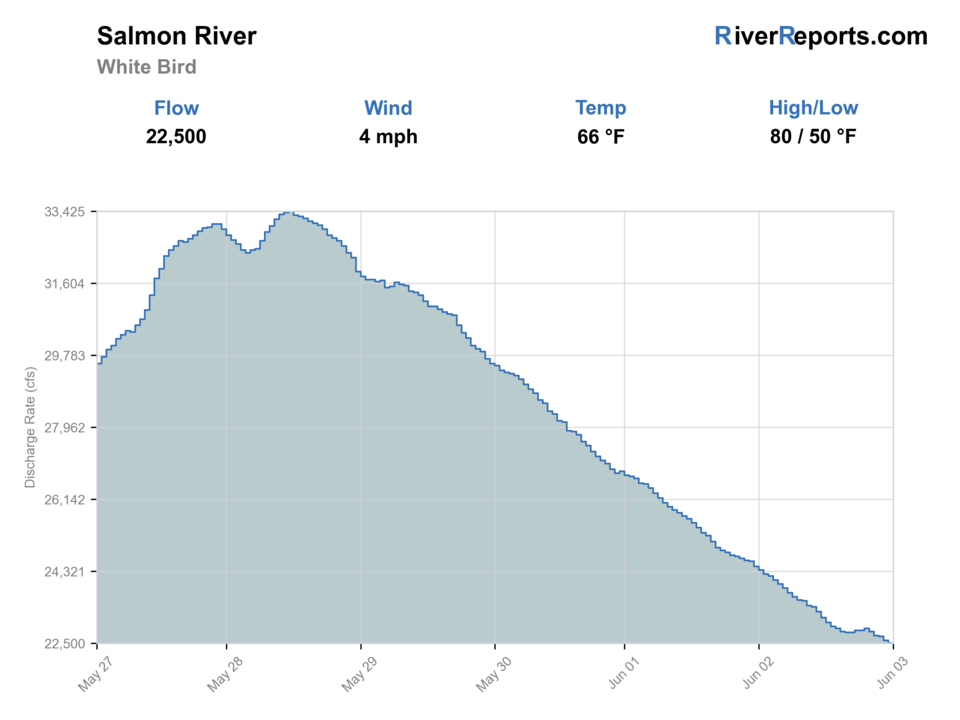
USGS data chart
Official USGS trend
Streamflow over the latest USGS reporting window.
Latest
22,500 cfs
Jun 3, 3 PM UTC
Weather
River weather report
Weather can change wading safety, road access, water temperature, hatches, and the best time of day to fish.
Live forecast loads as you reach this section
This keeps the report fast while still using the official National Weather Service forecast point.
Hatches and flies
Hatch chart and fly picks
Spring
Midges, BWOs, and early caddis
Zebra midge, BWO nymph, soft hackle, caddis pupa
Early summer
Caddis, PMDs, salmonflies in some canyon timing windows
Elk hair caddis, PMD emerger, stonefly nymph
Summer
Caddis and terrestrials
Foam ant, beetle, hopper, caddis dry
Fall
BWOs and baitfish windows
Parachute BWO, swing soft hackle, small streamer
Edge-water nymphs
Pheasant tail, caddis pupa, perdigon, zebra midge
You are fishing softer seams instead of the heavy mid-river push.
Big-river dries
Caddis, stimulator, hopper, ant
Surface activity appears along shelves, bars, or calmer inside water.
Streamers and bass bugs
Olive bugger, sculpin pattern, small popper
Warm-season lower-canyon water favors aggressive edge fish.
Tactics
How to fish it
Use the White Bird gauge first, then pick a specific public bar or ramp instead of trying to invent access on the fly.
Fish edges, inside bends, and current transitions that still let you control the drift from shore or from a controlled boat stop.
If the river looks too big for the access you have, skip it rather than forcing hero wades on a canyon river.
Separate resident-trout goals from salmon and steelhead goals because the rules and the day style are not interchangeable.
Rigging
Rod, leader, and setup notes
A 5- or 6-weight floating-line setup works for most resident-fish and indicator or streamer plans from shore.
Carry heavier tippet and split shot than you would on a small trout river because edge current still has real push.
If you are here for steelhead or salmon windows, rig and rule-check separately before you fish.
A wading staff is helpful, but the bigger safety win is simply refusing marginal entries.
Access
Access and planning notes
White Bird Gravel Pit
Primary named accessWade / float / trail
BLM access / ramp / bank
When to pick it
Start here when the flow leaves fishable edges and you want a defensible lower-canyon access point.
Caution
A named access does not make heavy canyon current safe to wade.
Lower Salmon access network
Boat or bar comparisonWade / float / trail
BLM recreation sites
When to pick it
Use the broader BLM context when White Bird is crowded or the day is already boat-oriented.
Caution
Shuttles, bars, and ramps should be planned before fishing, not improvised mid-day.
Highway 95 scout
Condition checkWade / float / trail
Road corridor / visual scout
When to pick it
Use the road corridor to compare color, boat traffic, and edge shape before committing.
Caution
Visual access from the highway is not the same as legal or safe river access.
This is a named-access river. Use BLM ramps and bars instead of assuming every gravel edge is a legal or sensible entry.
Boat traffic and launch activity can shape the day as much as fishing pressure.
For bank anglers, the best plan is usually one access point fished well rather than bouncing between many speculative stops.
Regulations
Check before fishing
Idaho Fish and Game lists the Salmon River as open all year except as modified in special rules, prohibits fishing within posted fish-weir or trap boundaries, and directs anglers to separate Chinook salmon and steelhead seasons and rules. Confirm the exact species season before you fish.
Primary base
White Bird or Riggins
Best day style
Bank-fishing, boat-ramp, and lower-canyon gravel-bar access with a big-water decision process
Check first
RiverReports trend, USGS 13317000, Idaho Salmon River rules, and lower-canyon weather
Safety
Heavy current, unstable bars, hot canyon afternoons, boat traffic, and long stretches between services
Gear
Helpful gear for this water
5- or 6-weight rod
A better match for big-river edges, streamers, and mixed-species setups.
Sun and heat layers
The lower canyon can get hot fast and there is limited shade at the access bars.
Wading staff
Useful when bars slope abruptly into stronger current than they first appear.
Dry bag or small boat bag
Helpful if you are fishing around ramps or combining shore fishing with a float stop.
Nearby water
Other water to research
Backup logic
High canyon flow
Choose Little Salmon, a smaller Idaho river, or a boat-only plan with proper shuttle margin.
Heat
Fish first light only, target appropriate species, or skip resident-trout expectations.
Species-rule uncertainty
Verify Chinook and steelhead seasons separately before fishing anadromous targets.
Boat traffic or ramp crowding
Use one defined access well or move rather than crowding a busy launch.
Salmon River
Use the broader Salmon River page when you want drainage-wide context instead of this White Bird reach.
Little Salmon River
A smaller-system backup when the lower main stem is too large or too warm for your plan.
Snake River
Another big-water option if your day is already boat- or bass-oriented.
FAQ
Fast answers
Is Salmon River fishable today?
Salmon River looks very fishable right now. The live score is 96/100, based on current flow, weather, public alerts, and the report's planning context. Recheck the linked gauge and forecast before leaving because conditions can change quickly after rain, heat, access changes, or flow swings.
What flow is best for Salmon River?
Stable flows that leave shelves, bars, and inside seams fishable without forcing you into the main push.
When should I skip Salmon River?
Skip when runoff volume, summer heat, or boat traffic turn the reach into a poor resident-fish plan from shore.
Is Salmon River safe to wade right now?
The fishability score is not a wading guarantee. Wade only where your chosen access has safe edges, clear footing, legal entry, and no forced crossings; high, rising, stained, or storm-affected water should be treated conservatively.
What should I check first at White Bird?
Start with RiverReports and USGS 13317000, then decide whether the lower-canyon edges are fishable from the specific public access you plan to use.
Is White Bird mainly a bank-fishing stop or a float launch?
It can be either, but the named BLM access is especially important for float and launch planning.
Do I need to check separate salmon or steelhead rules?
Yes. Idaho Fish and Game publishes separate Chinook and steelhead seasons and rules, and this reach is not a place to guess.
Sources
Source set for this report
Reviewed 2026-06-02