Idaho / West
Payette River
A Highway 55 North Fork Payette planning page built around big canyon current, roadside campground access, and honest trout expectations on a rafting-famous river.
Image: Generated regional planning image for North Fork Payette River / BlueStreamFly generated; not exact location / BlueStreamFlyFishability now: Payette River fishability today
GreatData confidence: High96/100
Fishable now because the live gauge is stable, weather is usable, and no public alert is active.
Flow observed
5:00 PM UTC
Weather observed
5:00 PM UTC
Score calculated
5:25 PM UTC
Why this rating
Flow
Weather
Public alerts
Next 6-12 hours
Hold
Stable live data supports staying with the plan, but recheck the gauge and forecast before leaving.
USGS flow
2,470 cfs
Current trend: flow stable, so weather, temperature, and access checks drive the next change.
More planning details: flies, flow bands, and live source checks
Fish it today
Start here
Start near Banks, fish one named Forest Service access well, and move only when the next stop clearly offers softer structure or less shared-use traffic.
Best flow clue
Moderate flows that still show clear eddies, side current, and bank seams without turning every accessible stop into a safety problem.
Skip trigger
Skip when runoff or canyon push leaves no clean edges, or when rafting traffic and highway crowds wipe out the quiet controlled stops this river needs.
Flow decision bands
Moderate edge water
Stable or slowly falling Banks flow is the best sign that bank seams, eddies, and short canyon drifts are actually fishable.
Low and clear
Low clear water can expose useful holding lanes, but fishable entry points still need to be legal and safe.
High canyon push
Rising or pushy water should make this a scouting day because the North Fork becomes a whitewater corridor first.
Traffic or storm caution
Raft traffic, thunderstorms, slick rock, or Highway 55 access stress can override a decent graph.
USGS flow
2,470 cfs
Current trend: flow stable, so weather, temperature, and access checks drive the next change.
Live USGS flow
2,470 cfs / stable
Live NWS forecast
73F / Partly Sunny
Water temperature not verified
Heat guidance uses weather and river type unless an official water-temperature value is available.
No NWS alert flag
No active NWS alert was returned for this forecast point.
Use RiverReports first for the public chart, then confirm the canyon trend with USGS 13246000 near Banks.
IDFG's planner points to rainbow trout, brook trout, redband, and whitefish, with catch-and-release winter rules on the upper Smylie Bridge-to-Payette Lake section but general Southwest rules on the rest of the river.
Forest Service campgrounds at Swinging Bridge, Canyon Creek, and Big Eddy give the clearest official access anchors between Banks and Smiths Ferry.
If the canyon feels too pushy for safe bank entries, treat the river as a drive-by scouting stop and choose calmer water elsewhere.
Editorial review
How this report is maintained
This report uses official regulation, flow, weather, and public-access sources first, then adds practical planning guidance for fly anglers.
Byline
BlueStreamFly editorial desk
Reviewed by
BlueStreamFly source review
Maintained by
BlueStreamFly
Last material review
2026-06-02
Report confidence
Good confidence
88/100
Good confidence: RiverReports, USGS 13246000 Banks flow, Idaho Fish and Game North Fork Payette rules, Boise National Forest campground access sources, weather coverage, generated media disclosure, and route-specific canyon guidance support the page. Confidence is moderated by whitewater traffic, steep access, rapid flow changes, and reach-specific safety.
Regulations
Idaho Fish and Game North Fork Payette planner details support current rule and reach checks.
Access
Boise National Forest Swinging Bridge, Canyon Creek, and Big Eddy sources support named public access, while site status and safe footing still need day-of checks.
Flow and weather
RiverReports, USGS 13246000 near Banks, and the National Weather Service point support live flow and weather decisions.
Fishing usefulness
The page now separates Banks flow, canyon-edge fishing, whitewater pressure, Forest Service access, storm caution, and nearby Boise-area backup choices.
Fishability dashboard and source review
2026-06-02 / material content or source review
RiverReports and USGS 13246000 Banks flow, Idaho Fish and Game North Fork Payette rules, Boise National Forest Swinging Bridge, Canyon Creek, and Big Eddy access pages, National Weather Service data, and route-specific canyon safety guidance were checked before updating the current-fishability decision layer.
2026-06-02
Updated the North Fork Payette to the current fishability standard with Banks trend bands, canyon access cards, backup cues, stable fishability SEO, and confidence signals.
2026-05-26
Published a new North Fork Payette report with Highway 55 access planning, rafting-corridor safety framing, and trout-expectation guidance tied to the Banks gauge.
Angler planning edge
Local details that change the plan
Best for
Roadside canyon scouting, Practical trout-and-whitefish sessions, Anglers who can separate safe edges from attractive but unfishable whitewater
Wade or float
Mostly a cautious bank-and-wade river for anglers. The corridor is built for whitewater recreation, so fly fishing works best from selected edges rather than through aggressive wading or improvised floating.
Best flows
Moderate flows that still show clear eddies, side current, and bank seams without turning every accessible stop into a safety problem.
When to skip
Skip when runoff or canyon push leaves no clean edges, or when rafting traffic and highway crowds wipe out the quiet controlled stops this river needs.
Local plan
Start near Banks, fish one named Forest Service access well, and move only when the next stop clearly offers softer structure or less shared-use traffic.
Pressure
Fishing pressure is usually secondary to rafting pressure, but that shared-use reality still shapes where and when you can fish well.
Access nuance
Named campgrounds are the key. They turn a fast roadside river into something you can actually fish with a plan instead of gambling on random shoulder pullouts.
Backup water
If the North Fork Payette is too forceful, switch to Mores Creek for small water or Boise River for a bigger but more forgiving urban-corridor option.
About the river
Setting, character, and why it fishes the way it does.
The North Fork Payette slices through a steep Highway 55 canyon north of Banks and is one of Idaho's best-known whitewater corridors.
That identity shapes the fishing. Public access is real and the river holds trout and whitefish, but safe fishable edges matter more than covering water or chasing the center of fast current.
The Banks-facing gauge is the right planning tool for this page because it reflects the canyon water most anglers can actually reach from the road between Banks and Smiths Ferry.
Target species
Rainbow trout
A primary target in accessible seams, eddies, and softer side current.
Mountain whitefish
A reliable payoff when deeper faster structure is still too pushy for surface work.
Redband trout
Part of the native and wild-fish character that keeps handling and release discipline important.
Brook trout
Present in the drainage, though not the main draw in the lower canyon corridor.
Reading the water
Moderate fishable flow
Best for finding bank seams, eddies, and short nymph or dry-dropper drifts off official access points.
Low clear flow
Good for more visible holding water, but also exposes just how limited safe bank entries can be.
High canyon push
Skip serious wading plans. The river becomes a whitewater corridor first and a fishing stop second.
Cold shoulder-season water
Slow down with nymphs and work protected soft structure near accessible banks.
Best seasons
Late spring
Only after runoff drops enough to open real fishing lanes along the canyon edge.
Summer
The most practical season for mixed trout-and-whitefish sessions, though recreation traffic can be heavy.
Early fall
A strong time for cleaner flows, cooler mornings, and fewer rafters on the obvious corridor stops.
Winter
Mainly an upper-drainage rules and conditions play, not a lower canyon default.
Preferred flow source
North Fork Payette River near Banks
RiverReports is the preferred chart source when coverage exists. When a matching USGS gauge exists, keep it open as the official backstop for station data and current hydrograph context.
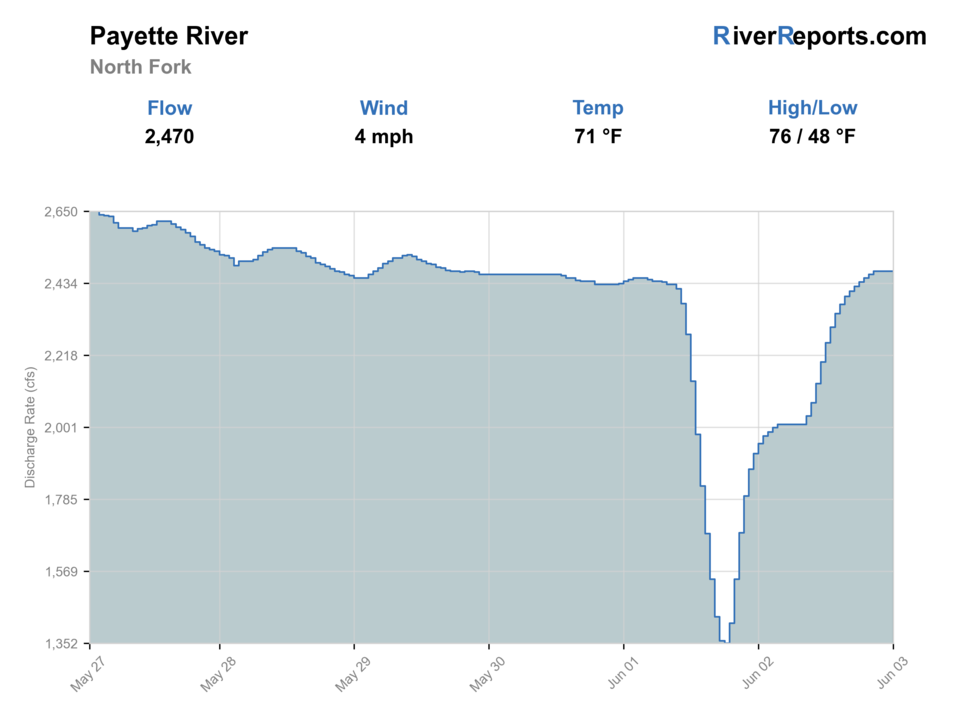
USGS data chart
Official USGS trend
Streamflow over the latest USGS reporting window.
Latest
2,470 cfs
Jun 3, 5 PM UTC
Weather
River weather report
Weather can change wading safety, road access, water temperature, hatches, and the best time of day to fish.
Live forecast loads as you reach this section
This keeps the report fast while still using the official National Weather Service forecast point.
Hatches and flies
Hatch chart and fly picks
Spring
BWOs, march browns, and caddis
BWO emerger, hare's ear, caddis pupa, prince nymph
Summer
Caddis, attractor windows, and terrestrials
Stimulator, elk hair caddis, ant, hopper-dropper
Late summer
Terrestrials and evening caddis
Foam beetle, hopper, ant, soft hackle
Fall
BWOs, midges, and small streamers
Parachute BWO, zebra midge, bugger, RS2
Nymphs
Prince, hare's ear, pheasant tail, perdigon, zebra midge
Best in canyon seams and deeper protected buckets where fish can hold out of the main push.
Dry-dropper
Stimulator or hopper with a compact beadhead
A practical searching rig for accessible summer bank water.
Attractor dries
Parachute Adams, elk hair caddis, stimulator
Useful in softer edges when fish slide up and the wind is manageable.
Small streamers
Bugger, leech, sculpin
Best in lower light or after higher water leaves fish tucked into slower structure.
Tactics
How to fish it
Choose one legal access point and fish the edges that actually slow down instead of chasing heroic casts across the main tongue.
Treat visible whitewater as the background, not the target, unless it also creates a genuine seam, pocket, or eddy you can reach safely.
Use nymphs and dry-droppers more than delicate long-leader dry-fly tactics because this canyon rewards practical control.
If raft traffic is stacking up, fish early, move to a quieter access, or call the day instead of fighting the corridor.
Rigging
Rod, leader, and setup notes
A 9-foot 5-weight is the most useful all-around setup for this canyon river.
Carry 4X and 5X for nymphs and dry-droppers, with slightly stronger material for streamers and heavy current control.
Studs or high-traction soles help more than extra fly boxes when the bank is steep or polished.
A short-handled net and compact sling are easier to manage than a big vest in this roadside canyon setting.
Access
Access and planning notes
Swinging Bridge Campground
Banks-area starting pointWade / float / trail
Forest Service / bank / wade edge
When to pick it
Start here when the Banks trend is moderate and you want a named public access close to the lower canyon.
Caution
Fast current and shared whitewater use can make nearby water unfishable even from good public access.
Canyon Creek Campground
Mid-corridor scoutWade / float / trail
Forest Service / short wade
When to pick it
Use it when you want a repeatable canyon stop instead of guessing at steep roadside pullouts.
Caution
Safe bank entries matter more than the amount of visible water.
Big Eddy Campground
Upper canyon optionWade / float / trail
Forest Service / trout and whitefish
When to pick it
Pick it when the lower corridor is crowded or you want a different mix of soft edges and public staging.
Caution
Check site status, traffic, and current before stepping into polished canyon rocks.
The Forest Service campground corridor gives this river repeatable legal access, which matters because many random roadside spots look easier from the truck than they are on foot.
Rafting and kayaking are part of the North Fork Payette's identity, so anglers should build the day around safe entry and quieter timing, not around owning the river.
This is not a forgiving wading river at higher flows. Good access does not change that.
Regulations
Check before fishing
IDFG's 2025-2027 North Fork Payette rules include catch-and-release trout regulations from Smylie Bridge to Payette Lake between December 1 and the Friday of Memorial Day weekend, kokanee catch-and-release upstream of Payette Lake, and Southwest Region general rules on other sections. Check the current planner before choosing your exact reach.
Primary base
Banks, Smiths Ferry, or a Highway 55 canyon day trip
Best day style
Roadside campgrounds, pullouts, short canyon wading, and selective bank fishing
Check first
RiverReports, USGS 13246000, IDFG reach rules, Highway 55 access, and rafting traffic
Safety
Fast canyon current, steep banks, roadside traffic, slick rock, and shared-use pressure with whitewater recreation
Gear
Helpful gear for this water
5-weight canyon rig
A practical rod for weighted nymphs, dry-droppers, and wind.
Traction-first wading setup
More important than specialized dry-fly tackle on this river.
Compact pack
Useful because many of the best stops are short roadside sessions, not long hikes.
Rain and road layers
Storms and canyon shade can cool the corridor quickly even on warm days.
Nearby water
Other water to research
Backup logic
High water
Scout from public sites only, then compare Mores Creek, Deadwood River, or the Boise River instead of forcing the canyon.
Heat
Fish early, stay near cooler moving water, and stop trout handling when edge water warms.
Storms or slick access
Leave canyon banks before storms make footing and road exits worse.
Heavy whitewater traffic
Use quieter bookend hours or switch to a smaller trout route with less shared-use pressure.
Boise River
A better backup when the North Fork Payette is simply too pushy for the style of trout day you want.
Deadwood River
A more remote option when you want cold-water trout focus without the same rafting corridor feel.
Mores Creek
A smaller more forgiving Boise-area choice when you still want a short Idaho trip but not a canyon flow problem.
FAQ
Fast answers
Is Payette River fishable today?
Payette River looks very fishable right now. The live score is 96/100, based on current flow, weather, public alerts, and the report's planning context. Recheck the linked gauge and forecast before leaving because conditions can change quickly after rain, heat, access changes, or flow swings.
What flow is best for Payette River?
Moderate flows that still show clear eddies, side current, and bank seams without turning every accessible stop into a safety problem.
When should I skip Payette River?
Skip when runoff or canyon push leaves no clean edges, or when rafting traffic and highway crowds wipe out the quiet controlled stops this river needs.
Is Payette River safe to wade right now?
The fishability score is not a wading guarantee. Wade only where your chosen access has safe edges, clear footing, legal entry, and no forced crossings; high, rising, stained, or storm-affected water should be treated conservatively.
Is the North Fork Payette a true fly-fishing river or mostly a whitewater river?
It is primarily famous for whitewater, but it still offers worthwhile fly-fishing windows when flows are moderate and you fish safe accessible edges.
Should I wade deep here?
Usually no. The best plan is conservative bank-based fishing from official access points rather than ambitious canyon wading.
What gauge should I start with?
Start with RiverReports and USGS 13246000 near Banks for the lower canyon reach this page is built around.
Sources
Source set for this report
Reviewed 2026-06-02