Colorado / West
South Platte Below Chatfield
A Chatfield-area South Platte planning page built around the river below the reservoir, state-park access, real-time flow checks, and honest expectations for an urban-edge trout and mixed-species day.
Image: Generated regional planning image for South Platte Below Chatfield / BlueStreamFly generated; not exact location / BlueStreamFlyFishability now: South Platte Below Chatfield fishability today
GoodData confidence: High74/100
Fishable now because flow has been checked, weather is usable, and no public alert is active.
Flow observed
Not returned
Weather observed
5:00 PM UTC
Score calculated
5:25 PM UTC
Why this rating
Flow
Weather
Public alerts
Next 6-12 hours
Hold
Stable live data supports staying with the plan, but recheck the gauge and forecast before leaving.
USGS flow
Check gauge
Current trend: previous-score comparison will become more useful after repeated live checks.
More planning details: flies, flow bands, and live source checks
Fish it today
Start here
Check the graph before leaving town, fish one good corridor section early, and keep Waterton or a higher South Platte backup ready if the lower river feels off.
Best flow clue
Stable moderate releases that leave bank edges and riffle tails readable without forcing risky wading.
Skip trigger
Skip when reservoir releases jump, when summer heat pushes the river toward warmwater conditions, or when park traffic makes stealth impossible.
Flow decision bands
Low but fishable
Low stable release water can fish from edges and park access when temperatures and recreation pressure are manageable.
Best below-reservoir window
Steady Chatfield releases, clear water, and mild weather create the best nymph, streamer, carp, and trout-edge signal.
Release or storm unsafe
Fast release changes, urban runoff, or pushy current should stop crossings and deep wading.
Metro pressure caution
Park crowds, dogs, bikes, tubing, and heat can reduce practical fishability even when flow is legal.
USGS flow
Check gauge
Current trend: previous-score comparison will become more useful after repeated live checks.
No current flow value
The source loaded, but did not return streamflow or gauge height.
Live NWS forecast
80F / Partly Sunny
Water temperature not verified
Heat guidance uses weather and river type unless an official water-temperature value is available.
No NWS alert flag
No active NWS alert was returned for this forecast point.
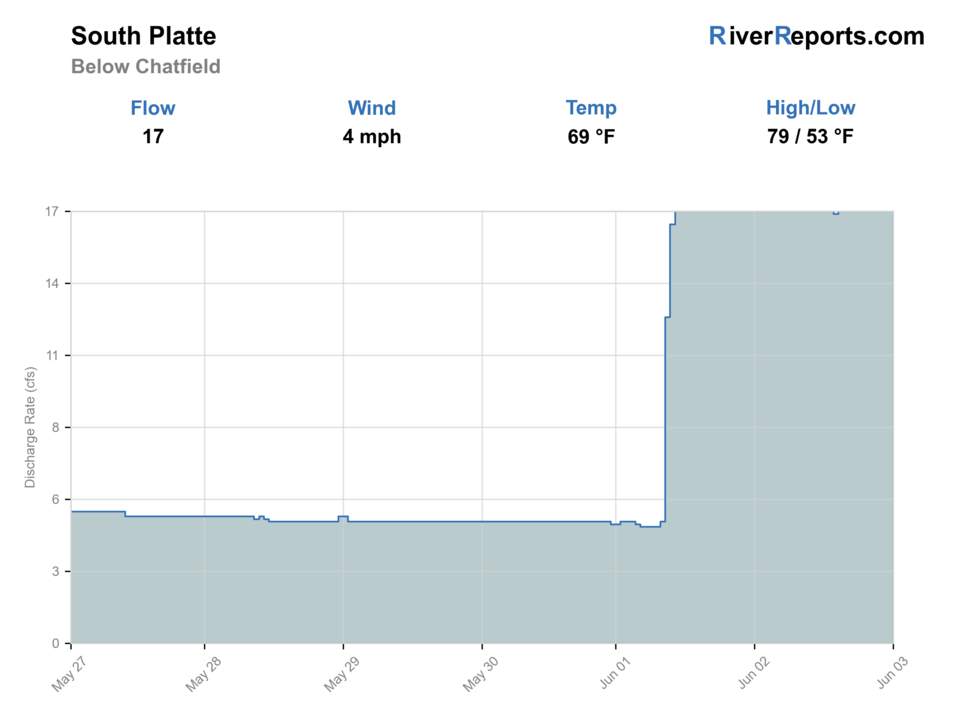
Use RiverReports first, then verify the day with USGS 06709610 below Chatfield Lake before you commit to wading or to a longer park walk.
Chatfield State Park sits at the mouth of Waterton Canyon where the South Platte leaves the foothills and reaches the prairie, so the river here fishes more like an urban-edge corridor than a remote trout destination.
Colorado's special regulations for Chatfield State Park include South Platte water inside the park boundary and add several park-specific restrictions around the dam and off-leash-area ponds.
If releases rise or the bike-and-foot traffic feels too heavy, this reach is better as a short opportunistic session than as a forced all-day plan.
Editorial review
How this report is maintained
This report uses official regulation, flow, weather, access, and public-land sources first, then adds practical planning guidance for fly anglers.
Byline
BlueStreamFly editorial desk
Reviewed by
BlueStreamFly source review
Maintained by
BlueStreamFly
Last material review
2026-05-31
Report confidence
Good confidence
88/100
Good confidence: RiverReports, USGS 06709610 flow, Chatfield State Park access, Denver Water recreation guidance, Colorado special-regulation sources, and weather data support the page. Confidence is moderated by release changes, urban runoff, recreation pressure, warm afternoons, and park-specific access conditions.
Regulations
Colorado special-regulation sources support the legal-check path before fishing below Chatfield.
Access
Chatfield State Park and Denver Water sources support strong public access planning, with fees, signs, closures, and exact banks still needing current checks.
Flow and weather
RiverReports, USGS 06709610, and the National Weather Service point are attached to the route.
Fishing usefulness
The page now separates below-reservoir release checks, park access, urban runoff, heat, recreation pressure, and South Platte backup choices.
Fishability dashboard and source review
2026-05-31 / material content or source review
RiverReports South Platte below Chatfield chart, USGS 06709610 flow data, Chatfield State Park access information, Denver Water South Platte recreation guidance, Colorado special-regulation sources, and the National Weather Service point were checked before updating the current fishability guidance.
2026-05-31
Updated South Platte below Chatfield with release trend guidance, state park and Denver Water access cards, urban heat and runoff cautions, backup cues, stable fishability SEO, and confidence signals.
2026-05-29
Added a page-specific report-confidence meter for South Platte below Chatfield flow, Chatfield access, Colorado rule checks, weather, and metro-river release planning.
2026-05-26
Published a new South Platte below Chatfield report with release-aware metro-river guidance, Chatfield access framing, and Front Range backup planning.
Angler planning edge
Local details that change the plan
Best for
Short Denver-area trout sessions, Release-aware river checks close to town, Anglers willing to pivot quickly if heat or crowds win
Wade or float
Mostly a wade-and-walk page. The value here comes from short bank sessions and trail mobility, not from treating the reach like a dedicated float fishery.
Best flows
Stable moderate releases that leave bank edges and riffle tails readable without forcing risky wading.
When to skip
Skip when reservoir releases jump, when summer heat pushes the river toward warmwater conditions, or when park traffic makes stealth impossible.
Local plan
Check the graph before leaving town, fish one good corridor section early, and keep Waterton or a higher South Platte backup ready if the lower river feels off.
Pressure
Pressure comes from convenience as much as from fishing quality, so fair-weather weekends can make the best park water feel crowded quickly.
Access nuance
The public access is broad compared with a private-ranch reach, but the productive water is not endless. Walking a little and choosing your time window matter more than chasing every visible bank.
Backup water
Waterton Canyon, the Deckers South Platte, or the North Fork are better pivots when below-Chatfield runs too warm, crowded, or release-heavy.
About the river
Setting, character, and why it fishes the way it does.
This page covers the South Platte immediately below Chatfield Reservoir and through the Chatfield State Park corridor near Littleton.
The river here sits between reservoir operations, suburban trail use, and a foothills-to-prairie transition, so it rewards anglers who are realistic about crowding and who pick their windows carefully.
It is still part of the larger South Platte system, but it should be planned as its own metro-adjacent release river rather than as a version of Waterton or Deckers.
Target species
Brown trout
A primary trout target in deeper runs and undercut banks when the water is cool and reasonably clear.
Rainbow trout
Part of the river mix below the reservoir and often the better choice when you want a practical short nymphing session.
Warmwater species
More relevant than in higher-elevation South Platte pages, especially farther into the lower metro corridor.
Reading the water
Stable moderate release
Best for short wades, seam nymphing, and reading the cleaner pocket water along park banks.
Low clear water
Fish light tippet, small flies, and lower-profile approaches because the river can get very transparent close to the city.
Higher reservoir release
Shrink the plan to bank water only and skip the day if safe footing disappears.
Hot summer afternoons
Start early and be willing to leave when the river starts fishing more like a warm corridor than a cold trout run.
Best seasons
Spring
Useful on stable release days before heavy summer park traffic starts to build.
Summer
Best early or after work on cooler days when flows and temperatures still favor trout handling.
Fall
Often the most pleasant mix of stable weather, lower traffic, and manageable water temperatures.
Winter
A credible local option on mild afternoons when you want a short metro trout session.
Preferred flow source
South Platte below Chatfield
RiverReports is the preferred chart source when coverage exists. When a matching USGS gauge exists, keep it open as the official backstop for station data and current hydrograph context.
USGS data chart
Official USGS trend
Streamflow over the latest USGS reporting window.
Weather
River weather report
Weather can change wading safety, road access, water temperature, hatches, and the best time of day to fish.
Live forecast loads as you reach this section
This keeps the report fast while still using the official National Weather Service forecast point.
Hatches and flies
Hatch chart and fly picks
Spring
Midges, BWOs, and caddis
Zebra midge, RS2, BWO emerger, caddis pupa
Summer
Caddis, PMDs, and terrestrials
Elk hair caddis, PMD dry, ant, beetle
Late summer
Terrestrials and evening caddis
Foam ant, hopper, caddis emerger, soft hackle
Fall
BWOs, midges, and small streamers
Parachute BWO, black beauty, RS2, olive bugger
Midge and BWO nymphs
RS2, zebra midge, black beauty, pheasant tail
The best default option for clear below-dam water and selective trout.
Dry-dropper flies
Small chubby, ant, caddis dry, perdigon
Useful when moderate releases leave enough broken edge water to cover efficiently.
Small streamers
Leech, mini bugger, sculpin
Good in low light or slight color, especially around deeper urban-bank structure.
Tactics
How to fish it
Treat the USGS and RiverReports trend as mandatory because reservoir-driven changes matter more here than on a simple freestone river.
Fish the cleaner current tongues, outside-bank shelves, and riffle tails instead of trying to cover every trail-visible run.
Time the day around lower park traffic when possible because this is shared-use water close to Denver.
If the river feels too warm, muddy, or crowded, turn it into a short scouting stop and move to a higher-elevation South Platte page.
Rigging
Rod, leader, and setup notes
A 4- or 5-weight floating-line setup handles most below-Chatfield trout fishing well.
Carry 5X and 6X plus a few slightly bigger flies for mixed-species or stained-water windows.
Use shorter nymph or dry-dropper rigs than you would on a wide drift because the best water is often close and controlled.
Pack light so you can move the trail corridor easily without overcommitting to one crowded stretch.
Access
Access and planning notes
Chatfield State Park
Primary public accessWade / float / trail
State park / bank / wade
When to pick it
Start here when park status, flow, and public-use pressure match the plan.
Caution
Park fees, seasonal closures, dogs, and recreation traffic need current checks.
Denver Water South Platte corridor
System access and release contextWade / float / trail
Recreation guidance / bank scout
When to pick it
Use it when release or corridor rules will decide the day.
Caution
Water-supply and recreation guidance varies by reach.
Below-reservoir release check
Flow safety filterWade / float / trail
USGS / RiverReports / wade scout
When to pick it
Pick it before committing to crossings or low-bank fishing.
Caution
Urban stormwater can change clarity faster than a simple flow number suggests.
Chatfield State Park is a fee-area access point, with long trail mileage and enough shared use that parking and path traffic can shape the day.
Park-specific fishing restrictions apply inside the Chatfield boundary, including no fishing from the dam or within 100 feet of the dam during the listed closure window.
This is a convenience reach. The best sessions come from timing and flow awareness more than from trying to force a classic all-day tailwater program.
Regulations
Check before fishing
Within Chatfield State Park, Colorado's special regulations cover the South Platte River and all ponds inside the park boundary. Review the current special-regulations page before fishing, especially the dam closure zone and park-specific species limits.
Primary base
Littleton, southwest Denver, or a short Front Range day trip
Best day style
State-park trail access, short riverbank walks, and urban-edge wading around Littleton
Check first
RiverReports, USGS 06709610, Chatfield State Park status, Colorado special regulations, and summer heat
Safety
Release changes, shared trail traffic, slippery banks, warm-season water temperatures, and no-fishing zones near the dam
Gear
Helpful gear for this water
4- or 5-weight rod
Best fit for short-range nymphing and dry-dropper work along the park corridor.
Thermometer
Important because a metro-edge river can warm quickly compared with higher South Platte reaches.
Light pack and trail shoes
Useful for walking the corridor efficiently before deciding where to stop.
Sun and wind layers
The park is open and exposed even on otherwise mild Front Range days.
Nearby water
Other water to research
Backup logic
High water
Compare Waterton Canyon, Deckers, or another South Platte reach after checking releases.
Heat
Fish early, shift to warmwater targets, or move to colder trout water.
Storms or stain
Let urban runoff and release changes settle before fishing.
Access issue
Use state park or Denver Water-confirmed access only; pivot if signs, closures, or parking are unclear.
South Platte Waterton Canyon
A more walk-in canyon trout option upstream when you want colder water and section-specific rules.
South Platte River
The broader Deckers and Cheesman corridor page when you want a destination tailwater instead of a metro session.
North Fork of the South Platte
A forested backup when below-Chatfield traffic or warm water makes the lower corridor less attractive.
FAQ
Fast answers
Is South Platte Below Chatfield fishable today?
South Platte Below Chatfield looks fishable right now. The live score is 74/100, based on current flow, weather, public alerts, and the report's planning context. Recheck the linked gauge and forecast before leaving because conditions can change quickly after rain, heat, access changes, or flow swings.
What flow is best for South Platte Below Chatfield?
Stable moderate releases that leave bank edges and riffle tails readable without forcing risky wading.
When should I skip South Platte Below Chatfield?
Skip when reservoir releases jump, when summer heat pushes the river toward warmwater conditions, or when park traffic makes stealth impossible.
Is South Platte Below Chatfield safe to wade right now?
The fishability score is not a wading guarantee. Wade only where your chosen access has safe edges, clear footing, legal entry, and no forced crossings; high, rising, stained, or storm-affected water should be treated conservatively.
Is this the same river as Waterton Canyon?
It is the same river system, but this page is for the South Platte below Chatfield Reservoir and the Chatfield State Park corridor, not the walk-in Waterton reach upstream.
What flow should I trust first?
Start with RiverReports for the quick chart, then confirm the day on USGS 06709610 below Chatfield Lake because release-driven changes matter here.
When should I skip the trout plan?
Skip when releases get pushy, when summer warmth takes over, or when a crowded fair-weather park day makes stealth and mobility too difficult.
Sources
Source set for this report
Reviewed 2026-05-31